
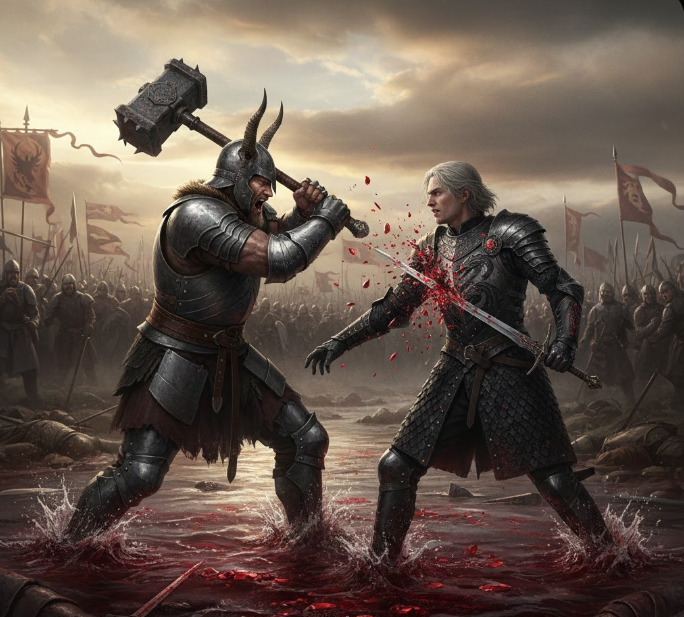
The water of the Green Fork did not run clear on that fateful day; it ran red with the blood of highborn lords and common smallfolk alike. Above the roar of the current and the screams of the dying, one sound echoed louder than any other: the bone-shattering crunch of a spiked warhammer meeting a dragon-etched breastplate. The Battle of the Trident was not just a military engagement; it was the tectonic shift that ended a three-hundred-year dynasty and birthed the world of Game of Thrones as we know it. To understand the political chaos of the series, one must first understand the mud, the rubies, and the monumental violence of the Trident.
I. Prelude to Blood: Why the Armies Met at the Trident
Before the first sword was drawn at the river’s edge, Westeros was already a powder keg. The madness of King Aerys II Targaryen had reached its zenith, and the execution of Rickard and Brandon Stark had ignited a fire that the “Mad King” could not extinguish. However, as the rebellion progressed, it became clear that the conflict would not be settled in the storm-swept coast of the Fingers or the fields of the Reach. It would be settled at the most vital crossing in the Seven Kingdoms.
The Geopolitical Chessboard
The Trident is the arterial heart of Westeros. For the Rebel Alliance—composed of the North, the Vale, the Stormlands, and the Riverlands—the goal was simple: unification. Robert Baratheon needed to merge his fragmented forces to create a singular fist capable of striking King’s Landing.
The Royalist forces, under the command of Prince Rhaegar Targaryen, who had finally emerged from his seclusion at the Tower of Joy, sought to intercept this unification. By meeting the rebels at the Green Fork of the Trident, Rhaegar intended to crush the rebellion before they could solidify their hold on the Riverlands. The location was a bottleneck; whoever controlled the ford controlled the fate of the capital.
The Stakes: Survival vs. Sovereignty
For Robert Baratheon, Eddard Stark, and Jon Arryn, the Trident was a matter of survival. There was no “peace” to be had with Aerys II; defeat meant the total extinction of their Houses. For Rhaegar, the battle was an attempt to salvage a crumbling legacy. Lore experts often debate Rhaegar’s true intentions, but at the Trident, he was the shield of the Dragon, defending a throne that his father had made nearly impossible to hold.

II. Order of Battle: The Royalists vs. The Rebels
To appreciate the scale of the Battle of the Trident, one must look at the sheer numbers and the quality of the men involved. This was the last time in Westerosi history that such a concentrated amount of martial prowess was gathered in a single square mile.
The Royalist Host (Approx. 40,000 Men)
Rhaegar Targaryen commanded the larger force, bolstered by the arrival of 10,000 Dornishmen under the command of Prince Lewyn Martell of the Kingsguard.
-
The Crownlands & The Reach: Loyalists from the houses surrounding the capital and reinforcements from the powerful Tyrell banners (though much of the Tyrell strength remained at the Siege of Storm’s End).
-
The Kingsguard: The presence of Ser Barristan Selmy and Ser Jonothor Darry provided the Royalists with unparalleled tactical leadership on the front lines.
-
The Weakness: Despite their numbers, the Royalist army was “green.” Many were new levies pressed into service, lacking the battle-hardened cynicism of the rebels who had been fighting for a year.
The Rebel Alliance (Approx. 35,000 Men)
Though outnumbered, the rebels were a cohesive, lethal unit. The “STAB” (Stark, Tully, Arryn, Baratheon) alliance had spent the previous months forging a bond in the fires of the Battle of the Bells.
-
Hardened Veterans: The Northmen and the Vale knights were accustomed to harsh terrain and brutal combat.
-
Leadership: Robert Baratheon was in his physical prime—a giant of a man whose charisma was as infectious as his rage. Alongside him stood the tactical mind of Eddard Stark and the seasoned wisdom of Jon Arryn.

III. The Clash at the Ruby Ford: A Tactical Breakdown
The battle was not a neat, orderly affair. Because it took place at a river crossing, the terrain was treacherous, muddy, and unpredictable.
The Struggle for the Banks
The fighting began with a massive push into the water. The Royalist cavalry attempted to force their way across, meeting a wall of rebel pikes and shields. The sound of metal on metal was said to be heard for miles. In the center of the fray, the water rose to the waists of the soldiers, making every step a gamble and every fall a death sentence by drowning.
The Dornish Threat and the Vale’s Response
Prince Lewyn Martell led a fierce Dornish charge that threatened the rebel left flank. This was perhaps the most dangerous moment for Robert’s cause. Had the flank buckled, the rebels would have been driven into the river and slaughtered. However, Ser Lyn Corbray—wielding the Valyrian steel sword Lady Forlorn—led a counter-charge that broke the Dornish lines, personally slaying the wounded Prince Lewyn in the process.
The Fog of War
As the afternoon wore on, the superior discipline of the rebel forces began to tell. The “green” Royalist troops struggled with the slippery conditions, while the Northmen, used to the bogs and snows of their homeland, held their ground. But the battle was far from over; it was merely waiting for its two protagonists to find each other.

IV. The Duel of the Century: Robert vs. Rhaegar
This is the moment that defined the history of Westeros. Amidst the chaos of 75,000 fighting men, the Prince of Dragonstone and the Lord of Storm’s End met in the middle of the river.
The Symbolism of the Armor
-
Rhaegar Targaryen: He wore black plate armor with the three-headed dragon of House Targaryen encrusted in shimmering rubies on his breastplate. He looked every bit the tragic hero of a singer’s ballad.
-
Robert Baratheon: He was a vision of primal fury, wearing a great stag-horned helm and wielding a massive iron warhammer that Ned Stark famously noted he could barely lift.
The Physics of the Duel
While the bards sing of a poetic struggle, the reality was a brutal display of martial physics. Rhaegar was a skilled jouster and a capable swordsman, but he was fighting a man possessed by a singular, vengeful purpose. Robert blamed Rhaegar for the “abduction” of Lyanna Stark, and that hatred fueled his strikes.
As their horses lunged through the water, Rhaegar managed to wound Robert, but he could not deliver a killing blow through the heavy Baratheon plate. Robert, however, needed only one opening. With a swing that supposedly shattered the silence of the entire battlefield, Robert’s hammer crashed into Rhaegar’s chest.
The Death of the Dragon
The blow was so powerful that it liquefied Rhaegar’s chest cavity and hammered the rubies right out of his armor. The Prince fell into the river, his lifeblood swirling into the current. As he died, he reportedly whispered a woman’s name: “Lyanna.”
The sight of the rubies floating in the water caused a momentary pause in the fighting as soldiers from both sides scrambled into the mud to retrieve them. This location would forever after be known as the Ruby Ford.
V. The Aftermath: A Dynasty Disintegrates
When Rhaegar fell, the Royalist cause died with him. The sight of their prince defeated caused a total collapse in morale.
The Rout
The Royalist army turned and fled. What began as a battle became a massacre as the rebel cavalry hunted down the retreating remnants. The road to King’s Landing was now wide open. There was no longer any force in Westeros capable of stopping the rebel advance.
The Mercy of a King
One of the most telling moments of Robert’s character occurred in the immediate aftermath. Ser Barristan Selmy, the legendary Kingsguard, was brought to Robert near death, having taken several wounds while fighting for Rhaegar. While Roose Bolton (ever the opportunist) advised Robert to slit Selmy’s throat, Robert famously replied, “I will not kill a man for being loyal, nor for being fought bravely.” He sent his own maester to tend to Selmy’s wounds—a gesture that solidified his image as a “true” king in the eyes of many.
The Vanguard
Because Robert was too injured from his duel with Rhaegar to ride at full speed, he gave command of the vanguard to Eddard Stark. Ned raced south to the capital, only to find that the “loyal” Lannisters had already arrived—and the Sack of King’s Landing was underway.

VI. The Legacy: How the Trident Shaped the TV Series
The ripples of the Battle of the Trident are felt in nearly every episode of Game of Thrones. It is the “original sin” of the series’ timeline.
The Ghost of Rhaegar
Everything Daenerys Targaryen does is in response to the loss at the Trident. She views herself as the “Last Dragon,” a title that only became hers because Rhaegar fell in the river. Similarly, the revelation of Jon Snow’s parentage (Aegon Targaryen) changes the context of the battle entirely. Was Robert killing a kidnapper, or was he killing a man who had legally married the woman Robert loved?
The “What If” Scenario
Military historians of Westeros often speculate: what if Rhaegar had won? Rhaegar had reportedly intended to call a Great Council to deal with his father’s madness once the rebellion was put down. Had Rhaegar survived the Trident, the War of the Five Kings might never have happened, the White Walker threat might have been addressed sooner, and the Targaryen dynasty might have been reformed rather than destroyed.
VII. The Silent Player: Why the Lannisters Weren’t at the Trident
One of the most frequent questions from fans of the Game of Thrones TV series is: Where was Tywin Lannister? As the most powerful Warden in the realm, his absence from the Battle of the Trident was a calculated political gamble that ultimately decided the fate of the Seven Kingdoms.
The Strategy of Neutrality
Lord Tywin Lannister had remained at Casterly Rock for the duration of the rebellion, ignoring summons from both King Aerys II and the rebels. Tywin was waiting to see which way the wind blew. Had Rhaegar emerged victorious at the Trident, it is almost certain that Tywin would have marched to the Prince’s side to offer “belated” support and secure his family’s standing.
The Pivot to King’s Landing
The moment news reached Casterly Rock that Rhaegar had fallen and the Royalist army was in retreat, Tywin made his move. He didn’t march to join Robert; he raced to King’s Landing. By the time Eddard Stark arrived with the rebel vanguard, the Lannisters had already betrayed the Mad King, sacked the city, and presented the bodies of Rhaegar’s children to Robert as a “blood offering” to seal their new alliance.

VIII. The Rubies of the Trident: Symbolism and Lore
In the books and the show, the “Rubies of the Trident” serve as a haunting metaphor for the Targaryen dynasty—shattered, scattered, and lost to the current.
The Elder Brother’s Discovery
In A Feast for Crows, readers encounter a character known as the Elder Brother on the Quiet Isle (near the mouth of the Trident). He mentions that even years later, rubies from Rhaegar’s breastplate continue to wash up on their shores.
-
Symbolic Meaning: This suggests that while the “Dragon” is dead, the pieces of that era still linger in the mud of Westeros, waiting to be found.
-
The Six Rubies: Interestingly, the Elder Brother mentions they have found six rubies. Fans often speculate on the significance of the number—perhaps representing the six Targaryens who fell during the war, or a hint that a “seventh ruby” (a seventh Targaryen, like Jon Snow) remains hidden.
IX. Tactical Analysis: Could the Royalists Have Won?
As a subject matter expert, it is essential to look beyond the “heroic duel” and analyze the military failures of the Crown’s forces.
-
Failure of Command: Rhaegar was a charismatic leader but lacked the raw battlefield experience of Robert Baratheon. Robert had been fighting a mobile, high-stakes campaign for a year. Rhaegar had been in the South, largely removed from the tactical evolution of the war.
-
The Terrain Disadvantage: The Royalists crossed the river to attack the rebels. In medieval warfare, attacking across a body of water is a nightmare scenario. The momentum of their superior numbers was negated by the mud and the flow of the Green Fork.
-
The Dornish Flank: While the 10,000 Dornishmen were the Royalists’ best asset, their placement on the flank made them vulnerable to the heavy cavalry of the Vale. When Prince Lewyn fell, the Dornishmen—who were fighting more for Elia Martell than for Aerys—lost their will to hold the line.
X. Frequently Asked Questions (FAQs)
Was the Battle of the Trident shown in the HBO show?
No, the battle was never shown in full. However, it is frequently mentioned by characters like Robert, Ned, and Barristan Selmy. It was also featured in the “History & Lore” animated features included in the Blu-ray releases, narrated by the actors themselves.
Who killed Rhaegar Targaryen?
Robert Baratheon killed Rhaegar Targaryen during a single combat duel in the middle of the river. Robert used his signature stag-horned warhammer to crush Rhaegar’s chest.
How did the battle affect Jon Snow’s story?
The battle made Jon Snow an orphan before he was even born. Because Rhaegar died at the Trident and Lyanna died shortly after at the Tower of Joy, Jon was raised as a bastard by Ned Stark to protect him from Robert Baratheon’s legendary hatred for all things Targaryen.
Where exactly is the Ruby Ford located?
The Ruby Ford is a crossing on the Green Fork of the Trident, located in the Riverlands. It is south of the Twins and north of the Crossroads Inn.
XI. Conclusion: The River That Never Stopped Flowing
The Battle of the Trident was the moment the dream of the Dragon died and the reality of the Stag began. It turned a rebel lord into a king and a beloved prince into a cautionary tale. For fans of Game of Thrones, the Trident is the ultimate “point of no return.” Without Robert’s hammer falling that day, there is no Ned Stark in King’s Landing, no exiled Daenerys in Essos, and no “Game” to be played.
The rubies may have been lost in the mud, but the consequences of that fight continue to wash up on the shores of Westerosi politics decades later. Whether Robert’s victory was a blessing or a curse remains one of the most debated topics in the fandom—a testament to the enduring power of George R.R. Martin’s world-building.


