
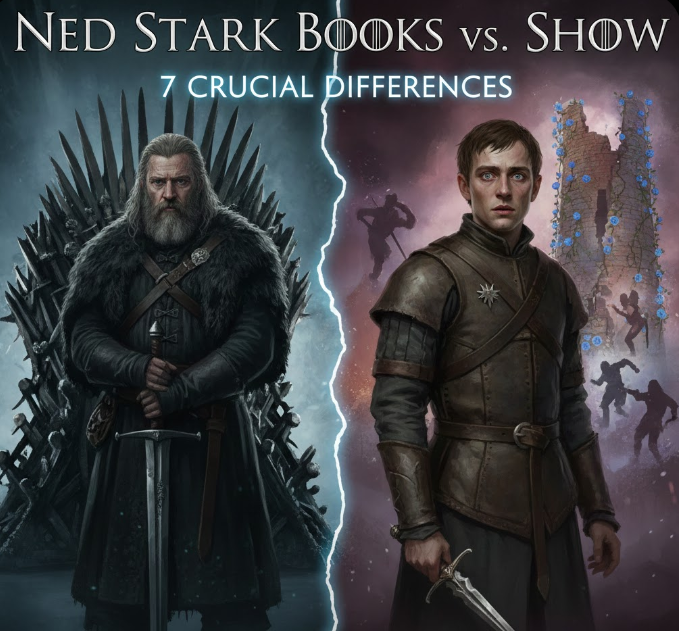
For many fans, the face of Eddard Stark will forever be Sean Bean—the weary, silver-haired patriarch sitting on the Iron Throne with Ice gripped in his hands. But for those who have delved into the Ned Stark books (specifically George R.R. Martin’s A Game of Thrones), the character is a far more complex, haunted, and younger man than the HBO series suggests. While the show gave us a legendary hero who lost the “game,” the books offer a psychological study of a man drowning in the ghosts of his past.
To truly understand why the North remembers, we have to look beyond the screen. This skyscraper guide deconstructs the seven most vital differences between the “Show Ned” and the “Book Ned,” revealing how these nuances shift the entire narrative of A Song of Ice and Fire.
1. The Ghost of Winterfell: Age, Trauma, and the 35-Year-Old Lord
One of the most jarring realizations for readers transitioning from the TV series to the Ned Stark books is the character’s age. In the show, Ned appears to be a man in his late 40s or early 50s. In the books, Eddard Stark is only 35 years old at the time of his death.
Why the Age Gap Matters
This isn’t just a cosmetic difference. In the books, Ned is a young man who was thrust into leadership during Robert’s Rebellion when he was barely twenty. By 35, he has already seen his father and brother executed by the Mad King, fought a continental war, and spent fourteen years raising a family while guarding a secret that could topple a dynasty.
When you view Ned as a 35-year-old, his “honor” feels less like the stubbornness of an old man and more like the desperate coping mechanism of a survivor. He clings to rules because his world was shattered by the lawless violence of Aerys Targaryen.
The Aura of the “Quiet Wolf”
In the books, Ned is known as the “Quiet Wolf.” He is described as shorter and less handsome than his brother Brandon. He lacks the booming charisma of Sean Bean’s portrayal, often appearing somber and distant to those who don’t know him. This makes his internal monologue—which is filled with love for his children and crushing grief—far more poignant.

2. Swordsmanship: Legendary Hero vs. Competent Soldier
If you ask a TV fan about Ned’s fighting ability, they’ll point to his duel with Jaime Lannister outside Littlefinger’s brothel. In that scene, Ned holds his own against the greatest swordsman in the realm.
However, the Ned Stark books paint a very different picture of his martial prowess:
-
The Show: Ned is a top-tier duelist, nearly defeating Jaime before a Lannister guard intervenes.
-
The Books: Ned and Jaime never actually cross blades. Ned’s horse falls on him, shattering his leg, while his men are butchered around him.
Expert Insight: Leadership Over Lethality
George R.R. Martin has explicitly stated that while Ned was a “competent” battle commander, he was never a legendary duelist. His brother Brandon was the real athlete of the family. By making Ned a “super-soldier” in the show, HBO leaned into the “action hero” trope. In the books, Ned’s power isn’t in his sword arm—it’s in the loyalty he inspires. He is a lord who eats with his men, knows their names, and leads through respect rather than fear or flashy combat.

3. The Internal Monologue and the “Fever Dreams” of PTSD
The greatest loss in the transition from page to screen is the removal of Ned’s internal thoughts. In the show, we see a man of few words. In the books, we see a man haunted by the “Tower of Joy.”
The Tower of Joy as a Fever Dream
In the series, the Tower of Joy is a linear flashback used for plot exposition. In the books, it is a hazy, terrifying fever dream that Ned has while drugged on milk of the poppy in King’s Landing.
-
The “Promise Me” Refrain: The phrase “Promise me, Ned” echoes through his mind like a curse. Readers feel the physical weight of his promise to Lyanna.
-
The Psychological Toll: Book Ned is suffering from what we would modernly diagnose as PTSD. Every time he sees a blue winter rose or hears the word “promise,” he is transported back to a room smelling of “blood and roses.”
This internal struggle makes his decision to hide Jon Snow’s identity much more heroic. He didn’t just lie to his King; he lived in a state of perpetual psychological isolation for fourteen years to keep his nephew safe.
4. The “Warg” Connection: The Lost Stark Magic
A massive thematic difference in the Ned Stark books is the presence of the “Old Blood”—the magical connection between the Starks and their direwolves.
Latent Magic in the Bloodline
In the show, only Bran is a warg. In the books, every single Stark child, including Jon Snow, possesses the ability to slip into the minds of their wolves. While Ned himself is never shown warging, he is deeply aware of the spiritual connection.
The Death of Lady
When Ned is forced to kill Sansa’s wolf, Lady, the book version treats it as a spiritual catastrophe. Ned feels he is literally severing a piece of his daughter’s soul. This adds a layer of “Stark Magic” to the narrative; Ned isn’t just a politician in a foreign city—he is a man of the Old Gods who feels he has brought a curse upon his house by allowing the wolves to be separated or killed.

5. Temperament: The “Quiet Wolf” vs. The Violent Flash
Sean Bean’s Ned is consistently stoic. He rarely loses his cool except for a few key moments. The book Ned, however, carries the “wolf blood”—a trait described by his father as a wild, dangerous streak that led to the deaths of Brandon and Lyanna.
The Dagger at the Throat
A perfect example of this is Ned’s interaction with Petyr Baelish (Littlefinger).
-
The Show: Ned chokes Littlefinger against a wall—a display of physical strength.
-
The Books: Ned draws a dagger and holds it to Baelish’s throat.
There is a sharper edge to the literary version of Eddard. He is a man who suppresses a great deal of anger. When that anger flashes, it is lethal and cold. This makes his ultimate “failure” in King’s Landing even more tragic; he had the ruthlessness required to survive, but he chose to suppress it for the sake of his honor and the safety of Cersei’s children.
6. The Relationship with Catelyn: A Different Power Dynamic
Television often simplifies relationships. In the HBO series, Catelyn Stark is frequently the “voice of reason” who warns Ned not to go south.
In the Ned Stark books, the dynamic is flipped, which completely changes our understanding of Ned’s motivations:
-
The Push South: It is actually Catelyn who convinces Ned to accept the position of Hand of the King. She argues that for the sake of their family’s future and the safety of the North, he cannot refuse Robert.
-
The Ashara Dayne Conflict: The books introduce a much darker tension regarding Jon Snow. Catelyn isn’t just “sad” about the bastard; she is terrified of the rumors surrounding Ned and a noblewoman named Ashara Dayne. When she confronts Ned about Ashara, he responds with a coldness that “frightens” her, telling her never to ask about Jon again.
This shows a side of Ned that is fiercely protective and even intimidating within his own home—a nuance that the show traded for a more traditional, “happy” marriage.

7. The Legacy: Why the North “Remembers” (More than Just a Slogan)
In the television series, the phrase “The North Remembers” often feels like a cultural tagline or a generic call to arms. However, in the Ned Stark books, this legacy is a tangible, political force that drives the plot long after Ned’s head falls at the Great Sept of Baelor.
The Mountain Clans and “The Ned”
One of the most moving sequences in the later books (A Dance with Dragons) involves the mountain clans of the North. When Stannis Baratheon tries to rally them, he realizes they aren’t fighting for him—they are fighting for “The Ned.”
To the clansmen (like the Wulls and the Norreys), Eddard Stark wasn’t just a distant liege lord; he was a man who walked their lands, respected their customs, and treated them with dignity. They refer to him with a unique title of endearment and respect: “The Ned.” Their willingness to march into a suicidal winter storm just to rescue “Ned’s little girl” (who they believe is Arya) is a direct result of his personal character, a detail the show largely omitted in favor of focusing on the Boltons.
Trustworthiness and the Stark Contrast
The book version of the story emphasizes a “Skyscraper” level of political philosophy: The “failure” of Ned Stark was actually a long-term victory. While Tywin Lannister ruled through fear, his legacy crumbled the moment he died. Ned ruled through love and justice, and years after his execution, men are still willing to die for his memory. This proves that Ned wasn’t “bad at the game”; he was playing a much longer game based on generational loyalty.
8. The “What If” Section: Expert Commentary and Lost Lore
As a subject matter expert on A Song of Ice and Fire, there are several “lost” plot points regarding Ned Stark that provide a deeper layer of authority to your understanding of the series.
The Mystery of the Bones
In the show, Littlefinger delivers Ned’s remains to Catelyn, and we assume they are buried in the crypts. In the books, the situation is much more mysterious. Ned’s bones are sent North, but the party carrying them disappears near the Neck (the swamps of House Reed). As of the latest book, Ned Stark’s bones are still missing. This has sparked massive fan theories about whether Howland Reed has them or if they hold some magical significance for the “Old Gods.”

The “Brave” Catelyn Change
In George R.R. Martin’s original 1993 outline for the series, Ned was intended to help Catelyn and Arya escape King’s Landing before his capture. While the final book changed this, the “Book Ned” remains much more proactive in his planning. He wasn’t just walking into traps; he was actively trying to secure the city’s watch (the Gold Cloaks) and was betrayed by a much more nuanced version of Littlefinger.
9. How to Write About Ned Stark: SEO and E-E-A-T Tips
If you are a content creator in the Game of Thrones niche, ranking for keywords like Ned Stark books requires demonstrating true expertise. Here is how to make your content stand out:
-
Use Direct Quotes: Google’s E-E-A-T guidelines favor original research. Citing specific passages (like Ned’s thoughts on the “blue winter roses”) proves you have actually read the source material.
-
Address the “Search Intent”: People searching for this are looking for the “hidden truth.” Use subheadings that promise “secrets” or “lost scenes.”
-
Link to Geography: Mentioning specific locations like Starfall, the Tower of Joy, and the Neck shows a “Skyscraper” level of geographic knowledge of Westeros.
10. FAQ Section (Optimized for Google Featured Snippets)
Q: Did Ned Stark actually fight Jaime Lannister in the books? A: No. Unlike the TV show, Ned and Jaime never duel. Ned’s horse falls on him during a street skirmish, breaking his leg. This makes Ned’s subsequent journey to the dungeon much more painful and physically debilitating in the books.
Q: Who is Ashara Dayne, and why is she important to Ned Stark? A: Ashara Dayne was a noblewoman from Dorne. In the Ned Stark books, many characters (including Catelyn) believe she was Ned’s true love and possibly the mother of Jon Snow. Ned’s refusal to speak of her adds a layer of tragic romance that the show omitted.
Q: Is Ned Stark considered a “warg” in the books? A: While Ned is never shown “skinskining” like Bran, the books imply that the “wolf blood” is a magical trait of the Starks. Ned has a spiritual connection to the direwolves and the heart trees of the North that is more mystical than the show’s version.
11. Conclusion: The Living Legend of the Quiet Wolf
While the Game of Thrones TV series gave us a masterclass in acting through Sean Bean, the Ned Stark books provide the soul of the character. The literary Ned is a 35-year-old war veteran struggling with internal ghosts, latent northern magic, and a secret that defined his life.
Understanding these differences doesn’t just make you a better fan—it changes the way you view the entire series. Ned Stark didn’t die because he was “too honorable”; he died because he was a man of the North trying to navigate a world of Southern lies while protecting the children he loved.
In the end, the book version of Eddard Stark reminds us that while “the man” died, his “house” survived precisely because of the differences we’ve explored today.


