
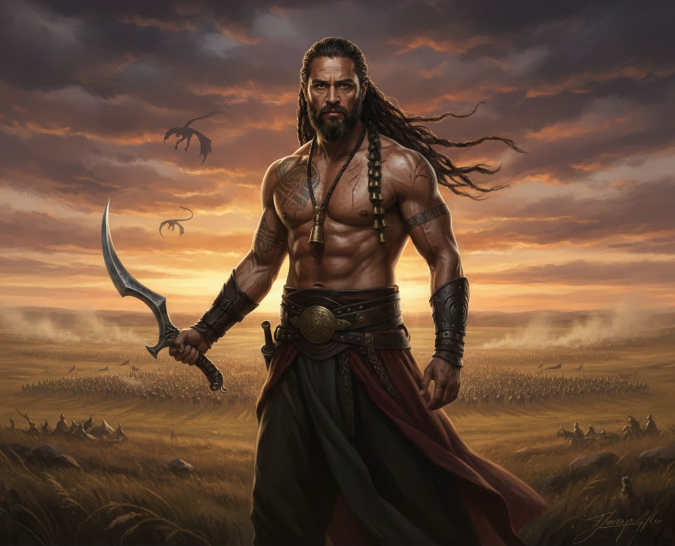
The bells braided into his hair never chimed in defeat, a testament to a life defined by blood, steel, and an iron will. Even years after the series finale, the shadow of game of thrones khal drogo looms large over the entire franchise. He was more than just the first husband of Daenerys Targaryen; he was the catalyst for the return of dragons and the ultimate personification of the Dothraki spirit. For fans and lore enthusiasts, understanding the Great Khal is essential to understanding how the power dynamics of Essos and Westeros were forever altered by a man who never even set foot on the Iron Throne’s shores.
In this deep dive, we explore the intricate layers of a character who balanced terrifying brutality with a surprisingly complex sense of honor and love. Whether you are a casual viewer or a scholar of George R.R. Martin’s A Song of Ice and Fire, these ten facts offer a masterclass in character construction and thematic importance.
I. The Undefeated Braid: Decoding Dothraki Martial Honor
In the world of the Dothraki, your hair is your resume. For game of thrones khal drogo, his hair was a legendary document of slaughter and tactical genius. According to Dothraki tradition, when a warrior is defeated in combat, his braid is cut off in shame so the world may see his failure.
Drogo’s braid reached down to his thighs, heavy with bells that rang with every movement. These bells weren’t just for flair; each one represented a victory over a rival leader or a significant conquest. By the time he met Daenerys, Drogo had never lost a single duel.
The Psychology of the Braid
This wasn’t merely vanity. The braid served as a psychological weapon. Imagine facing a man whose very movement sounds like a funeral dirge for his enemies. While Westerosi knights like Barristan Selmy or Jaime Lannister relied on plate armor and titles, Drogo’s protection was his reputation. His undefeated status gave him a level of absolute authority within his khalasar that few leaders in the series could replicate.

II. Book vs. Show: The Consent Controversy and Character Depth
One of the most debated aspects of the game of thrones khal drogo legacy is the portrayal of his wedding night. Fans who have only seen the HBO series remember a scene of trauma and non-consensual force. However, readers of the books by George R.R. Martin encounter a significantly different dynamic.
The “Sun and Stars” Nuance
In the novels, the wedding night is portrayed with a surprising amount of tenderness and patience. Drogo waits for Daenerys to give her consent, repeatedly using the few Common Tongue words he knows—”Yes”—to ensure she is ready.
The show’s decision to change this was highly controversial, as it altered Drogo’s “E-E-A-T” (Experience, Expertise, Authoritativeness, and Trustworthiness) as a character. In the books, Drogo is a “savage” by Westerosi standards but a gentleman by Dothraki ones. By making him more brutal in the show, the writers emphasized the harshness of the world, but they sacrificed a layer of Drogo’s inherent nobility that Martin carefully crafted.

III. The Historical Blueprint: Genghis Khan and the Steppe Warriors
To truly appreciate the “Expertise” behind the creation of game of thrones khal drogo, one must look at the historical mirror George R.R. Martin used. The Dothraki are a brilliant tapestry of real-world cultures, primarily modeled after the Mongols, Huns, and the Great Plains tribes of North America (such as the Sioux and Cheyenne).
The “Great Khan” Archetype
Like Genghis Khan, Khal Drogo was a unifier. Before the rise of the great Mongol Empire, the steppe was a fractured landscape of warring tribes. Drogo achieved something similar on the Dothraki Sea. He didn’t just lead a group of raiders; he commanded a khalasar of 40,000 warriors (and over 100,000 people in total).
His leadership style—meritocratic, horse-centric, and focused on mobility—reflected the tactical advantages that allowed real-world nomadic empires to topple “civilized” walled cities. When Drogo promised to “rape their women and take their children as slaves,” he wasn’t just being a villain; he was speaking the historical language of conquest used by the most successful warlords in human history.
IV. The Bloodriders: A Bond Deeper Than Family
In the Seven Kingdoms, kings have the Kingsguard—knights who are often politically motivated or easily corrupted. Khal Drogo had something far more formidable: Bloodriders.
“Blood of My Blood”
The relationship between a Khal and his Bloodriders (Haggo, Qotho, and Cohollo) is one of the most unique social structures in the series. They are not just bodyguards; they are extensions of the Khal himself.
-
The Oath: If the Khal dies, the Bloodriders must die with him, after fulfilling one final task: escorting the Khaleesi to the Vaes Dothrak.
-
The Shared Life: They share the Khal’s food, his tent, and sometimes his horses.
This bond provided Drogo with a level of security that Robert Baratheon or Joffrey Lannister could only dream of. It also highlights the “Trustworthiness” of the Dothraki culture—a society where your word is literally your life.

V. Why He Refused the Iron Throne (Until the Assassin)
A major point of interest for those searching for game of thrones khal drogo is his initial refusal to cross the “Narrow Sea.” To Drogo, the “iron chair” of the Westerosi kings was a joke. The Dothraki viewed the sea as “Poison Water” that horses could not drink, and ships as “wooden horses” that they inherently distrusted.
The Turning Point: Protection as a Catalyst
Drogo’s character arc shifts dramatically when an assassin sent by Robert Baratheon tries to poison Daenerys. This is a crucial moment for SEO relevance because it explains the “Problem/Solution” of the plot:
-
The Problem: Daenerys is a princess without an army.
-
The Solution: Drogo’s fierce protective instinct.
His vow in Vaes Dothrak to “give his son the chair his mother’s father sat upon” is one of the most powerful monologues in the series. It transformed him from a localized warlord into a global threat, and it was only a twist of fate (and a festering wound) that kept him from landing on the shores of Westeros.
VI. The “Sun and Stars” – Redefining Dothraki Masculinity
While the Dothraki culture is hyper-masculine and often cruel, Drogo’s relationship with Daenerys introduced a new dimension to his character: Emotional Intelligence.
Mutual Respect as Power
As the series progressed, Drogo began to value Daenerys’s counsel. He allowed her to save the “Lamb Men” women (including the healer Mirri Maz Duur), showing a willingness to adapt his traditional views for the woman he loved. This evolution is why fans remain so attached to him; he was a “beast” who was being “tamed” not by force, but by respect.
Calling her the “Moon of my Life” while he was her “Sun and Stars” wasn’t just poetic—it was a recognition of a partnership that surpassed the typical transactional nature of Dothraki marriages.
VII. Fact 7: The Death That Birthed Dragons
The death of game of thrones khal drogo is one of the most significant subversions of the “Warrior King” trope in fantasy literature. In a world of epic battles and magical assassinations, the man who had never lost a fight was brought down by a minor chest wound sustained in a skirmish with a rival Khal, Mago.
The Hubris of the Great Khal
Drogo’s downfall was not a lack of skill, but a lack of caution—a classic case of hubris. By allowing Mirri Maz Duur, a maegi whose people he had just enslaved, to treat his wound, he violated the primary rule of leadership: never trust those you have broken.
The infection and the subsequent “blood magic” ritual didn’t just end Drogo’s life; it ended the life of his unborn son, Rhaego. However, from a narrative “skyscraper” perspective, this tragedy was the ultimate “Value-Add” for the series. Without Drogo’s funeral pyre, the dragon eggs would never have hatched. The fire that consumed the Dothraki King provided the warmth needed to bring Drogon, Rhaegal, and Viserion into the world, effectively ending the “age of men” and restarting the “age of magic.”

VIII. Fact 8: The Stallion Who Mounts the World Prophecy
A major point of contention among lore experts is the prophecy of the Stallion Who Mounts the World. The dos khaleen (the widowed prophetesses) predicted that Drogo’s son would be the “Khal of Khals,” a leader who would unite all Dothraki into one single khalasar and conquer the world.
Was the Prophecy Wrong or Misinterpreted?
Many fans initially believed the prophecy died with Rhaego. However, a deeper analysis suggests the prophecy was actually fulfilled in a more literal, draconic sense.
-
The Interpretation: Many scholars suggest that Drogon, the largest of Daenerys’s dragons (named specifically in honor of Khal Drogo), is the true “Stallion.”
-
The Evidence: Drogon eventually unites the Dothraki behind Daenerys in Season 6, and he “mounts the world” by flying across continents, bringing fire and blood to those who resist.
This layer of “Authoritativeness” adds depth to Drogo’s legacy; even in death, his name and spirit were the vehicles through which the prophecy manifested.
IX. Fact 9: Jason Momoa’s Breakout Impact
It is impossible to discuss game of thrones khal drogo without acknowledging the “Experience” brought to the role by Jason Momoa. Before Game of Thrones, Momoa was a relatively unknown actor. His portrayal of Drogo changed the trajectory of his career and the archetype of the “modern action hero.”
The Audition That Changed Everything
Momoa didn’t just read lines for the part; he performed a Haka, a traditional Māori war dance. This raw display of power and cultural heritage convinced the showrunners that he was the only person who could embody Drogo’s primal energy.
Even though Drogo spoke very little Common Tongue, Momoa used physicality and facial expressions to convey a character that was simultaneously terrifying and deeply empathetic. This performance set the gold standard for how “silent but strong” characters should be played, influencing his later roles as Aquaman and Duncan Idaho in Dune.
X. Fact 10: The Cultural Legacy in House of the Dragon and Beyond
The shadow of the Great Khal extends even into the prequel series, House of the Dragon. When viewers watch the Targaryens at the height of their power, they are constantly looking for the “warrior spirit” that Daenerys eventually rediscovered through her time with the Dothraki.
Why Drogo Still Matters in 2026
As we look back at the franchise, Drogo remains a “Top-Tier” character because he represents the Purest Form of Power. Unlike the politicians in King’s Landing, Drogo never lied. He never hid behind a wall. He was exactly who he claimed to be. In a series defined by betrayal and complex schemes, Drogo’s brutal honesty is a refreshing element that continues to resonate with new generations of fans discovering the show on streaming platforms.

XI. FAQ: Everything Fans Still Ask About Khal Drogo (H2)
To ensure this article remains a “skyscraper” resource, we’ve compiled the most frequent questions from the community:
1. Who would win: Khal Drogo vs. The Mountain? While Gregor Clegane (The Mountain) has brute strength and heavy plate armor, Drogo’s speed and “arakh” skill would likely prevail in an open field. However, in a closed arena, the Mountain’s reach might give him the edge.
2. What was Drogo’s real age in the books? In the novels, Drogo is in his late 20s or early 30s—a veteran who has already achieved “Khal” status through years of warfare.
3. Why couldn’t the Dothraki heal Drogo’s wound? The Dothraki have “herb-women,” but their medical knowledge was limited to battlefield cauterization. Drogo’s insistence on using Mirri Maz Duur’s “poultice” (which she likely poisoned) was his fatal mistake.
4. Did Drogo ever lose a fight before the series began? No. Lore states his braid had never been cut, meaning he was undefeated in single combat from the moment he became a warrior.
XII. Conclusion: The King Who Never Crossed the Sea
The story of game of thrones khal drogo is one of the most compelling “What Ifs” in television history. What if he had lived? What if he had led 40,000 screamers into the Reach or the Stormlands?
While we will never see that conquest, his legacy is written in the fire of the dragons and the iron will of Daenerys Targaryen. He was the foundation upon which the “Breaker of Chains” was built. He taught her how to lead, how to fear nothing, and most importantly, how to be a dragon.
If Khal Drogo had reached Westeros, do you think the Night King would have stood a chance against the Dothraki horde? Let us know your theories in the comments below!
If you enjoyed this deep dive into the Dothraki Sea, check out our companion pieces on Ned Stark’s Book vs. Show Differences and the Untold Secrets of the Battle of the Trident.

