
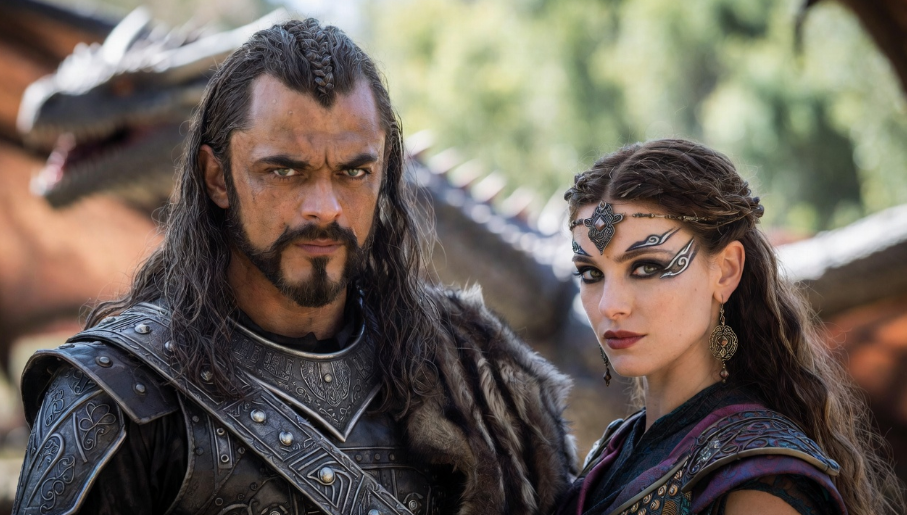
When Khal Drogo first thundered onto the screen in the pilot episode of Game of Thrones, audiences were met with an imposing figure: a towering warrior with a long, bell-adorned braid, painted vest, and an aura of untamed power. Bells rang in his hair with every step, each one a testament to a victory in battle—no braid ever cut, no defeat ever suffered. Yet beneath the fearsome exterior lay a story far more complex than brute strength. For many fans searching “drago game of thrones” (a common variation on the iconic Khal Drogo), the curiosity runs deeper: Who was this Dothraki warlord really? How did a man of so few words become the catalyst for Daenerys Targaryen’s transformation into the Mother of Dragons? And why does his brief but explosive presence continue to echo through the entire series, even years after his tragic exit?
Khal Drogo—often misspelled as “Drago” in searches, perhaps unconsciously linking him to the black dragon Drogon he indirectly inspired—was never meant to be a long-term character. Yet his arc, spanning just the first season of HBO’s adaptation (and the early chapters of George R.R. Martin’s A Game of Thrones), packs more emotional weight, cultural depth, and narrative consequence than many multi-season roles. His story is one of conquest, unexpected tenderness, betrayal, and rebirth through fire. This comprehensive exploration uncovers the untold layers of Khal Drogo: from Dothraki traditions and book-show differences to Jason Momoa’s career-defining performance and the enduring legacy that shaped Daenerys’ path to power—and tragedy.
Who Is Khal Drogo? The Dothraki Warlord Explained
Origins and Rise to Power in the Dothraki Culture
The Dothraki are a nomadic horse-lord people inhabiting the vast grasslands known as the Dothraki Sea in Essos. Their society revolves around strength, mobility, and martial prowess. A khal leads a khalasar—a massive horde of warriors, bloodriders, slaves, and followers—and rules through fear, respect, and proven dominance in combat.
Khal Drogo rose to become one of the most feared and respected khals in living memory. As described in both Martin’s books and the show, he had never been defeated in battle. His braid, uncut and weighted with tiny bells from slain enemies, symbolized this unbroken record. Cutting a warrior’s braid after defeat was the ultimate humiliation; Drogo’s remained long and intact, a living trophy.
Dothraki customs shaped every aspect of his life: the reverence for horses (they ride everywhere, even short distances), the prohibition against crossing water (seen as weakness), and the prophecy of the Stallion Who Mounts the World—a prophesied conqueror who would unite all khalasars and lead them to dominion over the world. Drogo’s khalasar was one of the largest, numbering in the tens of thousands, making him a kingmaker in the eyes of those like Viserys Targaryen seeking an army.
“Drago” vs. Drogo – Why Fans Search It This Way
The frequent search term “drago game of thrones” likely stems from phonetic similarity, non-native English pronunciations, and an intriguing subconscious connection: the black dragon Drogon, born from Drogo’s funeral pyre, bears a name that echoes his own. This linguistic link reinforces Drogo’s symbolic rebirth through Daenerys’ dragons, a theme that resonates deeply with fans revisiting his story.

Khal Drogo’s Relationship with Daenerys Targaryen – From Transaction to True Love
The Arranged Marriage and Early Dynamics
Daenerys Targaryen’s brother Viserys “gifts” her to Khal Drogo in exchange for an army to reclaim the Iron Throne. The marriage begins as a cold transaction: Daenerys, barely 13 in the books (adjusted to 16-17 in the show for sensitivity), is terrified of the towering warrior and his culture.
Their wedding night highlights the cultural clash. In the show, Drogo shows restraint and attempts gentleness after seeing her fear; in Martin’s book, the scene is far more brutal, emphasizing Daenerys’ lack of agency. Over time, however, mutual respect grows.
The Evolution of Their Bond
Drogo learns to communicate with Daenerys beyond commands. He teaches her Dothraki phrases, listens to her counsel, and begins treating her as an equal partner rather than property. Iconic terms of endearment emerge: “moon of my life” (Drogo to Daenerys) and “my sun and stars” (her reply).
This relationship subverts expectations. Drogo, the archetypal barbarian warlord, reveals vulnerability and love. Daenerys, initially a pawn, gains confidence as Khaleesi and starts influencing her husband’s decisions—most notably when she halts the rape of captured women, leading to the fatal chain of events.
The Pregnancy and the Stallion Who Mounts the World
Daenerys becomes pregnant with Rhaego, whom the dosh khaleen prophesy as the Stallion Who Mounts the World. This child represents the ultimate fulfillment of Dothraki destiny—and raises the stakes of Drogo’s life immeasurably.
The Fight with Mago and the Infected Wound
Khal Drogo’s downfall begins with an act of mercy that Daenerys initiates. After a raid on a Lhazareen village, she commands her khalasar to stop the systematic rape of captured women. One of Drogo’s warriors, Mago, openly defies her order and insults her authority. In Dothraki culture, such a challenge cannot go unanswered—especially not from a khaleesi backed by her husband.
Drogo confronts Mago in single combat. The fight is swift and brutal: Drogo slits Mago’s throat with a single arakh stroke. To the khalasar, it is a routine demonstration of dominance. Drogo sustains only a shallow cut to his left breast—barely a scratch. He laughs it off, smears the blood across his chest, and rides away victorious.
What no one realizes at the time is that the wound has become infected. In the unforgiving Dothraki Sea, with no access to maesters or modern medicine, even minor injuries can turn deadly.
Mirri Maz Duur’s “Healing” and Blood Magic
Daenerys, desperate to save her husband, turns to Mirri Maz Duur—a Lhazareen maegi (godswood priestess and healer) captured in the raid. Mirri claims she can heal the festering wound with a poultice and ritual. Drogo, weakened and feverish, allows it.
In the show, the infection is portrayed as the primary cause, with Mirri’s treatment deliberately worsening it as an act of vengeance for her village and the rape of her people. In George R.R. Martin’s A Game of Thrones, the text leaves more ambiguity: some readers interpret the wound as poisoned by Mago’s blade (a theory supported by later hints about poisoned weapons in Essos), while others see it as simple sepsis compounded by Mirri’s sabotage.
The turning point comes when Mirri performs a blood magic ritual inside Drogo’s tent. She sacrifices Rhaego—Daenerys’ unborn son—in a horrific exchange to restore Drogo’s life. The ritual succeeds in a twisted way: Drogo’s body lives, but his mind is gone. He becomes a catatonic shell, breathing but unresponsive, his once-mighty frame reduced to a living corpse.
Devastated, Daenerys smothers him with a pillow in an act of mercy, ending the warrior’s suffering.
Was Drogo’s Death Avoidable? Analyzing the Tragedy
Drogo’s death is layered with inevitability and avoidable missteps:
- Cultural hubris — Drogo’s refusal to wear armor or seek maester-like care reflects Dothraki disdain for “weak” healing traditions.
- Daenerys’ growing influence — Her intervention to save the Lhazareen women directly leads to Mago’s challenge and the wound.
- Mirri’s revenge — The maegi exploits Daenerys’ trust, turning a potential recovery into a deliberate catastrophe.
- Foreshadowing of tragedy — Drogo’s death mirrors the fragility of power built solely on strength; it plants the seeds for Daenerys’ later obsession with conquest at any cost.
This sequence remains one of the most emotionally devastating in the entire series.

Jason Momoa’s Breakthrough Performance – Bringing Khal Drogo to Life
Casting and Preparation
When HBO cast Jason Momoa as Khal Drogo, many fans were initially skeptical. The Hawaiian-born actor, then best known for smaller roles and his work on Stargate Atlantis, seemed an unconventional choice for a Dothraki warlord inspired by Mongol and steppe nomad cultures.
Momoa, however, brought authenticity and physicality. He bulked up significantly for the role, trained extensively in arakh combat, and immersed himself in the character’s mindset. He also advocated for cultural sensitivity—helping shape the Dothraki language (created by David J. Peterson) and pushing for more nuanced portrayals of Drogo’s tenderness.
Behind-the-Scenes Insights and Impact
Momoa has shared in interviews that he saw Drogo not as a villain but as a man shaped by a harsh world—someone capable of deep love despite his violent life. His chemistry with Emilia Clarke was immediate and electric, selling the evolution from transactional marriage to genuine partnership.
The performance launched Momoa into global stardom. Post-Game of Thrones, he became Aquaman in the DC Extended Universe, starred in Dune (2021), and built a career blending action-hero charisma with emotional depth—all roots traceable to those seven episodes as Khal Drogo.

The Birth of Drogon – A Direct Namesake and Symbolic Rebirth
When Daenerys places Drogo’s lifeless body on the funeral pyre alongside Mirri Maz Duur (bound and alive), three dragon eggs, and the body of her stillborn son Rhaego, she steps into the flames herself. The pyre burns through the night. In the morning, the entire khalasar witnesses an impossible sight: Daenerys emerges unburnt, and three newborn dragons perch on her shoulders and arms.
The black dragon—the largest and most aggressive of the trio—receives the name Drogon. Fans have long noted the clear phonetic and symbolic connection: Drogo → Drogon. George R.R. Martin himself has never explicitly confirmed it as intentional on Daenerys’ part, but the parallel is unmistakable. Drogon is not merely named after her husband; many readers and viewers interpret him as a spiritual or magical continuation of Drogo’s essence—raw power, fierce loyalty, and untamed ferocity reborn in fire and blood.
This moment marks the literal and figurative rebirth of Khal Drogo’s legacy. His death enables the return of dragons to the world after nearly two centuries, setting in motion every major event of the remaining series.

Influence on Daenerys’ Character Arc
Drogo’s death is the single most formative trauma in Daenerys Targaryen’s journey. Before him, she was a frightened exile. Through him, she discovered love, agency, sexual awakening, leadership, and the taste of real power as Khaleesi of a vast khalasar.
After him, she carries forward several key traits that define her later seasons:
- The belief that strength and conquest are the only paths to security
- A willingness to use overwhelming force when crossed (mirroring Drogo’s response to Mago)
- The recurring motif of “fire and blood” as both literal and emotional inheritance
- Deep-seated grief that fuels both her compassion and her eventual ruthlessness
In the House of the Undying visions (Season 2), Daenerys sees a tent containing a still, catatonic Drogo cradling their son Rhaego—her greatest “what if” fantasy. The vision underscores how much of her later ambition is an attempt to reclaim the life and family she lost with Drogo.
Broader Themes and Cultural Resonance
Drogo’s arc allows Game of Thrones to explore:
- The collision of cultures (Dothraki vs. Westerosi vs. Lhazareen)
- The complexity of toxic masculinity redeemed through love
- The cost of empire-building and conquest
- Cross-cultural romance and mutual transformation
Even in 2026, with the series long concluded and House of the Dragon expanding the universe, Drogo remains one of the most debated and memed early characters—proof of how deeply his brief presence resonated.
Book vs. Show: Key Differences in Khal Drogo’s Story
While the broad strokes remain consistent, several changes alter tone and implication:
- Age and Wedding Night Books: Daenerys is 13; the wedding night is unambiguously non-consensual and traumatic. Show: Age raised to ~16–17; Drogo shows hesitation and gentleness after seeing her tears.
- Cause of the Wound Books: Ambiguous—could be simple infection or subtle poison on Mago’s arakh. Show: Clearly an infected scratch, with Mirri’s sabotage more overtly malicious.
- Mirri Maz Duur’s Ritual Books: More mysterious and open to interpretation (was Rhaego truly sacrificed, or was the stillbirth coincidental?). Show: Explicit child sacrifice shown in horrific detail.
- Funeral Pyre Books: Drogo’s braid is cut by Jhogo before the pyre (a profound Dothraki humiliation). Show: Braid remains intact, emphasizing his undefeated status even in death.
These adjustments made the show more palatable to modern audiences while preserving the core tragedy.
Fascinating Facts and Lesser-Known Details About Khal Drogo
- The bells in Drogo’s braid are not decorative—each represents a defeated enemy whose braid was cut and melted down.
- Jason Momoa created several of Drogo’s iconic grunts and non-verbal expressions himself.
- The Dothraki language used in Season 1 contains roughly 1,700 words, many coined specifically for Drogo’s dialogue.
- Drogo never says more than a handful of full sentences in English across all seven episodes.
- His horse’s name is never spoken on screen, following Dothraki custom of not naming mounts.
- Momoa’s real-life chest and arm tattoos were incorporated into Drogo’s costume design.
- The phrase “moon of my life” was improvised in rehearsal by Momoa and Clarke.
- In Martin’s original outline, Drogo was intended to survive longer into the story.
Expert Insights – What Khal Drogo Teaches Us About Power and Love
From a literary perspective, Drogo draws clear inspiration from historical steppe conquerors (Genghis Khan, Attila) but subverts the archetype by revealing vulnerability. His arc illustrates Martin’s recurring theme: absolute power built on physical dominance is fragile when confronted with love, betrayal, or simple bad luck.
Drogo also serves as a counterpoint to Westerosi knights. Where they wear armor and follow chivalric codes, Drogo fights bare-chested with an arakh—yet he displays more genuine honor and love than many “civilized” lords. His relationship with Daenerys anticipates later doomed romances (Jon/Dany, Robb/Talisa) and shows that love across cultural divides can be transformative—but rarely without cost.
Conclusion
Khal Drogo occupies only a fraction of Game of Thrones’ runtime, yet his shadow stretches across the entire saga. He is the first man Daenerys truly loves, the father of her lost child, the reason dragons returned, and the emotional wound that never fully heals. Searching “drago game of thrones” may begin as a typo or curiosity about a memorable warrior—but it leads to one of the series’ most poignant stories of strength, tenderness, loss, and unintended legacy.
In the end, Drogo did not conquer Westeros with his khalasar. Instead, through his death and the fire that followed, he gave the world something far more dangerous: dragons—and a queen who would one day burn cities in pursuit of the empire he never claimed.
Thank you for reading. Which Drogo moment hits you the hardest—the tenderness of “moon of my life,” the tragedy of the pyre, or the birth of Drogon? Share in the comments, and explore more deep dives into Westeros lore right here on Game of Thrones Insider.
FAQs
Why do people search “Drago Game of Thrones”? It’s a very common misspelling of Khal Drogo, often influenced by the similar-sounding name of his dragon namesake, Drogon.
Did Khal Drogo truly love Daenerys? Yes. Their relationship evolves from obligation to genuine mutual love, proven by his protective actions, pet names, and willingness to change for her.
Is Drogon named after Khal Drogo? Almost certainly. The phonetic similarity and symbolic rebirth make it one of the clearest intentional connections in the series.
How did Khal Drogo die in the books vs. show? Both feature infection + Mirri’s blood magic, but the books leave more ambiguity about poison vs. sepsis, and include the cutting of his braid.
Would Drogo have conquered Westeros if he lived? Possibly—but Dothraki fear of the sea, internal khalasar politics, and Westerosi military discipline would have made it extremely difficult.

