
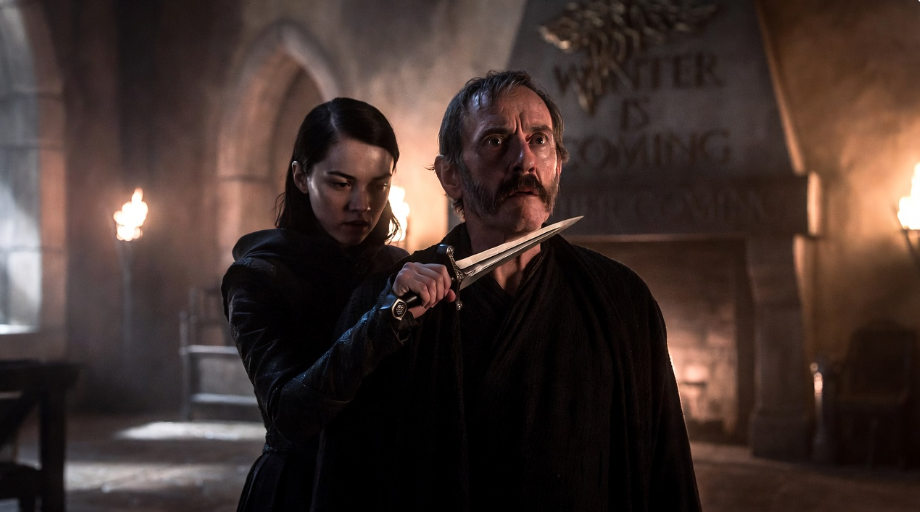
In one of the most cathartic moments of Game of Thrones, Arya Stark stepped forward in Winterfell’s great hall, drew the same Valyrian steel dagger that had once been used in an attempt on her brother Bran’s life, and swiftly slit the throat of Petyr “Littlefinger” Baelish. The Baelish death scene in Season 7, Episode 7 (“The Dragon and the Wolf”) marked the end of one of the show’s most cunning and despised manipulators—a man whose schemes had ignited wars, toppled houses, and left countless bodies in his wake. As blood pooled on the stone floor, the lone wolf who had climbed the ladder of chaos finally fell, betrayed by the very family he sought to control.
For fans revisiting the series or debating the twists years later, the Baelish death remains a pivotal and polarizing event. It delivered long-awaited justice for betrayals stretching back to Season 1, yet it also sparked controversy over pacing and character consistency in the later seasons. This in-depth guide breaks down everything: Littlefinger’s rise and fall, the trial scene step by step, the profound symbolism of the dagger, fan reactions, and the broader impact on the story. Whether you’re seeking closure on how Arya executed Littlefinger or analyzing why his downfall felt both satisfying and abrupt, this comprehensive breakdown provides the clarity and context you need.
Who Was Petyr Baelish? The Rise of Littlefinger
Petyr Baelish, better known as Littlefinger, began as a minor lord from the Fingers—a rocky, insignificant region of the Vale. His ambition far outstripped his birthright. As a boy, he fell deeply in love with Catelyn Tully, only to be rejected and humiliated in a duel with her betrothed, Brandon Stark. That rejection fueled a lifetime of resentment toward the Starks and a relentless drive to climb the social ladder.
Littlefinger’s early schemes revealed his genius for manipulation. He orchestrated the death of Jon Arryn, Hand of the King, by convincing Lysa Arryn (Catelyn’s sister) to poison her husband with tears of Lys. This act sparked the chain of events leading to the War of the Five Kings. He then betrayed Ned Stark in Season 1’s throne room, holding a dagger to Ned’s throat and declaring, “I did warn you not to trust me.” That betrayal led directly to Ned’s execution and plunged Westeros into chaos—precisely as Littlefinger intended.
Throughout the series, Littlefinger amassed power through calculated alliances and betrayals. He married Lysa Arryn, then murdered her by pushing her through the Moon Door of the Eyrie, gaining control of the Vale. He later sold Sansa Stark to the Boltons, subjecting her to horrific abuse under Ramsay, all to secure his influence in the North. His signature philosophy—”Chaos is a ladder”—perfectly encapsulated his worldview: disorder was not a problem to solve but an opportunity to exploit.
By Season 7, Littlefinger had positioned himself in Winterfell, advising Sansa while sowing discord between her and Arya. He believed he could turn the Stark sisters against each other, eliminating threats to his influence. But he underestimated how much the Starks had grown—and how deeply they remembered his past crimes.

The Long Road to Winterfell – Littlefinger’s Season 7 Arc
Littlefinger’s arrival in the North after the Battle of the Bastards was strategic. He brought the Vale knights to secure victory for Jon Snow and Sansa, earning apparent gratitude. Yet his true goal was control. He whispered doubts into Sansa’s ear, suggesting Arya posed a threat and that Jon’s leadership left her vulnerable.
The season built tension through a seemingly real feud between Arya and Sansa. Arya discovered a letter Sansa wrote under duress in Season 1, pleading for Ned’s life and appearing to betray the family. Sansa, meanwhile, grew suspicious of Arya’s faceless man skills and Bran’s revelations. Littlefinger encouraged the rift, hoping to isolate Sansa and position himself as her only ally.
Foreshadowing was everywhere. Bran, now the Three-Eyed Raven, watched Littlefinger closely. The catspaw dagger—once used in the assassination attempt on Bran—reappeared when Littlefinger gifted it to him, perhaps to gain trust or test loyalties. Arya practiced with it against Brienne, demonstrating her lethal precision. These elements converged in the finale, proving the Starks had been playing the long game.

The Trial of Petyr Baelish – Scene-by-Scene Breakdown
The climax unfolded in Winterfell’s great hall, surrounded by Northern lords and the Stark siblings.
Sansa began by appearing to put Arya on trial, reading accusations of treason. Littlefinger looked smug, believing his plan had worked. Then Sansa turned: “Which charges confuse you?” She listed his crimes methodically.
First: “You murdered our aunt Lysa Arryn. You pushed her through the Moon Door and watched her fall. Do you deny it?” Littlefinger claimed he acted to protect Sansa, but Sansa countered he did it for power in the Vale.
Next: conspiring to murder Jon Arryn with tears of Lys, framing the Lannisters to ignite war. Bran confirmed the details.
Then the betrayal of Ned Stark: “You conspired with Cersei Lannister and Joffrey Baratheon to betray our father.” Bran revealed he had seen Littlefinger hold a knife to Ned’s throat.
The final charge: attempting to murder Bran with the catspaw dagger, then conspiring against the Starks repeatedly.
Littlefinger’s defenses crumbled. He begged Sansa, offering bribes and alliances. Sansa delivered the verdict: “Thank you for all your lessons, Lord Baelish. I will never forget them.” Arya stepped forward and slit his throat with the same dagger he once used against her family. Littlefinger bled out, gasping, as the hall watched in silence.
The execution was swift and symbolic, restoring Stark unity just as greater threats loomed.

Why the Dagger? Symbolism and Poetic Justice
Few moments in Game of Thrones carry as much symbolic weight as the weapon used to end Littlefinger’s life. The Valyrian steel catspaw dagger—slender, ornate, and razor-sharp—first appeared in Season 1 when an assassin attempted to murder Bran Stark after his fall from the tower. That dagger belonged to Petyr Baelish, who later claimed it had been stolen from him. In reality, he had given it to the would-be killer as part of his scheme to frame the Lannisters and deepen the growing rift between the great houses.
Seven seasons later, that same dagger returned to Winterfell. Littlefinger himself handed it to Bran in an attempt to curry favor or perhaps to test the waters. Instead, it became the instrument of his own execution. Arya wielded it with the same cold precision she had honed as a Faceless Man, slicing Littlefinger’s throat in a single, decisive motion.
The poetic justice is unmistakable. The tool of betrayal became the tool of retribution. The weapon meant to destroy a Stark child and fracture the family was used by another Stark child to eliminate the man responsible for so much suffering. The phrase “the North remembers” took literal form: every crime Littlefinger had committed against House Stark—Ned’s execution, Sansa’s torment, Bran’s near-death—was repaid with the very blade that started the chain.
This full-circle moment also underscored one of the show’s core themes: power built on lies and manipulation is fragile. Littlefinger climbed the ladder of chaos only to be pulled down by the very people he underestimated. The dagger, once a symbol of his cunning, became the final signature on his death warrant.
Was Littlefinger’s Death Satisfying? Fan Reactions and Controversies
The execution of Petyr Baelish remains one of the most divisive moments in the later seasons of Game of Thrones. Viewer reactions split sharply along several fault lines.
The Celebration Camp For many fans, the scene was pure catharsis. Littlefinger had spent years betraying, manipulating, and abusing the Starks. His death felt like long-overdue justice. Social media lit up with cheers during the original airing—memes of “finally,” gifs of Arya’s cold stare, and triumphant captions like “The North Remembers.” Sansa delivering the final verdict and Arya carrying out the sentence empowered both sisters, showing their growth from victims to masters of their own fate. For viewers who had rooted against Littlefinger since Season 1, the moment was deeply satisfying.
The Criticism Side Others felt the death was rushed and unsatisfying. Season 7 had already faced accusations of accelerated pacing, and some argued Littlefinger’s downfall suffered from the same problem. Critics pointed out that the master manipulator who had outwitted everyone from Ned Stark to Cersei Lannister suddenly seemed oblivious to the danger he was in. His final pleas felt out of character for a man who had always had an escape route. Many fans also lamented that the buildup—particularly the Arya-Sansa feud—appeared contrived only to be resolved abruptly in the finale. Some even called it “plot convenience” rather than earned storytelling.
Balanced View – Strengths and Flaws The truth lies somewhere in between. The showrunners faced the challenge of concluding major character arcs before the final season shifted focus to the White Walkers and the battle for the Iron Throne. Littlefinger’s death needed to happen to clear the board and restore Stark unity. While the execution itself was masterfully acted—Aidan Gillen’s wide-eyed panic and rasping final words were chilling—the lead-up could have benefited from more subtle clues and less overt misdirection.
Aidan Gillen himself later commented in interviews that Littlefinger’s end was “inevitable” given his trajectory. He had always gambled on being the smartest person in the room, and when he finally wasn’t, the consequences were swift.
The Bigger Impact – How Baelish’s Death Changed the Game
Littlefinger’s elimination had immediate and far-reaching consequences.
First, it solidified Stark unity at a critical moment. With Jon heading south to treat with Daenerys and the Army of the Dead marching closer, the North could no longer afford internal division. Sansa and Arya’s reconciliation—sealed by the shared act of justice—allowed them to face the coming threats as a united front.
Second, it marked the symbolic end of the “old game” of political scheming and backstabbing that had defined the early seasons. Littlefinger represented the classic Westerosi power broker—someone who thrived in the shadows, trading secrets and favors. His death signaled that the rules were changing: supernatural forces, dragons, and direct military confrontation would now dominate.
Finally, his demise completed Sansa’s transformation into a true political player. Every lesson Littlefinger had taught her—ruthlessness, observation, distrust—came back to haunt him. She turned his own playbook against him, proving she had become more dangerous than her teacher ever imagined.

Expert Insights and Comparisons
Comparing the show to George R.R. Martin’s books adds another layer. In A Song of Ice and Fire, Littlefinger remains alive (as of A Dance with Dragons), still scheming in the Vale and manipulating Sansa. His survival allows for potential future betrayals and alliances that the show chose to forego.
Thematically, Littlefinger’s death parallels other major villain exits. Like Joffrey’s poisoning at the Purple Wedding, it was satisfying because the character had earned widespread hatred. Like Ramsay Bolton’s execution by his own hounds, it felt personal and poetic. Yet unlike those deaths, Littlefinger’s lacked prolonged suffering—he died quickly, almost mercifully, which some fans felt robbed the moment of extra catharsis.
What stands out most is how the scene reinforced the show’s recurring message: family and loyalty ultimately triumph over individual ambition. Littlefinger’s entire life was built on isolation and self-interest; the Starks’ strength came from rediscovering trust in one another.
FAQs About Baelish’s Death
Did Littlefinger know Arya was a threat? He underestimated her. He knew she was dangerous but believed Sansa would side with him over her sister. He never anticipated the sisters working together under Bran’s guidance.
Why didn’t he flee or fight back? By the time the trial turned against him, he was surrounded by armed Northern lords and faced with undeniable evidence from Bran. Escape was impossible, and he had no allies left in Winterfell.
Was the trial fair? In Westerosi terms, yes—it followed the basic structure of accusation, evidence, and execution. Littlefinger was given a chance to speak, though his excuses were dismissed.
How does this compare to his book fate? In the books, Littlefinger is still alive and continues to groom Sansa in the Vale. The show chose to conclude his arc earlier to streamline the final seasons.
Any hidden details in the scene? Watch Sansa’s face closely—she remains composed the entire time, a stark contrast to her earlier vulnerability. Also, the dagger is deliberately shown in close-up multiple times to remind viewers of its history.
Conclusion
The death of Petyr Baelish was more than just another execution—it was the closing of a long, bitter chapter in the Stark family’s story. From Ned’s beheading to Sansa’s suffering to Bran’s fall, Littlefinger had left a trail of destruction that finally circled back to him in Winterfell’s great hall. Arya’s blade delivered justice, Sansa’s words sealed his fate, and Bran’s visions provided irrefutable proof. Together, the siblings ended the man who had once seemed untouchable.
Whether you view it as a triumphant moment of poetic justice or a rushed conclusion to a brilliant villain, the Baelish death scene remains unforgettable. It reminds us why Game of Thrones captivated audiences for so long: complex characters, shocking betrayals, and moments when the wheel finally turns.
If you haven’t rewatched Season 7 recently, go back and look for the clues—Sansa’s careful wording, Arya’s silent observation, Bran’s quiet certainty. They were all there, waiting for the right moment to strike.
What do you think—was Littlefinger’s death satisfying, or did the show rob us of a more drawn-out downfall? Drop your thoughts below, and don’t forget to check out our other deep dives into Sansa’s evolution, Arya’s kill list, and the full breakdown of Season 7’s most pivotal moments.

