
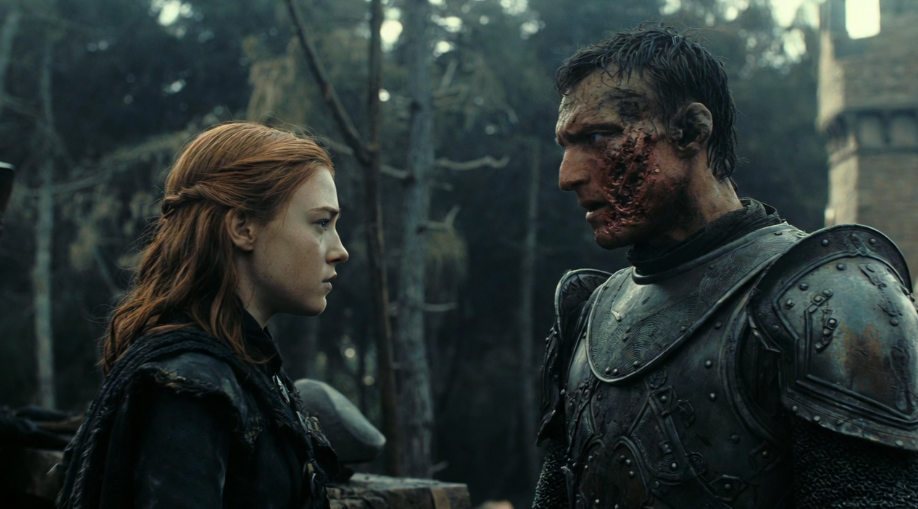
Imagine a seven-foot-tall, battle-scarred killer who burns with hatred for his monstrous brother and disgust for the world he serves. Now picture an eleven-year-old girl, sharp as Valyrian steel, who has just watched her father’s head roll and is already writing names on a kill list in her mind. What happens when these two violently different people are forced to travel together across a war-torn continent?
The answer is one of the most emotionally complex, quietly profound, and unexpectedly moving relationships in the entire Game of Thrones series.
The Hound and Arya didn’t start as friends. They didn’t even start as allies. They began as captor and captive, predator and prey, Lannister dog and Stark wolf cub. Yet over the course of several seasons, their forced companionship transformed into something far deeper: a bond built on brutal honesty, dark humor, reluctant protection, mutual survival, and — eventually — genuine care.
Fans across the world continue to call the Hound and Arya the show’s best relationship for good reason. No romance, no political alliance, no grand destiny — just two deeply damaged people slowly learning to see humanity in each other in a world that punishes any display of it.
In this in-depth analysis, we’ll trace every major stage of their journey, examine the key scenes that defined their bond, explore the themes they embody, compare the books and show, and explain why — even years after the finale — this unlikely duo remains one of the most beloved and rewatchable dynamics in television history.
Who Are The Hound and Arya? Background and First Impressions
To understand why the Hound and Arya became so special, we must first understand who they were when they met.
Sandor Clegane – The Hound: A Feared Lannister Enforcer with a Hidden Heart
Sandor Clegane was never meant to be noble. Born into a lesser branch of an infamous house, he was disfigured as a child when his older brother Gregor — later known as the Mountain — held his face in a brazier as punishment for playing with one of Gregor’s toys.
The trauma left Sandor with horrific burn scars across the left side of his face and a lifelong, almost pathological terror of fire. He grew into a massive, brutally effective warrior who served House Lannister not out of loyalty, but because it gave him purpose, gold, and the opportunity to channel his rage.
Sandor was cynical, coarse, and unflinchingly honest. He despised knights, mocked honor, and openly called King Joffrey a “vicious idiot boy.” Yet beneath the snarling exterior lay flickers of something else — a buried sense of justice, disgust at needless cruelty, and a strange, almost childlike vulnerability that only a few people ever glimpsed.
Arya Stark: The Defiant Young Wolf
Arya Stark was never going to be the kind of lady her mother wanted. She preferred swordplay to needlework, riding astride instead of sidesaddle, and dreaming of adventure instead of marriage alliances. Her father Ned gave her a small sword called Needle — a gift that would define her life.
When King Robert’s visit to Winterfell turned into Ned’s arrest and eventual execution, Arya’s world collapsed. She watched her father die. She saw her friend Mycah butchered by the Hound on Joffrey’s orders. She fled King’s Landing disguised as a boy, and began compiling her famous list — a litany of names she intended to kill.
The Hound was on that list from the beginning.
The Spark of Conflict – Their First Encounters (Season 2)
Their first real interaction is pure venom.
After Ned’s execution, Arya is captured during her escape from King’s Landing. The Hound, still serving the Lannisters, recognizes her almost immediately and takes her prisoner — not out of cruelty, but because he sees the ransom potential.
From Arya’s perspective, the Hound is the living symbol of everything she hates: Lannister brutality, the murder of Mycah, the destruction of her family. She spends much of early Season 2 glaring at him, plotting escape, and waiting for any chance to drive a blade into his heart.
The Hound, for his part, treats her like an annoying cargo — rude, dismissive, and occasionally threatening. Yet even in these early moments, small cracks appear.
He doesn’t rape her. He doesn’t abandon her to die. He feeds her. He protects her from other soldiers. And when she tries to escape, he drags her back — not gently, but not with unnecessary violence either.
The stage was set for one of television’s most unlikely road-trip partnerships.
The Evolution of Their Relationship: From Enemies to Road Companions
Captor and Captive – The Early Days (Seasons 2–3)
The relationship begins in pure antagonism.
The Hound intends to ransom Arya to her family — or to whoever will pay the most. Arya intends to kill him the moment she gets the chance.
They travel through the war-torn Riverlands, witnessing horrors that affect both of them differently:
- Arya sees villages burned and innocents slaughtered — fuel for her growing rage and her list.
- The Hound sees the same scenes and mostly shrugs — “this is what war looks like.” Yet he quietly prevents her from being gang-raped by soldiers, and he shares food even when she spits insults at him.
The turning point comes slowly, through necessity.
They are both outsiders. Both survivors. Both carrying trauma that no one else fully understands.
The Road Trip That Changed Everything – Key Seasons 3–4 Moments
This is where the Hound and Arya truly become one of the show’s defining duos.
Iconic Scenes and Dark Humor
- The chicken scene (“You’re the worst sheep-shagger in the Seven Kingdoms”) — a masterclass in gallows humor and reluctant camaraderie.
- The repeated “what the fuck’s a Lommy?” exchange after Arya tells him about her friend’s death — showing how the Hound slowly starts listening to her.
- The tavern scene at the crossroads inn with Polliver and his men — one of the most satisfying moments in the entire series. The Hound’s calm “I understand the sword” speech, followed by the brutal fight, and Arya’s cold “nothing” after killing Polliver — the moment she crosses a name off her list in front of the man who once stood on the opposite side of her worldview.
Mentorship and Tough Love
The Hound teaches Arya harsh lessons:
- Mercy is a luxury most people can’t afford.
- The world isn’t divided into good men and bad men — it’s divided into living men and dead men.
- Kill quickly or be killed slowly.
Arya, in turn, begins to chip away at the Hound’s armor:
- She refuses to let him wallow in self-pity.
- She calls out his cowardice when he abandons her at the Bloody Gate.
- She forces him to confront his fear of fire during the Battle of the Blackwater (though indirectly).
They argue constantly. They insult each other. They save each other’s lives — often without thanks.
And somewhere along the way, they start to understand each other in ways no one else can.
Mutual Growth – How They Changed Each Other
Arya learns that killing isn’t always clean or satisfying. The Hound learns that someone can look at his ruined face and not flinch — and that someone can see past his rage to the man underneath.
The Turning Point: Mercy, Abandonment, and Unfinished Business
The Fight with Brienne and Arya’s Choice (Season 4)
Everything changes in one of the most emotionally wrenching sequences of the entire series.
After the brutal Red Wedding, Arya and the Hound continue their journey north, aiming to ransom her to the last living family she has left — her aunt Lysa at the Eyrie. When they finally reach the Bloody Gate, they are too late: Lysa is dead, murdered by Littlefinger.
Exhausted, wounded, and out of options, the Hound tries to sell Arya to the Brotherhood Without Banners — only to be attacked by Brienne of Tarth, who has been searching for Sansa and now recognizes Arya.
The fight that follows is savage. The Hound, already weakened by a festering wound, battles Brienne in a desperate, ugly struggle. He loses. Brienne leaves him bleeding out on the rocks, calling for Arya to come with her to safety.
Arya refuses.
Instead, she climbs down to the dying Hound. He begs her to kill him — to give him the mercy stroke and end his suffering. He even offers her the money he was going to ransom her for. He calls her “little sister.” He admits, in his broken way, that she’s the closest thing he has to family.
Arya looks at him for a long moment.
Then she walks away.
She doesn’t kill him. She doesn’t save him. She simply leaves him to die alone.
This scene has sparked endless debate among fans:
- Was it mercy? (By refusing to kill him, she denied him the quick death he craved — arguably the cruelest thing she could do.)
- Was it revenge? (He killed Mycah. He served the Lannisters. He was on her list.)
- Was it conflicted love? (She couldn’t bring herself to end the only person who had consistently protected her, even if in his own brutal way.)
The truth is probably a painful mixture of all three.
Arya had learned from the Hound himself that the world doesn’t reward mercy. Yet she also couldn’t cross the final line with the one person who had become, against all odds, more than just an enemy.
The Hound’s scream of rage and despair as she disappears into the mist is one of the most haunting sounds in the series.

Reunion and Redemption Arc (Seasons 7–8)
Years pass. Both survive against every expectation.
The Hound finds a new purpose with the Brotherhood Without Banners and later joins Jon Snow’s fight against the dead. Arya becomes a faceless assassin and then returns home to Winterfell.
When they finally meet again in Season 7, the reunion is quiet but loaded.
Arya walks past the Hound in the Winterfell courtyard. He calls after her.
“Thought you’d have killed me by now.”
She stops. Turns. Looks at him — really looks — and says, simply:
“You were on my list.”
A beat.
“But I took you off.”
It’s one of the most understated, powerful moments in the entire show.
Later, in Season 8, during the lead-up to the Battle of Winterfell, the Hound tries one final time to protect her. When Arya insists on going to King’s Landing to kill Cersei, he stops her at the gates of the Red Keep. He tells her the city is burning, the dragon is loose, and she will die if she goes in.
He says the words that sum up their entire relationship:
“You’re not like me. You’re better than me.”
Arya looks at him — this time with something close to affection — and says:
“Thank you… Sandor.”
She uses his real name for the first time.
Then she walks away, heading north instead of south — choosing life over vengeance, a lesson the Hound himself had unknowingly taught her.
He watches her go, and for the first time in the series, Sandor Clegane looks almost at peace.

Why The Hound and Arya Are the Best Duo in Game of Thrones
Unconventional Dynamics That Make Them Stand Out
No other pairing in Game of Thrones feels quite like the Hound and Arya.
- They have the banter and chemistry of a classic buddy-cop movie — except the cop is a seven-foot killer and the buddy is a teenage assassin.
- Their relationship is completely platonic. There is zero romantic tension — something rare in a show filled with star-crossed lovers and political marriages.
- They are both outsiders: a disfigured man shunned by society, and a girl who refuses every traditional role expected of her.
- Their humor is dark, crude, and brutally honest — a perfect antidote to the show’s heavier moments.
They insult each other constantly. They save each other constantly. They never say “I care about you” — but their actions scream it.
Lessons and Themes They Embody
Their arc is one of the clearest illustrations of George R.R. Martin’s central themes:
- Survival in a cruel world — neither trusts easily, yet they survive by relying on each other.
- The blurred line between vengeance and mercy — Arya’s kill list shrinks as she grows; the Hound moves from mindless violence to something closer to justice.
- Finding humanity in unexpected places — two of the most violent characters in the show slowly rediscover their own capacity for care.
- Redemption through connection — the Hound dies fighting his brother (and his past), but he dies having protected someone he genuinely loved. Arya chooses life, carrying the lessons he taught her.
Fan-Favorite Quotes That Prove Their Bond
Here are some of the most quoted lines that fans still share years later:
- “Safety is a mummer’s show. The only safety is in the grave.” — The Hound
- “You’re the worst sheep-shagger in the Seven Kingdoms.” — Arya
- “What the fuck’s a Lommy?” — The Hound (repeated endlessly)
- “I understand the sword. I’ve been carrying one since I was your age.” — The Hound to Polliver
- “You’re not like me. You’re better than me.” — The Hound
- “Thank you… Sandor.” — Arya
These exchanges are raw, funny, heartbreaking — and completely unforgettable.

Book vs. Show Differences
In George R.R. Martin’s A Song of Ice and Fire, the Hound and Arya’s relationship is shorter and less emotionally intimate.
- Arya is captured and travels with the Hound for a briefer period.
- There is no extended road-trip banter.
- The “mercy” scene never happens — the Hound disappears after the Red Wedding, presumed dead until later books reveal he may have survived as the gravedigger on the Quiet Isle.
- The emotional payoff of their reunion and farewell is entirely a show invention.
The television adaptation amplified their chemistry, gave them more screen time, and turned a compelling side story into one of the emotional pillars of the series.
Lasting Impact and Fan Legacy
Why Fans Still Call Them the Show’s Best Relationship
Even years after Game of Thrones ended in 2019, the Hound and Arya remain one of the most frequently discussed and celebrated dynamics in the fandom.
On platforms like Reddit (especially r/gameofthrones and r/asoiaf), Twitter/X, Tumblr, and TikTok, fans regularly post threads, video edits, and memes with captions like:
- “The Hound and Arya are still the best duo in television history”
- “No couple, no romance — just two traumatized people who actually made each other better”
- “The real love story of Game of Thrones was the Hound and Arya all along”
What keeps this pairing so alive is how rare and authentic it feels in a show filled with betrayals, political marriages, and doomed romances.
They never needed to kiss, declare love, or share a grand tragic moment to prove their bond. Their connection was built in the quiet, ugly, everyday moments of survival — sharing a campfire, arguing over directions, saving each other from death without fanfare.
That realism resonates deeply with viewers who are tired of idealized relationships.
Expert Insights and Analysis
From a storytelling perspective, the Hound and Arya serve as a perfect microcosm of George R.R. Martin’s worldview:
- Symbolism: The Hound (a scarred, fire-fearing dog of war) and Arya (a wolf cub who becomes a faceless killer) represent two different paths of survival. One clings to rage and cynicism; the other embraces adaptability and vengeance. Yet both eventually choose something better.
- Deconstruction of knighthood and honor: The Hound mocks knighthood while quietly behaving more honorably than most “true” knights. Arya rejects lady-like behavior but develops her own code of justice.
- Mercy vs. vengeance: Their arc is one long meditation on whether killing someone who has wronged you brings peace. Arya ultimately chooses life over endless revenge — a lesson the Hound himself helped teach, even if he never fully learned it.
Showrunners David Benioff and D.B. Weiss have said in interviews that they deliberately expanded the Hound–Arya road trip because the chemistry between Rory McCann and Maisie Williams was electric from the first table read. They recognized early on that this pairing had the potential to carry real emotional weight.
Critics and academics have also written about their relationship as a rare example of platonic “found family” in prestige television — a bond forged not by blood or romance, but by shared trauma and mutual recognition.
Conclusion
The Hound and Arya began as enemies. They became reluctant travel companions. They grew into something far more profound: two people who, in a world designed to strip away humanity, managed to preserve a small, jagged piece of it for each other.
Their story is not about love in the traditional sense. It’s about recognition. About seeing someone else’s scars and not turning away. About protecting someone even when you can barely protect yourself.
In a series remembered for shocking deaths, political intrigue, and dragons, one of the quietest, most human moments remains the last time Arya looked back at Sandor Clegane and said his name — not as a monster, not as a captor, but as a person.
“Thank you… Sandor.”
In those two words, everything they had been through was acknowledged.
And in the years since the show ended, fans continue to return to those scenes — not just for nostalgia, but because they remind us that even in the darkest stories, connection is possible.
If you haven’t rewatched their episodes in a while, do it. The journey from hatred to respect holds up better than almost any other arc in Game of Thrones.
What’s your favorite Hound and Arya moment? Drop it in the comments below — we’d love to hear which scene still hits you the hardest.
Frequently Asked Questions About The Hound and Arya
Did Arya and the Hound have romantic feelings? No. Their relationship is strictly platonic — a mentor/protégé, older brother/younger sister, or damaged-soul-to-damaged-soul dynamic. The show deliberately avoided any romantic framing, and both actors and writers have confirmed this.
Why didn’t Arya kill the Hound when he begged her to? The most common interpretations are:
- She refused to give him the mercy he wanted — a final act of cruelty after everything he’d done.
- She couldn’t bring herself to kill the only person who had consistently protected her.
- By that point, he was no longer on her list in the same way — she had outgrown simple vengeance.
What happened to the Hound after Arya left him? In the show, he survives, recovers, and eventually joins the fight against the White Walkers. He dies in Season 8 during his final confrontation with his brother, the Mountain.
Are there big differences between the books and the show? Yes — in the books, their time together is shorter, there’s no Bloody Gate mercy scene, and the Hound disappears after the Red Wedding (with strong hints he survives as the gravedigger on the Quiet Isle). The show expanded and deepened their emotional arc significantly.
Best Episodes to Rewatch Their Dynamic
Here are the episodes that showcase the Hound and Arya at their best:
- Season 2, Episode 3 – “What Is Dead May Never Die” — First real interactions
- Season 3, Episode 5 – “Kissed by Fire” — Chicken scene and campfire talks
- Season 4, Episode 7 – “Mockingbird” → Episode 10 – “The Children” — The tavern massacre and the mercy scene
- Season 7, Episode 7 – “The Dragon and the Wolf” — Reunion at Winterfell
- Season 8, Episode 5 – “The Bells” — Final farewell
These five episodes contain the emotional core of their relationship.


