
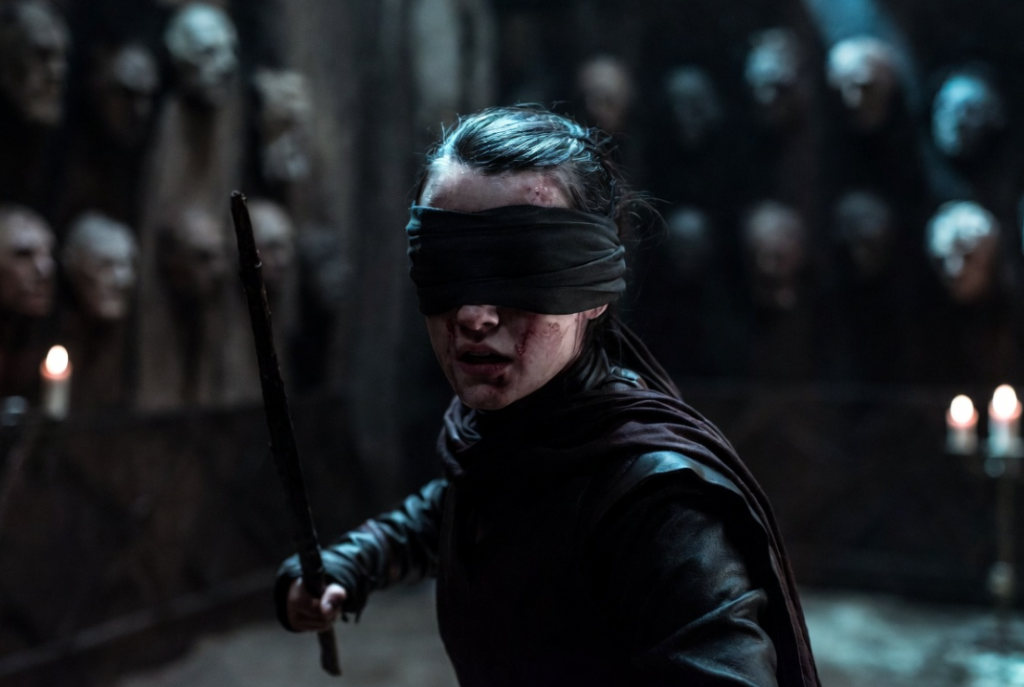
In the chilling final moments of Game of Thrones Season 5, Episode 10 “Mother’s Mercy,” Arya Stark’s world went black. One moment she was standing in the House of Black and White, the next she was screaming in total darkness while the screen faded to credits. Fans everywhere paused, rewound, and immediately started searching: why did Arya go blind?
It wasn’t a dream sequence, a hallucination, or a cheap cliffhanger. Arya’s blindness was a deliberate, rule-bound consequence of the Faceless Men’s ancient training methods, her refusal to fully surrender her identity as Arya Stark of Winterfell, and a calculated step in turning a vengeful girl into the ultimate assassin. In this definitive guide, we break down the exact canon reason, the multi-layered motivations behind it, the full context from both the HBO series and George R.R. Martin’s books, behind-the-scenes insights, symbolic meaning, and how this pivotal moment shaped Arya’s entire arc through the final seasons.
Whether you’re rewatching the Braavos storyline, preparing for a re-read of A Feast for Crows, or simply trying to understand one of the show’s most memorable “what just happened?” moments, this article delivers the complete, spoiler-aware explanation you’ve been looking for—backed by episode transcripts, actor interviews, and direct comparisons to the source material. No filler. No speculation without evidence. Just the real reason, explained by someone who has analyzed every frame of Arya’s journey since the series premiered in 2011.
Spoiler Warning This article discusses major plot points from Seasons 5 and 6 of Game of Thrones, as well as relevant chapters from A Feast for Crows. Proceed only if you’re caught up or don’t mind knowing what happens next.
Arya Stark’s Path to Braavos — Why She Sought the Faceless Men
From Winterfell Outlaw to Braavosi Refugee
Arya’s road to the House of Black and White began the moment her father, Ned Stark, was executed in King’s Landing. From that point forward, the youngest Stark daughter became a survivor in a world that wanted her dead. She escaped with Yoren’s recruits, trained under Syrio Forel’s “dance” philosophy, endured the horrors of Harrenhal under Tywin Lannister, and eventually crossed paths with Jaqen H’ghar—the enigmatic assassin who owed her three deaths and later gave her a mysterious iron coin inscribed with “Valar Morghulis.”
By the end of Season 4, Arya had lost almost everyone she loved. The Red Wedding, the deaths of Robb and Catelyn, the betrayal at the Twins, and her narrow escape from the Brotherhood Without Banners left her with only one goal: revenge. The iron coin was her ticket out of Westeros. When she finally reached Braavos in Season 5, Episode 2 (“The House of Black and White”), she was no longer the playful little girl from Winterfell. She was a hardened killer carrying a list of names and a burning need to become someone else.
Arrival at the House of Black and White
The temple itself is one of the most visually striking locations in the entire series—a cavernous, candle-lit sanctuary dedicated to the Many-Faced God, where death is treated as a sacred gift rather than a tragedy. Arya’s first interactions with the Kindly Man (the priest who becomes her primary teacher) and the mysterious Waif established the ground rules immediately: serve the god, ask no questions, and above all, become “No One.”
She was given menial tasks—washing corpses, scrubbing floors, learning the Braavosi language—and slowly introduced to the Hall of Faces, the room where the Faceless Men store the visages of those who came to die. It was here that Arya first learned the power of the faces: by wearing them, a Faceless Man could become anyone and deliver the “gift” of death without personal attachment.

Early Training and the Price of Becoming “No One”
Before the blindness incident, Arya had already begun the painful process of shedding her identity. She surrendered her sword Needle (temporarily), memorized the names on her kill list, and started drinking the strange potions that allowed her to see through the eyes of others via the faces. Yet something always held her back. Deep down, she remained Arya Stark. That internal conflict would prove fatal to her early training—and directly led to her loss of sight.
Understanding the Faceless Men and the Many-Faced God
Core Philosophy — “Valar Morghulis” and the Gift of Death
The Faceless Men are not a simple assassin’s guild. They are a religious order that worships the Many-Faced God, an entity that encompasses every god of death across cultures (the Stranger in the Faith of the Seven, the Drowned God, the Lord of Light’s Great Other, etc.). Their creed, “Valar Morghulis” (“All men must die”) and its response “Valar Dohaeris” (“All men must serve”), is more than a greeting—it’s a statement of purpose. Death is a mercy, and the Faceless Men are its humble servants.
Jaqen H’ghar explains this to Arya multiple times: the faces they wear belong to no one. The assassin is merely the instrument. Personal grudges, revenge, or attachment to one’s former self have no place in the order. This philosophy is why the Faceless Men charge exorbitant fees and only kill those who have been “marked” for death by the god.
The Faces, the Poison, and the Rules of the House
The Hall of Faces is not a costume closet. Each face is preserved from a person who willingly gave their life to the temple. Wearing one requires a ritual involving a special potion that temporarily grants the wearer the memories, voice, and appearance of the deceased. But the potion is toxic to anyone who has not fully committed to becoming “No One.” Unauthorized use triggers a violent reaction—exactly what happened to Arya.
In the Season 5 finale, after Arya defies orders and uses a face for her own revenge, Jaqen explicitly states the rule: “The faces are for no one… You are still someone… and to someone, the faces are as good as poison.” That single line is the canon key to understanding why did Arya go blind.

Book vs. Show Differences (For Die-Hard Fans)
George R.R. Martin’s books handle the training slightly differently. In A Feast for Crows, Arya (under the name “Cat of the Canals”) spends more time living in Braavos, learning to lie, observing people, and gradually being given the “gift” of blindness through a different ritual involving the milk of the poppy and a deliberate, phased training process. The show condensed this timeline for pacing reasons, turning the blindness into a sudden, potion-induced punishment in Episode 10. Both versions serve the same narrative purpose—forcing Arya to rely on her other senses—but the show made the consequence more visually dramatic and immediate.
Showrunners David Benioff and D.B. Weiss have confirmed in interviews that they wanted viewers to feel the same disorientation Arya experienced, which is why the screen literally goes black with her.
The Exact Moment Arya Went Blind — Season 5, Episode 10 Breakdown
The Mission That Went Wrong
Arya’s first official assignment was straightforward: kill an insurance salesman named the Thin Man who was poisoning the crew of a ship. Instead, she spotted Meryn Trant—the Kingsguard knight who had murdered her sword instructor Syrio Forel and was on her personal kill list. Consumed by revenge, Arya abandoned her mission, followed Trant to a brothel, and used one of the stolen faces to infiltrate and kill him in a brutal, eye-stabbing sequence that echoed her own trauma.
This was the ultimate breach of protocol: she used the gift of the Faceless Men for personal vengeance rather than serving the Many-Faced God.
Jaqen’s Confrontation and the Fatal Lesson
Back at the temple, Jaqen is waiting. The confrontation is one of the most tense scenes in the entire Braavos arc. He forces Arya to admit her disobedience, then makes her remove the face she wore. What follows is the pivotal explanation:
“A girl is not ready to become no one. A girl still has a name. A girl is still someone. The faces are for no one.”
He then hands her a vial of poison and orders her to drink. As the potion takes effect, Arya’s vision blurs, colors drain away, and she collapses in panic. The camera cuts to black from her point of view, perfectly mirroring her internal state.
The Potion and Immediate Aftermath
The blindness is not metaphorical—it is total and immediate. Arya wakes up the next morning (Season 6, Episode 1) still sightless, forced to beg on the streets of Braavos and endure daily beatings from the Waif. Jaqen’s apparent suicide by the same poison is later revealed to be another teaching tool; the man who “died” was wearing a different face, proving once again that identity is fluid and death is never final in the House of Black and White.
The Real Reason Arya Lost Her Sight — Punishment, Training, or Both?
The question at the heart of every fan discussion is simple: why did Arya go blind? Was it pure punishment for disobedience, or was it a necessary part of her training? The truthful answer, backed by canon dialogue and later events, is that it was both.
Punishment for Defiance
Arya broke three fundamental rules of the Faceless Men in rapid succession:
- She accepted a mission from the temple but abandoned it to pursue personal revenge.
- She stole and wore a face without permission, using the sacred tools of the order for her own kill list instead of the god’s will.
- She continued to hold onto her identity as Arya Stark, refusing to truly become “No One.”
Jaqen’s words in the Season 5 finale make this explicit. The faces are not toys or weapons for personal grudges. When an untrained person wears them while still being “someone,” the magical or alchemical properties of the disguise act as poison. The blindness was the direct physiological consequence of that violation. It was the price of defiance, designed to be severe enough to break her attachment to her old self.
Many viewers initially interpreted the scene as simple retaliation, but a closer reading shows the Faceless Men rarely act out of anger. Their methods are cold, calculated, and always in service of their philosophy. The punishment fit the crime perfectly: Arya wanted to see her enemies die with her own eyes, so the consequence stripped her of sight entirely.
Strategic Training Step to Forge “No One”
Beyond punishment, the blindness served a deeper pedagogical purpose. The Faceless Men do not train assassins through conventional combat drills alone. They strip away every crutch a person relies upon.
Sight is the dominant human sense. By removing it, the order forced Arya to develop her remaining senses—especially hearing, touch, smell, and spatial awareness—to superhuman levels. This is exactly what we see in Season 6. The blind Arya learns to fight in total darkness, anticipate attacks before they land, and navigate the chaotic streets of Braavos using only sound and memory.
In later episodes, the Waif’s brutal stick-fighting lessons are not random torture. They are the practical application of the blindness training. Arya must learn to “see” without eyes, to move like water (echoing Syrio Forel’s earlier teachings), and to kill without hesitation or personal emotion. The temporary loss of vision was the crucible that accelerated this transformation.
Jaqen himself confirms the dual nature when Arya eventually earns her sight back: the blindness was both consequence and classroom. It tested whether she could survive as “No One” while still secretly remaining Arya Stark.
Symbolism and Character Growth
Thematically, Arya’s blindness is one of the richest symbolic moments in the entire series. Loss of sight represents the shedding of ego and the illusions of identity. Just as the Faceless Men wear the faces of the dead, Arya had to “die” in a metaphorical sense—losing the ability to see the world through the eyes of Arya Stark—before she could be reborn stronger.
This arc parallels other major characters’ journeys through darkness:
- Bran Stark loses the use of his legs but gains the gift of greensight and warging.
- Theon Greyjoy loses his name and identity (“Reek”) before reclaiming a version of himself.
- Even Sandor Clegane’s “death” and resurrection carry similar rebirth symbolism.
For Arya, blindness became the turning point where her childhood desire for revenge evolved into something colder and more professional. She stopped being a list-driven avenger and started becoming a true instrument of death—skills she would later use with devastating effect upon returning to Westeros.
Life as a Blind Assassin — Arya’s Brutal Season 6 Training
Daily Struggles and Street Survival
Season 6 opens with Arya completely blind and cast out of the temple. She is forced to beg on the streets of Braavos, relying on the kindness (or cruelty) of strangers. The Kindly Man occasionally appears to offer her a chance to return if she fully renounces her identity, but Arya stubbornly clings to her name.
These street scenes are among the most grounded and painful in the show. Without sight, everyday tasks become life-threatening. Crossing crowded markets, avoiding pickpockets, and finding food turn into daily ordeals. The sequence brilliantly illustrates how far Arya has fallen from the privileged Stark daughter and how much she must endure to rise again.
Iconic Stick-Fighting Sequences
The heart of the blind training arc consists of the repeated stick-fighting duels with the Waif. These scenes are masterfully choreographed, shot in dim lighting that emphasizes Arya’s growing reliance on sound. Each beating teaches her something new:
- Episode 1: She is repeatedly knocked down, disoriented and frustrated.
- Episode 2–3: She begins to anticipate strikes, blocking and countering with increasing precision.
- The final duel before regaining her sight shows a transformed Arya who fights with confidence and fluidity.
These sequences pay off Syrio Forel’s “what do we say to the God of Death?” lessons in a visceral way. Arya is no longer fighting with rage—she is dancing with death.
Behind-the-Scenes Insights from Maisie Williams
Maisie Williams has spoken extensively about the physical and emotional demands of filming the blindness storyline. She wore opaque white contact lenses for weeks, which caused real discomfort and limited her actual vision on set. Directors used audio cues and precise choreography so Williams could perform the fights while genuinely unable to see clearly.
In interviews (including with Entertainment Weekly and HBO’s official behind-the-scenes features), Williams revealed that the experience made her performance more authentic. The frustration and determination viewers saw were often real. She described the stick fights as some of the most exhausting sequences she ever filmed, requiring months of stunt training. Her commitment helped make the arc feel raw and believable, elevating Arya from a fan-favorite character to one of the show’s most compelling survivors.
How (and When) Arya Regained Her Sight
The Tests That Proved Her Worth
Arya’s sight is restored in Season 6, Episode 3 (“Oathbreaker”) after she passes a critical test. Following another brutal beating by the Waif, she is brought back to the House of Black and White. The Kindly Man offers her water from the sacred pool—the same pool used for granting the “gift” of death and, in this case, life and vision.
The restoration is not a reward for obedience but proof that she has internalized the lessons. She has learned to function without sight, to separate her personal desires from the act of killing, and to walk the razor’s edge between being Arya Stark and becoming “No One.”

The Bigger Picture — Why the Faceless Men Ultimately Let Her Go
Jaqen’s final conversation with Arya is telling. He acknowledges that she has learned what she came for, yet she can never fully become “No One” because her identity as a Stark is too strong. Instead of killing her for failing the final test (as the Waif demands), he allows her to leave with her life and her Needle.
This decision reveals the pragmatic side of the Faceless Men: they recognize when a pupil has reached the limit of what their order can teach. Arya takes the skills—stealth, face-changing (later used sparingly), heightened senses, and emotional detachment—and applies them to her own goals in Westeros.
Lasting Impact on Arya’s Character Arc and the Series
How Blindness Shaped Her Future Kills and Identity
The Braavos training, especially the blindness period, directly influenced Arya’s later actions. Her ability to move silently, strike without hesitation, and read people through non-visual cues made her one of the most dangerous characters in the final seasons. The confrontation with the Waif in Season 6, Episode 8 is a direct callback: Arya uses everything she learned while blind to turn the tables in total darkness.
Even her decision to abandon the Faceless Men and return home shows growth. She chooses her family and her Stark identity over becoming a nameless killer—yet she keeps the valuable tools the order gave her.
Fan Theories and Common Misconceptions Debunked
Several popular theories have circulated since the episode aired:
- Theory: Arya went blind simply because she stabbed Meryn Trant in the eyes (eye-for-an-eye punishment). Reality: The show never suggests this. The canon reason is the unauthorized use of the face combined with still being “someone.” The eye-stabbing was poetic justice for Syrio, but not the cause of her blindness.
- Theory: The blindness was permanent until the end of the series. Reality: It was temporary, lasting only the early episodes of Season 6, and served as training rather than lifelong punishment.
- Theory (Book readers): The show ruined the subtlety of the books. Reality: While the books spread the training over more chapters, the core lesson—losing sight to gain other strengths—remains identical in purpose.
The clearest evidence remains Jaqen’s direct explanation in the temple.
Why This Plot Point Still Resonates with Fans
More than a decade later, Arya’s blindness remains one of the most discussed moments in Game of Thrones. It represents a rare instance where the show slowed down to focus on character development through suffering and growth. In an era of fast-paced spectacle, the quiet, painful episodes of a blind girl learning to fight in the dark delivered some of the series’ most memorable television.
Expert Tips for Fans Rewatching the Braavos Arc
To get the most out of Arya’s training storyline on rewatch:
- Pay close attention to sound design in Season 6 episodes 1–3. The absence of visual cues makes every footstep and breath intentional.
- Notice how Arya’s posture and movement change after blindness—she becomes more cat-like and economical, echoing Syrio’s teachings.
- Compare Jaqen’s calm demeanor with the Waif’s aggression; both serve the same god but teach different lessons.
- Look for subtle foreshadowing: Arya’s use of the coin, the first time she wears a face, and her refusal to throw away Needle all hint she will never fully become “No One.”
- Recommended viewing order for maximum impact: Watch Season 5 Episode 10, then immediately continue into Season 6 without long breaks to feel the continuity of her struggle.
FAQs
Is Arya’s blindness permanent in the show? No. It lasts for the first few episodes of Season 6 and is fully reversed once she completes the training phase.
Why did Jaqen drink poison in front of her? It was a demonstration, not actual suicide. The man who appeared to die was wearing another face. This reinforced that identity and death are illusions within the House of Black and White.
How does the show’s version differ from the books? The books use a slower, more psychological approach with the “milk of the poppy” and extended street life as Cat of the Canals. The show made the blindness more sudden and visually dramatic for television pacing.
Did Maisie Williams actually go blind during filming? Not literally, but she wore special opaque contact lenses that severely limited her vision, creating genuine discomfort that translated into her performance.
What would have happened if Arya had fully become “No One”? She likely would have remained with the Faceless Men as a full member of the order, losing her Stark identity forever. Her inability to do so is what allowed her to eventually leave and reclaim her name.
Was the blindness only because she killed Meryn Trant? No. The killing itself was secondary. The real violation was using the Faceless Men’s sacred faces for personal revenge while still clinging to her own identity.
Can Arya still change faces after leaving Braavos? She retains the ability and uses it once more in Season 6 (as a servant girl to lure the Waif), but largely abandons the practice afterward, choosing to fight as herself.
Conclusion
Arya Stark went blind in Game of Thrones because she defied the core rules of the Faceless Men while still holding onto her identity as “someone.” The potion she drank reacted violently to her incomplete transformation, serving as both punishment for disobedience and a rigorous training exercise to sharpen her other senses and detach her from ego.
What could have been a permanent tragedy became one of her greatest strengths. The girl who entered the House of Black and White seeking revenge emerged as a sharper, more dangerous version of herself—still Arya Stark, but armed with the deadly skills of the Many-Faced God’s servants.
This arc remains a masterclass in character development through suffering. It showed that true growth often requires losing something essential first. For fans, it reinforced why Arya became one of the most beloved characters in the series: she endured unimaginable pain, adapted, and ultimately chose her own path.
If you’ve just rewatched the Braavos episodes and still have questions, or if this moment sparked new appreciation for Arya’s journey, drop your thoughts in the comments below. What was your reaction when the screen went black in Season 5? Which part of her training hit hardest?
For more deep dives into the Stark siblings, Faceless Men lore, or the best Braavos episodes ranked, explore the rest of our Game of Thrones TV series archive. Subscribe for future breakdowns as we continue revisiting the series that defined a generation.


