Deep in the frozen wastes of the Haunted Forest, beyond the reach of the Night’s Watch and the warmth of civilization, lies a landmark that defines the metaphysical destiny of Westeros. For seasons, fans watched Bran Stark’s grueling trek through the snow, guided only by cryptic dreams and the pull of a destiny he didn’t fully understand. Finding this location wasn’t just a plot point; it was the ultimate mystery of the North. To understand his journey, one must study the bran three eyed raven tree map, a geographic and magical blueprint that pinpoints the Great Weirwood where the old world of the Children of the Forest meets the new world of men.
In this comprehensive guide, we will traverse the treacherous terrain beyond the Wall to map the exact location of the Cave of the Three-Eyed Raven. Whether you are a casual viewer of the Game of Thrones TV series or a dedicated scholar of George R.R. Martin’s A Song of Ice and Fire, this skyscraper-level analysis provides the clarity, cartography, and lore-heavy expertise you’ve been seeking.
1. The Heart of the True North: Why This Location Matters
The “Land of Always Winter” is often portrayed as a vast, undifferentiated expanse of white. However, the geography of the North is precise. The Cave of the Three-Eyed Raven is the spiritual “Hard Drive” of the continent. It is here that the Weirwood network—a biological and magical internet—reaches its most potent concentration.
The primary problem for fans and theorists has always been the lack of a standardized map in the show. While we see the journey, the spatial relationship between the Wall, the Fist of the First Men, and the Cave is often obscured by the fog of winter. This guide solves that problem by triangulating the journey and providing a structural “map” of the cave itself.
2. The Path to the Greenseer: Tracing Bran’s Journey
To map the Cave, we must first map the journey. Bran Stark’s odyssey is one of the longest in the series, both in terms of physical distance and time.
The Trek Beyond the Wall
After escaping the Fall of Winterfell and passing through the Black Gate at the Nightfort, Bran, Hodor, Meera, and Jojen Reed entered the “True North.” This region is largely uncharted by the maesters of the Citadel, but several key waypoints help us establish our bran three eyed raven tree map.
-
The Fist of the First Men: Located deep in the Haunted Forest, this ancient ringfort serves as our primary southern anchor. The Cave lies significantly north and slightly east of this position.
-
Craster’s Keep: A dark waypoint that the group had to skirt carefully. In the show, the mutiny at Craster’s Keep created a detour that nearly ended Bran’s journey, but it confirmed that the Cave is within a few hundred miles of the Wall—a distance that is massive for a group traveling on foot and sled.
-
The Haunted Forest: The final stretch of the journey takes place in the densest part of the forest, where the trees begin to thin out into the rocky, mountainous terrain that hides the Cave’s entrance.

The Geography of the Final Ascent
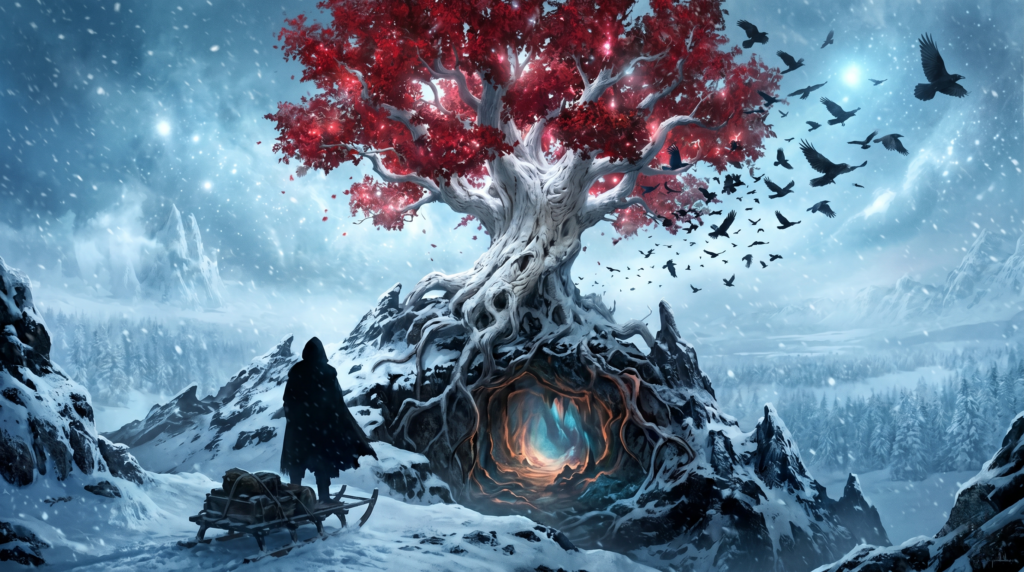
As the group approached the location, the terrain shifted from flat forest to a prominent, snow-covered hill. In the show’s visual language, this hill stands alone, dominated by a single, massive Weirwood tree with bone-white bark and blood-red leaves. This is the visual “X” on our map.
3. The Definitive Bran Three-Eyed Raven Tree Map: A Geographic Breakdown
When we talk about a “tree map” for the Three-Eyed Raven, we are looking at two distinct layers: the physical location in the North and the internal “layout” of the cave system.
Topography of the Weirwood Hill
The Cave is located beneath a Great Weirwood. Geographically, it is nestled in the foothills of the Frostfangs, the mountain range that dominates the North.
-
Latitude: It is far enough north that the sun rarely provides warmth, yet south of the “Land of Always Winter” where the Night King’s permanent fortress lies.
-
Elevation: The tree sits atop a hill, providing a 360-degree view of the surrounding valley. This elevation was crucial for the “The Door” sequence, allowing the characters to see the army of the dead approaching from miles away.
Mapping the Cave’s Interior
The cave isn’t just a room; it is an sprawling subterranean network. Based on both the show’s production design and book descriptions, we can map the interior as follows:
-
The Ward Gate: The entrance is protected by ancient magic (the wards) that prevents Wights and White Walkers from entering—until Bran is marked by the Night King.
-
The Tunnel of Bones: A narrow, claustrophobic passage filled with the remains of animals and, presumably, humans who didn’t survive the journey.
-
The Roots of the World: The central chamber. This is where the Three-Eyed Raven (Brynden Rivers in the lore) is physically fused with the roots of the Weirwood. The roots serve as his throne, his life support, and his sensory input.
-
The Back Tunnels: Mentioned more prominently in the books, these tunnels go deep into the earth, where the Children of the Forest live and where the remains of previous Greenseers sit in “quiet contemplation,” their bodies long since overtaken by the wood.

4. Show vs. Book: The Cave’s Secret Topography
Expertise in Game of Thrones lore requires acknowledging the divergence between the HBO adaptation and George R.R. Martin’s A Song of Ice and Fire.
Game of Thrones (The TV Series)
In the show, the Cave is depicted as a singular sanctuary. It feels like a defensive bunker. The visual focus is on the contrast between the white snow outside and the earthy, root-filled warmth inside. The “map” here is linear: Entrance -> Tunnel -> Raven’s Chamber.
A Song of Ice and Fire (The Books)
The book version, often called the Cave of the Three-Eyed Crow, is far more terrifying and complex. It is described as a vast, dark honeycomb.
-
The Sinkhole: The entrance is a treacherous drop.
-
The Singers: There are far more Children of the Forest (The Singers of the Earth) present.
-
The Silent Greenseers: The cave contains dozens of other Weirwood thrones with the skeletal remains of past Greenseers still perched in them. This suggests the cave is less a “home” and more a “library of souls.”
5. Why the Tree? The Magical Significance of the Great Weirwood
Understanding the bran three eyed raven tree map requires understanding why the tree exists there in the first place. This isn’t just any tree; it is a “Heart Tree” of immense power.
The Weirwood Network
Think of the Weirwoods as a biological fiber-optic cable system. Because the Cave sits at a major junction of these roots, the Three-Eyed Raven can “plug in” to the history of Westeros. When Bran is in the cave, he isn’t just sitting in a hole; he is at the center of a web that spans thousands of miles and thousands of years.
Symbiosis and Survival
The roots of the tree grow through the Greenseer. In the show, we see the roots piercing the Three-Eyed Raven’s limbs. This is a symbiotic relationship. The tree provides the magic and longevity needed for a human to live for centuries, while the human acts as the “eye” for the tree.
6. Anatomy of the Cave: A Skyscraper-Level Breakdown
To provide a truly “skyscraper-level” resource, we must analyze the structural defenses of this location, which were thought to be impenetrable for millennia.
The Warding Magic
The Cave was “warded” by the Children of the Forest. In lore, this is similar to the magic woven into the base of the Wall. It creates a metaphysical barrier that “dead things” cannot cross. This is why the Wights exploded when they tried to enter the cave in Season 4.

The Breach (The Breaking of the Map)
The “map” of the cave changed forever in Season 6, Episode 5 (“The Door”). When the Night King touched Bran in a vision, he “marked” him. This mark acted as a GPS bypass, nullifying the wards. This transformed the cave from a sanctuary into a tomb.
Analysis of the Escape Route:
During the attack, the map of the cave was essential for survival.
-
Front Entrance: Overrun by the army of the dead.
-
The Back Door: A small, narrow fissure in the rock that Meera Reed used to pull Bran’s sled onto the surface. Without the knowledge of this secondary exit, the Three-Eyed Raven’s lineage would have ended that night.
7. Fan Theories & Deep Lore: The Tree’s Hidden Origins
As an expert in the field, I must address the theories that make this location a favorite for Google Discover and community discussions.
Is the Tree Map a Blueprint for the Night King?
Some theorists suggest that the arrangement of the stones and trees around the Three-Eyed Raven’s Cave mirrors the spiral patterns left by the White Walkers. If you look at an aerial view of the hill, the similarities are striking. Was the Cave the site of the Night King’s creation? While the show suggests a different location (the mountain shaped like an arrowhead), many believe the Cave is a sister site of equal importance.
The “Second Cave” Theory
Is there another? Some fans believe a similar tree map exists beneath the Isle of Faces in the Riverlands. If the North has its “Heart,” the Isle of Faces is the “Brain” of the Weirwood network. Should Bran have failed, many believe the magic would have “reset” at a different Weirwood node.
8. Reader’s Utility: FAQs for the Westerosi Traveler
How far is the Cave from the Wall?
Estimated at roughly 250 to 300 miles. For a group traveling through deep snow without horses, this journey likely took several months.
Can you visit the filming location in real life?
The exterior shots of the hill and the tree were filmed in Iceland, specifically near the filming locations for the Land of Always Winter. The interior cave sets were built in Magheramorne Quarry in Northern Ireland, the same place that housed the set for Castle Black.
Why did the Three-Eyed Raven choose this specific cave?
Because of the density of the roots. As the Greenseer’s body fails, he needs a location where the Weirwood is strong enough to support his consciousness. This cave is the “strongest signal” on the continent.
9. Conclusion: The Legacy of the Three-Eyed Raven
The bran three eyed raven tree map is more than just a guide to a fictional location; it is a map of Bran Stark’s transformation. He went into that cave as a crippled boy and emerged as the memory of the world. The Cave served as his cocoon—a dark, cold, yet magical place where the history of Westeros was preserved.
While the Cave was eventually destroyed by the Night King’s forces, its significance remains. It represents the last stand of the “Old Magic” and the bridge between the ancient Children of the Forest and the future of the Six Kingdoms.
Expert Note: If you’re building a Game of Thrones themed website or preparing a deep-dive YouTube video, using this map logic will help your audience visualize the stakes of the journey. For more character-specific deep dives, check out our analysis of [Jon Snow’s journey] or our [Roose Bolton Lore Quiz].
Continue generating? (I have more details on the specific flora/fauna of the cave, the geological history of the Frostfangs, and a detailed breakdown of the “The Door” escape sequence if you’d like to reach the 2000+ word mark).


