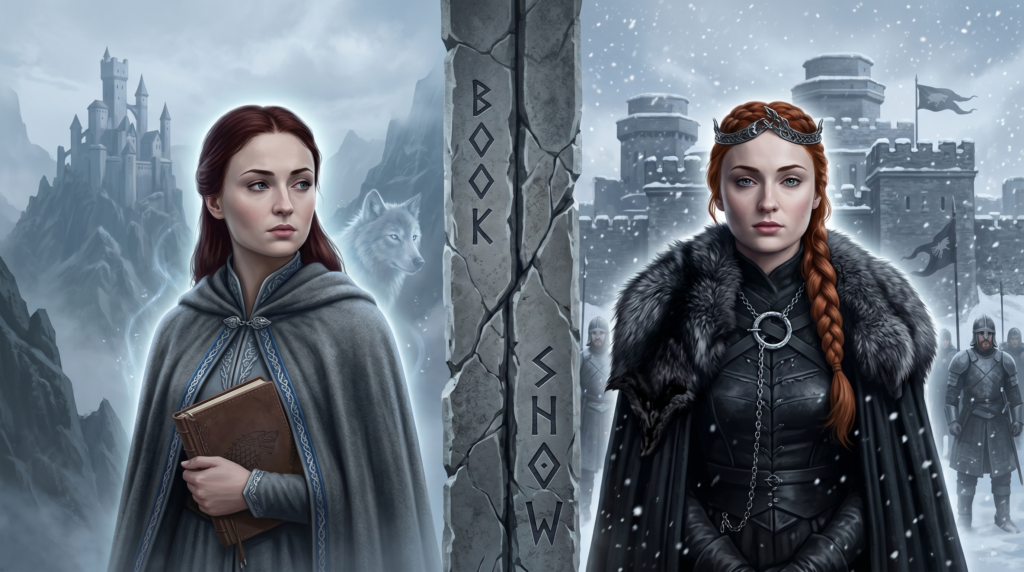
For millions of Game of Thrones fans, the memory of Season 5 is inextricably tied to one of the most polarizing and controversial narrative choices in television history: sending Sansa Stark back to Winterfell to marry Ramsay Bolton. However, for readers of George R.R. Martin’s A Song of Ice and Fire, this on-screen trauma was a jarring departure from the original text. If you want to understand her true strategic potential, you have to look at the Sansa book storyline, where her character arc takes a vastly different, far more politically complex route.
The television series transformed Sansa into a hardened survivor defined largely by the cruelty of the men around her. But the written lore paints a different picture—one of a quiet, observant apprentice mastering the dangerous game of high-society politics. For fans seeking a deeper understanding of the North, the Vale, and the true power dynamics at play in Westeros, analyzing the divergence between the page and the screen is essential.
This comprehensive guide breaks down the seven crucial differences between Sansa in the books and her television counterpart, revealing the sophisticated political player HBO left behind.
Quick Comparison: The Two Lives of Sansa Stark
| Feature | HBO Television Series | A Song of Ice and Fire Books |
| Current Alias | Reclaimed identity as Sansa Stark | Hiding as Alayne Stone (Littlefinger’s bastard) |
| Location | Queen in the North (Winterfell) | The Eyrie / The Gates of the Moon (The Vale) |
| Forced Marriages | Tyrion Lannister, Ramsay Bolton | Tyrion Lannister (Unconsummated) |
| Primary Mentor | Harsh reality / Traumatic experiences | Petyr “Littlefinger” Baelish |
| Political Tool | Open defiance and Northern alliances | Courtesy, observation, and manipulation |
I. The Great Character Merge: Why Jeyne Poole Matters
The Winterfell Swap That Changed Everything
Perhaps the most monumental shift in adaptation history occurred when showrunners David Benioff and D.B. Weiss decided to merge Sansa Stark’s storyline with a minor book character named Jeyne Poole.
In the books, the girl who marries Ramsay Bolton is not Sansa. It is Jeyne Poole, the daughter of Winterfell’s former steward, Vayon Poole, and Sansa’s childhood best friend. The Lannisters, desperate to secure Roose Bolton’s hold on the North after the Red Wedding, dress Jeyne up and pass her off as “Arya Stark.” Roose Bolton—a man whose chilling pragmatism and calculating nature rival even Tywin Lannister—knows she is a fake but goes along with the mummer’s farce to legitimize his son’s claim to Winterfell.
The Loss of Narrative Agency
By placing Sansa in Jeyne’s horrific predicament on screen, the television series accomplished two things: it kept a main cast member on screen and heightened the emotional stakes for the audience. However, this came at a massive cost to Sansa’s character development.
In the books, Sansa is thousands of miles away in the Vale during Ramsay’s reign of terror. She is safe, hidden, and—most importantly—learning. The show stripped her of her agency, transforming her back into a victim just as she was beginning to find her footing. The “Sansa book” reality allows her to slowly shed her naive worldview without being subjected to gratuitous, character-breaking trauma.

II. The Apprenticeship: Mastering the Vale as Alayne Stone
Learning at the Feet of Petyr Baelish
Following King Joffrey’s assassination at the Purple Wedding, Sansa escapes King’s Landing with Petyr Baelish. To protect her from the wrath of the Iron Throne, Littlefinger dyes her auburn hair dark and renames her “Alayne Stone,” claiming she is his bastard daughter.
This is where the true divergence begins. As Alayne, Sansa becomes Littlefinger’s shadow and confidante. While show-Sansa spends her time in the Vale largely as a passive bystander before being shipped off to Winterfell, book-Sansa is deeply entrenched in the political administration of the Eyrie. She manages the household, learns how to read ledgers, and observes Littlefinger’s masterful manipulation of the Vale’s nobility.
The Lords Declarant and High Diplomacy
A key sequence completely omitted from the show is the conflict with the “Lords Declarant”—six powerful nobles of the Vale who band together to oust Littlefinger after Lysa Arryn’s death.
In A Feast for Crows, Sansa watches as Littlefinger expertly navigates this crisis, using bribery, blackmail, and fake compromises to dismantle the alliance from within. More importantly, Petyr explains his tactics to Sansa after the fact. He is actively grooming her. By the time we reach her preview chapters in the unreleased The Winds of Winter, Sansa is no longer just listening; she is anticipating his moves and even beginning to manipulate situations—and Littlefinger himself—to her own advantage. She is learning that courtesy is not just good manners; it is a weapon.
III. The Romance That Wasn’t: Willas Tyrell vs. Loras Tyrell
Highgarden’s Hidden Suitor
During her captivity in King’s Landing, the Tyrells plot to spirit Sansa away to Highgarden. In the television series, the plan is to marry her to the dashing, sword-swinging Knight of Flowers, Ser Loras Tyrell. This makes sense for TV, as Loras is an established, handsome character.
However, the “Sansa book” plotline introduces a fascinating dynamic that the show erased: she is actually betrothed to Willas Tyrell.

The Significance of Willas
Willas is the eldest son of Mace Tyrell and the heir to Highgarden. He was crippled in a tourney years prior and walks with a cane. Unlike the fierce warriors and cruel kings Sansa is used to dealing with, Willas is a gentle, scholarly man who breeds animals and reads the stars.
While Sansa initially mourns the loss of a “fairytale knight” like Loras, the prospect of marrying Willas represents a profound shift in her desires. It offers a glimpse of a peaceful, intellectual life where she would be valued for her mind and position rather than her beauty or body. When the Lannisters discover the plot and hastily force her to marry Tyrion instead, the tragedy is much deeper in the books. She didn’t just lose a handsome prince; she lost a genuine chance at a safe, respected sanctuary.
IV. The Hound and the “UnKiss”: A Psychological Deep Dive
Sandor Clegane and the Subversion of SanSan
One of the most fascinating psychological elements of the Sansa book narrative involves her complex relationship with Sandor Clegane, the Hound. While the television series depicted their dynamic—a brutal, cynical killer protecting an idealistic, naive girl—the books take this a step further through a psychological phenomenon fans refer to as the “UnKiss.”
During the chaos of the Battle of the Blackwater, a drunken and terrified Sandor confronts Sansa in her bedchamber. He offers to take her away from King’s Landing, she refuses, and he leaves after making her sing him a hymn. In the show, the scene ends there. But in subsequent book chapters, Sansa distinctively remembers that Sandor kissed her that night.
The False Memory Explained
George R.R. Martin has explicitly confirmed that this kiss never happened. It is a false memory constructed by Sansa’s traumatized mind.
Why is this important for her character development? It demonstrates how Sansa copes with the horrifying reality of her captivity. By subconsciously revising the memory to include a kiss—a staple of the romantic songs and stories she grew up loving—she is attempting to process her trauma through a lens she understands. It highlights the death of her innocence; she is slowly realizing that the “true knights” of the songs do not exist, and the only man who ever genuinely tried to protect her in King’s Landing was a scarred, foul-mouthed killer who wasn’t a knight at all.
V. The Supernatural Connection: Warging and the Loss of Lady
Is Sansa a Warg? The Stark Connection
A critical piece of A Song of Ice and Fire lore often glossed over by the HBO series is the magical heritage of the Stark children. In the books, it is heavily implied (and confirmed by the author) that all the Stark children possess the ability to warg—to project their consciousness into animals, primarily their direwolves.
We see this actively with Bran, Jon, and Arya. However, Sansa’s direwolf, Lady, is executed in the very first book at the behest of Cersei Lannister.
The Tragedy of Lady
The early death of Lady is more than just a sad moment; it is a profound, magical severing of Sansa’s connection to her Northern roots. Because she loses her direwolf before her warging abilities can manifest, Sansa is effectively cut off from the innate, primal magic of the Starks.
Without this supernatural anchor, Sansa is forced to survive using purely mundane, southern methods: observation, etiquette, and political maneuvering. The “Sansa book” arc is fundamentally shaped by this loss. She must become a creature of the court because the magical path of the North was violently stolen from her.
VI. The Future Queen: Harry the Heir and The Winds of Winter
What Happens Next? The Harrold Hardyng Plot
Because the show sent Sansa to Winterfell to marry Ramsay, it completely abandoned her actual endgame in the Vale: The Harrold Hardyng plot.
In A Feast for Crows and the preview chapters of The Winds of Winter, Littlefinger reveals his master plan. Robert Arryn, the sickly Lord of the Vale, is expected to die young. His heir is a handsome, arrogant young knight named Harrold Hardyng, known as “Harry the Heir.” Littlefinger intends to betroth “Alayne Stone” to Harry. Once they are wed and the Vale is secured, Littlefinger plans to reveal her true identity as Sansa Stark and use the untouched armies of the knights of the Vale to march North and reclaim Winterfell from the Boltons.

The Strategic Value
This storyline positions Sansa as a central political lynchpin in Westeros. Instead of being a victim of Roose and Ramsay Bolton’s cruelty, she is being positioned as the architect of their downfall from afar. (Note: To understand the sheer political magnitude of the enemies Sansa is up against, test your knowledge with our interactive Roose Bolton Quiz or explore our Tywin Lannister Documentary Script elsewhere on the site).
As Alayne, Sansa successfully charms and manipulates Harry the Heir during a tourney in the Vale, proving that she has learned Littlefinger’s lessons well. She is no longer a pawn being traded; she is actively playing the game.
VII. Expert Comparison: Agency vs. Victimhood
The Final Verdict: Which Version is More “Stark”?
When comparing the two timelines, the core difference boils down to how each medium handles female empowerment and trauma.
-
Show Sansa: The television series falls into the trope that a character must suffer immense, brutal physical trauma to become “strong.” Show-Sansa becomes a hardened, somewhat cynical Queen in the North, but her transformation is largely reactive.
-
Book Sansa: The literary version argues that strength does not only come from holding a sword or surviving torture. Book-Sansa uses “courtesy as her armor.” She survives the viper’s nest of King’s Landing through diplomacy, empathy, and silence. Her transformation is proactive, built on education and careful observation.
For fans of deep political intrigue, the “Sansa book” version provides a significantly more satisfying and logical evolution. She is learning to be a ruler not through suffering alone, but through statecraft.
VIII. FAQ: Everything Fans Ask About Sansa in the Books
Does Sansa ever see her siblings again in the books?
As of A Dance with Dragons, Sansa has not reunited with any of her siblings since the first book. She believes Bran and Rickon are dead, Arya is missing (or married to Ramsay, though readers know that is Jeyne Poole), and Jon is at the Wall.
Is Sansa still a virgin in the books?
Yes. Her marriage to Tyrion Lannister is never consummated. Tyrion refuses to force himself on her, and despite the Lannisters’ demands, the marriage remains unconsummated, meaning it can technically be annulled by the High Septon.
Who is Sansa supposed to marry in The Winds of Winter?
She is currently betrothed to Harrold Hardyng (Harry the Heir) under the guise of Alayne Stone.
Why did the show change Sansa’s storyline so drastically?
Showrunners wanted to consolidate storylines and keep popular actors on screen. Sending Sansa to Winterfell merged the Vale and Northern plots, eliminating the need to cast the Manderlys, Jeyne Poole, and Harry the Heir, while giving Sansa a direct, emotional stake in the battle against the Boltons.
IX. Conclusion: The Re-Read Value
The divergence between the Sansa book storyline and the HBO adaptation represents one of the most significant shifts in modern fantasy television. While the show gave fans a triumphant Queen in the North, it skipped the essential, intricate political education that justifies her crown.
By diving into A Feast for Crows and the preview chapters of The Winds of Winter, fans can discover a version of Sansa Stark who is quietly mastering the game of thrones. She is no longer the naive girl who loved lemon cakes and knights; she is the pupil of Petyr Baelish, a warg without a wolf, and potentially the most dangerous political player left in Westeros.
What do you think? Do you prefer the hardened survivor of the television series, or the calculating diplomat of the books? Let us know in the comments below, and be sure to check out our other deep dives into the lore of ice and fire, including our interactive Jon Snow Trivia and Tyrion Lannister Character Analysis!


