“When the snows fall and the white winds blow, the lone wolf dies, but the pack survives.”
This enduring quote from Eddard Stark defines the tragic, triumphant saga of House Stark. Yet, when we examine the surviving members of this ancient family, the contrast between them is staggering. While fans often analyze the intricate political maneuvers of the Queen in the North, it was Sansa Stark’s sister, Arya, who walked the darkest, most isolated path to secure her family’s future.
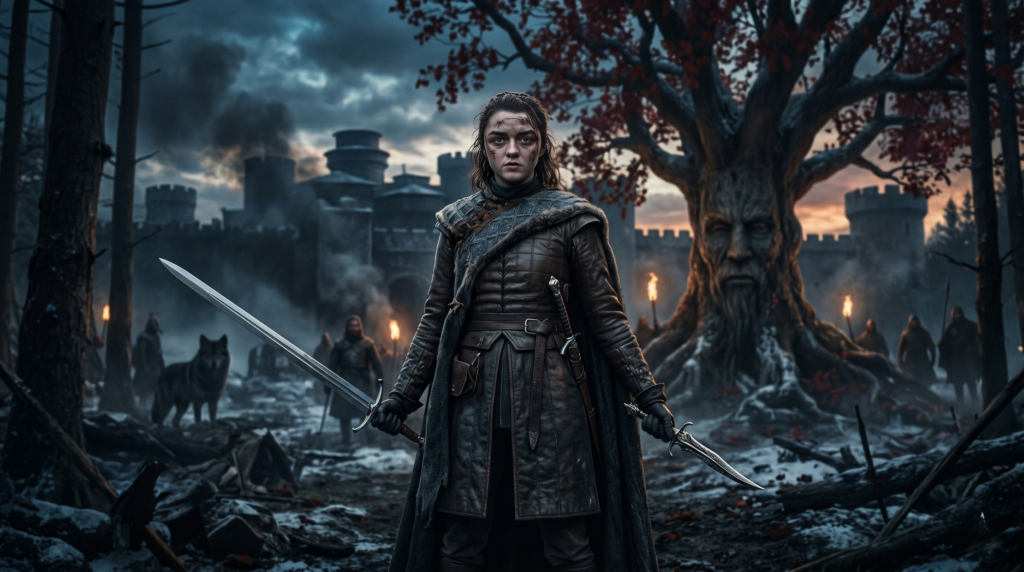
For casual viewers and hardcore readers of A Song of Ice and Fire alike, Arya Stark represents the ultimate rejection of Westerosi societal norms. She was never meant to be a lady, a pawn, or a victim. She was forged in trauma, trained by assassins, and ultimately became the dagger in the dark that saved the world of the living.
This comprehensive guide breaks down the psychology, the lore, and the defining moments of Arya Stark. We will explore how a rebellious child transformed into the Savior of Westeros, examining the mentors who shaped her, the enemies who broke her, and the undeniable bond that ultimately brought the Stark pack back together.
In this comprehensive guide, you will discover:
-
The psychological impact of Arya’s early rejection of Winterfell’s traditions.
-
How her trauma catalyzed her evolution from captive to trained killer.
-
The hidden philosophies of her mentors, from Syrio Forel to the Faceless Men.
-
An in-depth analysis of her pivotal reunion with Sansa Stark.
-
Why the lore of Game of Thrones demanded Arya be the one to defeat the Night King.
II. The Early Years: Why Arya Was the “Other” Stark Sister
Contrasting the Stark Daughters
To understand Arya, you must first understand the world she was born into. In the patriarchal society of Westeros, highborn girls had one primary duty: to marry well and forge political alliances. Sansa Stark embraced this reality, dreaming of gallant knights, southern courts, and songs of high romance. She excelled in Septa Mordane’s lessons in needlework and etiquette.
Arya, conversely, was the “Winterfell Outcast.” She was consistently outshone by her older sister in every traditional metric of femininity. Often referred to as “Arya Underfoot,” she preferred the mud of the courtyard, the clash of wooden swords, and the company of the castle’s common folk. This early dynamic established a bitter rivalry between the sisters. Arya’s resentment of Sansa wasn’t just sibling jealousy; it was a fundamental rejection of a system that offered her no autonomy.
“Needle” and Syrio Forel: The First Steps
The trajectory of Arya’s life changed with a single gift from her half-brother, Jon Snow. Before leaving for the Night’s Watch, Jon gave her a custom-forged Braavosi blade, aptly named “Needle”—a profound subversion of the needlework she despised.
When Ned Stark discovered the blade in King’s Landing, he made a crucial parenting decision. Rather than confiscate it, he hired the former First Sword of Braavos, Syrio Forel. Syrio did not teach her Westerosi knightly combat; he taught her the “Water Dance.” More importantly, he instilled a psychological resilience that would become her mantra. When faced with the ultimate terror, Syrio taught her to say only one thing to the God of Death: “Not today.”

III. The Catalyst: Destruction of the Stark Household
Witnessing the Beheading of Ned Stark
The true death of Arya the child occurred on the steps of the Great Sept of Baelor. Hidden in the crowd, protected only by the Night’s Watch recruiter Yoren, she witnessed the execution of her father, Ned Stark, on the orders of King Joffrey Baratheon.
This specific trauma fundamentally rewired her worldview. The honorable, rule-abiding philosophy of her father had gotten him killed. From this moment on, justice in Arya’s eyes was no longer a matter of law or kings; it was a matter of blood.
The Road to Harrenhal
Disguised as an orphan boy named “Arry,” she navigated the war-torn Riverlands. Her capture and subsequent imprisonment at Harrenhal served as a masterclass in survival. Here, she learned to be invisible.
In the television series, she famously served as cupbearer to Tywin Lannister, engaging in a dangerous game of verbal chess with the most ruthless man in Westeros. (For a deeper dive into his geopolitical maneuvers, check out our full documentary breakdown: Was Tywin the Real Power Behind the Throne?). In the books, her time at Harrenhal is even more harrowing, involving interactions with the chilling Lord of the Dreadfort. If you want to test your knowledge of this treacherous Northern house, see if you can survive our interactive Roose Bolton Quiz.
Harrenhal taught Arya that the high lords playing the game of thrones viewed the smallfolk as expendable. It solidified her empathy for the downtrodden and her hatred for those who abused their power.
IV. The Hound and the Girl: An Unlikely Mentorship
Lessons in Brutality
Following her escape from the Brotherhood Without Banners, Arya was taken captive by Sandor Clegane, the Hound. What began as a hostage situation evolved into one of the most complex and vital relationships in Game of Thrones.
Sandor stripped away any remaining naivety Arya harbored. Syrio Forel taught her elegance; Sandor Clegane taught her brutality. He showed her that in a vicious world, honor is often a liability. He forced her to look at the ugly reality of death, teaching her where the heart is, how to pierce armor, and that survival often means abandoning conventional morality.
The Prayer List
It was during these lonely nights on the Kingsroad that Arya began reciting her infamous “Death List.” Whispering the names of those who had wronged her family—Cersei, Walder Frey, Meryn Trant, The Hound—became a coping mechanism. It was a way to exert control in a world where she was entirely powerless.
This list anchored her. It gave her a singular, driving purpose: vengeance. But it also posed a significant danger. As she ticked names off her list, she risked losing her humanity entirely, slowly transforming into the very monsters she sought to destroy.

V. A Girl Has No Name: The Braavos Transformation
The House of Black and White
Armed with the iron coin given to her by Jaqen H’ghar and the phrase “Valar Morghulis” (All men must die), Arya crossed the Narrow Sea to the Free City of Braavos. Here, she entered the House of Black and White, the temple of the Many-Faced God, to train with the elite guild of assassins known as the Faceless Men.
This phase of her journey was psychological warfare. To become a Faceless Man, one must surrender all personal attachments, desires, and history to become “No One.” For a girl whose entire existence was currently defined by her family name and her trauma, this was an agonizing process. She was beaten, blinded, and stripped of her possessions, save for one: she hid Needle beneath the rocks, unable to completely sever her tie to Jon Snow and her Stark heritage.
Regaining Identity
The ultimate test in Braavos was not assassination, but a test of self. While the Faceless Men demanded absolute neutrality, Arya could not permanently extinguish her moral compass or her thirst for Stark justice.
Expert Insight: The Role of the Waif
The Waif was not just an abusive superior; she was a narrative foil. The Waif represented the absolute erasure of identity that the Faceless Men required. By defeating the Waif in total darkness—using the blind combat skills she had suffered to learn—Arya definitively rejected the cult’s core philosophy.
When Jaqen H’ghar proclaimed that a girl had finally become “No One,” she delivered one of the series’ most defining lines: “A girl is Arya Stark of Winterfell. And I’m going home.” She took their lethal skills but kept her soul.
VI. The Reunion: Sansa Stark and Her Sister (The Power Shift)
Returning to Winterfell
When Arya finally returned to Winterfell in Season 7, the landscape had drastically changed. The Bolton occupation had ended, and the Stark banner flew once more. However, the reunion between Sansa Stark and her sister was fraught with a new kind of tension.
They were no longer the squabbling children of Season 1. Sansa had survived the psychological and physical torment of Joffrey Baratheon, Cersei Lannister, and Ramsay Bolton to become a hardened, pragmatic political leader. Arya had become an apex predator. Their differing survival mechanisms immediately clashed. Sansa viewed Arya’s blunt, violent worldview as a threat to Northern stability, while Arya viewed Sansa’s diplomatic compromises as a betrayal of Stark loyalty.
The Execution of Littlefinger
This tension was masterfully exploited by Petyr “Littlefinger” Baelish, who sought to divide the sisters to maintain his influence over the North. For several episodes, the audience was led to believe that the sisters might actually turn on each other.
However, the climax of this storyline solved the core “problem” of their relationship. By combining Sansa’s political intellect with Arya’s lethal capability, they outmaneuvered the ultimate manipulator. In a chillingly efficient trial, Sansa passed the sentence, and Arya swung the sword (or, rather, the dagger). It was the moment the pack truly reformed. They realized that their vast differences were not a weakness, but the ultimate strength of House Stark.
VII. The Savior of Westeros: The Long Night
Why Arya?
For years, the overarching prophecy of A Song of Ice and Fire pointed toward Jon Snow or Daenerys Targaryen as the “Prince That Was Promised”—the singular hero destined to defeat the Night King. Yet, when the Long Night fell upon Winterfell, it was Arya Stark who struck the final blow.
From a lore perspective, this makes perfect, devastating sense. Jon Snow was the classic fantasy hero, but the Night King was a supernatural force that could not be beaten in a traditional duel. It required an assassin. The Red Woman, Melisandre, reminded Arya of a prophecy she had spoken years prior: “Brown eyes, green eyes, and blue eyes… eyes you’ll shut forever.”
Every torment, every beating in Braavos, every silent footstep learned in the Red Keep and the House of Black and White prepared her for the moment she snuck past the army of the dead in the Godswood.
The Catspaw Dagger
The weapon used to kill the Night King was a masterstroke of storytelling architecture. The Valyrian steel “Catspaw dagger” was the exact same blade an assassin used in Season 1 in an attempt to murder her brother, Bran Stark. The weapon that started the War of the Five Kings and nearly destroyed House Stark was the very weapon Arya used to save the world, plunging it into the Night King with a deft hand-drop maneuver she learned through years of survival.
VIII. Comparison Table: Sansa vs. Arya Stark
Understanding the dichotomy between the two Stark women reveals how brilliantly George R.R. Martin and the showrunners constructed their parallel journeys.
| Feature | Sansa Stark | Arya Stark |
| Primary Weapon | Political Influence / Diplomacy | Needle / Valyrian Steel / Stealth |
| Mentors | Cersei Lannister, Margaery Tyrell, Littlefinger | Syrio Forel, The Hound, Jaqen H’ghar |
| Final Title | Queen in the North | Explorer of the Sunset Sea |
| Core Value | Preservation of the Pack and Northern Independence | Justice, Vengeance, and Personal Autonomy |
| Survival Strategy | Adaptation and strategic submission | Rebellion and mastering combat |
IX. Beyond the Iron Throne: Arya’s Legacy
The Sunset Sea
In the series finale, while Jon Snow goes North of the Wall and Sansa assumes her throne, Arya makes a shocking but fitting decision. She asks the question: “What’s west of Westeros?”
Sailing the Sunset Sea is the ultimate realization of her character arc. Having crossed every name off her list (either by her own hand or by circumstance) and having secured her family’s safety, the assassin had no place in the peacetime politics of the Six Kingdoms or the newly independent North. She was fundamentally a wanderer.
Comparison to Queen Nymeria
This ending beautifully mirrors the legendary Rhoynar warrior queen, Nymeria—the very historical figure Arya idolized as a child and named her direwolf after. Queen Nymeria led her people across the narrow sea in ten thousand ships to find a new home. By sailing West, Arya ascends from being a mere player in the Game of Thrones to becoming a legendary explorer in her own right.

X. Conclusion: The Sisterhood that Saved the North
The story of Sansa Stark’s sister is arguably the most dynamic arc in modern fantasy television. Arya Stark began as an outcast who refused to accept the narrow confines of her society. Through unimaginable grief, rigorous training, and a sheer refusal to die, she weaponized her trauma.
Yet, her greatest triumph was not becoming a killing machine; it was remembering who she was. By holding onto her Stark identity and ultimately reconciling with Sansa, the two sisters achieved what their father, mother, and eldest brother could not. They protected the North.
Want to test your knowledge of the North? Dive deeper into the lore of Westeros by challenging yourself with our interactive Jon Snow Trivia or test your wits against the smartest man in the Seven Kingdoms with our Tyrion Lannister Quiz available right here on the site!
XI. Frequently Asked Questions (FAQ)
Is Arya Stark older than Sansa?
No, Arya Stark is the younger sister. Sansa is the eldest daughter of Eddard and Catelyn Stark, making her the older sister to both Arya and their brother Bran.
Why did Arya Stark go West of Westeros?
Arya chose to explore the Sunset Sea because she realized she was not suited for life as a traditional highborn lady or a peacetime ruler. With her family safe and her death list resolved, her restless, adventurous nature drove her to map the unknown areas of the world, much like her childhood hero, Queen Nymeria.
How many people did Arya Stark actually kill on her list?
On the television show, Arya directly killed four people who were officially on her spoken list: Polliver, Rorge, Meryn Trant, and Walder Frey. Others on her list died by different means (like Joffrey and Tywin) or were eventually removed from the list in her heart (like The Hound).
What is the name of Sansa Stark’s sister?
Sansa Stark’s younger sister is named Arya Stark. Played by Maisie Williams in the HBO series, she is the youngest daughter of Lord Eddard Stark and Lady Catelyn Stark of Winterfell.King.


