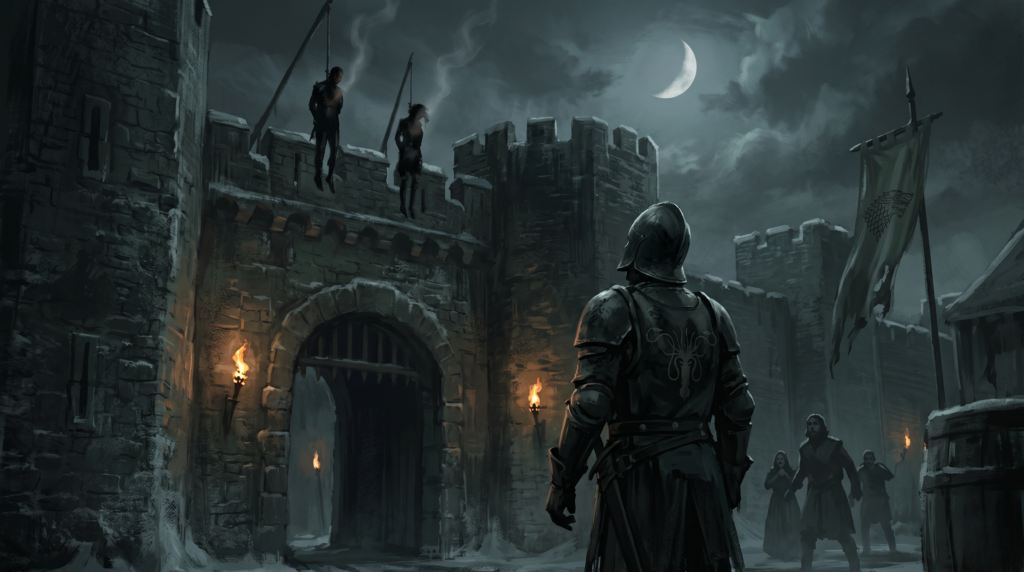
The final moments of Game of Thrones Season 2, Episode 7, “A Man Without Honor,” remain etched in the minds of viewers as one of the most chilling visual sequences in television history. As the camera pans up to reveal two small, charred bodies suspended by ropes above the gates of Winterfell, the show fundamentally shifts. If you are watching this sequence for the first time, or simply returning to untangle the complex web of Westerosi betrayals, you are undoubtedly asking one desperate question: did Theon Greyjoy kill Bran and his younger brother, Rickon Stark?
The short, immediate answer is no. Bran and Rickon Stark were not the boys burned and hung at Winterfell.
However, understanding who those boys actually were, why Theon committed such an atrocity, and how this single lie triggered a domino effect that destroyed the Stark family is crucial to grasping the deeper lore of A Song of Ice and Fire. This wasn’t just a shock-value plot twist; it was a masterclass in narrative deception that ultimately reshaped the political landscape of the North, paving the way for opportunists who were waiting in the shadows.
Here is the comprehensive, expert breakdown of the darkest lie told in the North, the psychology behind Theon’s unforgivable choice, and how it changed Westeros forever.
The Fall of Winterfell: Setting the Stage for Betrayal
To understand the tragic events at the miller’s farm, we first have to examine the fragile state of Winterfell and Theon’s own fractured psychology.
Raised as a ward (and essentially a high-born hostage) by Ned Stark following the Greyjoy Rebellion, Theon spent his life caught between two worlds. He was treated well by the Starks, forming a brotherly bond with Robb, yet he was never truly one of them. When Robb sends him back to the Iron Islands to secure a naval alliance, Theon’s biological father, Balon Greyjoy, rejects him as a soft, “green land” northerner.
Desperate to prove his Ironborn ruthlessness and claim glory for his estranged family, Theon makes a catastrophic tactical blunder: he seizes a largely undefended Winterfell with a mere skeleton crew of twenty men.
Taking the castle was easy; holding it was impossible. Theon quickly realizes he is out of his depth. He lacks the respect of his Ironborn raiders, particularly the hardened veteran Dagmer Cleftjaw, and he faces the silent, burning hatred of the Winterfell citizens who watched him grow up. His grip on power relies entirely on keeping his high-value hostages—Bran and Rickon Stark—secure.
When the wildling Osha orchestrates a daring midnight escape, smuggling the Stark boys, their direwolves, and Hodor out of the castle, Theon’s fragile illusion of control shatters.

The Investigation: A Prince’s Panic
The morning after the escape, the reality of the situation sets in. If word reaches the Northern lords that Theon has lost the Stark heirs, his occupation will end in a bloodbath. He immediately organizes a hunting party, accompanied by his ironmen and a deeply distressed Maester Luwin, to track the boys using hunting hounds.
The tracking leads them to a local farm by the Acorn Water—a farm owned by a miller who had shown kindness to Bran in the past. It is here that the trail of the direwolves mysteriously vanishes. (We later learn that Osha cleverly led the group through a stream to mask their scent before doubling back to hide in the crypts of Winterfell itself).
Standing at the miller’s farm with an empty trail, Theon is faced with a terrifying ultimatum. Returning to Winterfell empty-handed means admitting defeat. Dagmer Cleftjaw, sensing Theon’s panic, manipulates the young prince’s insecurity. While the show leaves the initial dialogue between them somewhat ambiguous, the implication is clear: if they cannot find the Starks, they must provide the illusion that the Starks were caught.
The Revelation: Who Were the Burned Bodies?
The bodies hung above the gates of Winterfell were actually the two young sons of the local miller.
Because the boys were roughly the same age and height as Bran and Rickon, they served as perfect stand-ins. However, the ironmen faced a massive logistical problem: the miller’s boys looked nothing like the Stark children. They lacked the aristocratic features, the specific hair color, and the fine clothing of nobility.
To hide this discrepancy, Theon ordered the boys to be killed and their bodies burned beyond all recognition.
-
The Brutality of the Deception: The burning served a dual purpose. First, it completely obscured the victims’ identities, ensuring no one—not even Maester Luwin, who delivered Bran and Rickon—could definitively prove the bodies weren’t the Stark princes. Second, the sheer brutality of the act was designed to strike terror into the hearts of the Winterfell commoners, establishing Theon as a ruthless conqueror who should not be crossed.
-
A Masterful Narrative Sleight of Hand: For viewers and readers alike, this was a masterful stroke of deception by author George R.R. Martin. By relying on the “burned body” trope, he weaponized the audience’s own assumptions against them. We knew Game of Thrones was a ruthless story—we had already witnessed the execution of Ned Stark. Therefore, it was entirely believable that the show would brutally murder two child protagonists.

The Psychology of a Turncloak: Why Theon Crossed the Line
The murder of the miller’s boys represents the point of no return for Theon Greyjoy. Prior to this moment, his actions could be viewed through the lens of a misguided young man trying to win his father’s love. Seizing Winterfell was a betrayal, yes, but it was a bloodless, strategic military move.
Killing innocent children to cover up his own incompetence was an act of pure villainy born out of cowardice.
“It’s better to be cruel than weak.” — Theon Greyjoy’s internal justification, struggling with the cognitive dissonance of his actions.
This lie would come to define Theon’s psychological destruction. The ghosts of the boys he killed haunted his every waking moment. When Winterfell is eventually sacked and he falls into the sadistic hands of Ramsay Snow, Theon’s horrific torture—and his transformation into the broken creature known as “Reek”—is framed almost as a karmic punishment for this specific sin. He convinced the world he was a child-killer, and as a result, no one came to his rescue.
Furthermore, this act creates a fascinating, tragic foil to his surrogate father, Ned Stark. Ned sacrificed his own legendary honor and told a massive lie (claiming Jon Snow was his bastard) to save an innocent child. Theon, in stark contrast, sacrificed innocent children and told a massive lie to save his own pride.
Book vs. Show: “A Clash of Kings” Deep Dive
To truly demonstrate authoritative knowledge of George R.R. Martin’s universe, we must look at how this pivotal event unfolds in the source material, A Clash of Kings. While the HBO adaptation perfectly captures the emotional gravity of the deception, the novels offer a more intricate, and arguably darker, sequence of events.
The Introduction of Ramsay Snow (The Original “Reek”)
In the television series, Dagmer Cleftjaw is the primary catalyst who pushes Theon toward murdering the miller’s boys. However, the book introduces a far more sinister influence. Before Theon takes Winterfell, a man named Ramsay Snow (the Bastard of Bolton) is captured by Northern forces while disguised as his own servant, “Reek.”
When Theon captures the castle, he unknowingly takes the disguised Ramsay into his service. It is actually Ramsay—whispering poison into Theon’s ear—who devises the plan to kill the miller’s children and burn their bodies. This early interaction brilliantly foreshadows the horrific dynamic that will later define their relationship. Ramsay helps Theon create the lie that dooms him, only to later torture him for it.
The Darkest Fan Theory: Were They Theon’s Own Children?
For fans interested in the deep, unspoken lore of Westeros, there is a haunting theory regarding the miller’s wife. In the books, Theon briefly recalls having sexual encounters with the miller’s wife during his teenage years riding through the Acorn Water.
Given the timeline and the ages of the boys, many readers believe that the children Theon murdered were actually his own illegitimate sons. While this is never explicitly confirmed by Martin, it adds a layer of Greek tragedy to Theon’s character arc—a man so desperate to prove he is a true Greyjoy that he unknowingly murders his own flesh and blood to secure a castle that isn’t his.
The Ripple Effect: How the Fake Death Changed Westeros
The lie at the miller’s farm did not just impact Winterfell; it acted as the catalyst for the downfall of the Northern rebellion. The news that the Stark line had been seemingly extinguished sent shockwaves across the continent, directly causing three major political shifts.
1. Robb Stark’s Fatal Mistake
King in the North Robb Stark was fighting a brilliant military campaign in the Riverlands, but the news of Bran and Rickon’s deaths shattered his emotional resolve. In his overwhelming grief, he sought comfort in the arms of Talisa Maegyr (or Jeyne Westerling in the books). By marrying her, Robb broke his sacred oath to Lord Walder Frey. This single, grief-stricken decision directly resulted in the Red Wedding, effectively ending the Stark rebellion.
2. Catelyn Stark’s Desperate Treason
Believing her youngest sons were dead, Catelyn Stark’s mental state deteriorated into pure desperation. With her husband executed and her youngest boys “murdered,” she became fixated on saving her daughters, Sansa and Arya, who were held hostage in King’s Landing. Driven by a mother’s frantic grief, Catelyn committed treason against her own son’s army by secretly releasing their most valuable prisoner, Jaime Lannister. This fractured Robb’s army and alienated his key bannermen, particularly the Karstarks.
3. The Rise of House Bolton
The perceived death of the Stark heirs created a massive power vacuum in the North. Calculating political players like Roose Bolton recognized that without Bran and Rickon, the Stark dynasty was fatally weakened. If you are a fan who enjoys mapping out the strategic intellect of characters like Roose or Tyrion Lannister, you can trace the Bolton betrayal directly back to Theon’s lie. Roose allied with the Lannisters and the Freys precisely because Theon had eliminated the Stark “spares,” making a takeover of the North mathematically possible.
Where Did Bran and Rickon Actually Go?
If the bodies hanging from the gates were not the Stark princes, how did they evade Theon’s hunting party?
The answer lies in Osha’s brilliant survival instincts. She recognized that the Ironborn were searching outward, assuming the boys were fleeing toward an allied stronghold. Instead, after masking their tracks in the river, Osha led Bran, Rickon, Hodor, and the direwolves right back into the belly of the beast: The Crypts of Winterfell.
For days, the rightful heirs to the North hid in pitch-black darkness among the statues of their dead ancestors while Theon’s men walked the courtyards just above their heads.
Following the eventual sacking and burning of Winterfell by Ramsay Bolton, the survivors emerged from the crypts to find their home in ruins. Recognizing that keeping the boys together made them a larger target, the group made a heartbreaking decision to separate:
-
Bran Stark: Guided by his prophetic dreams, Bran traveled North beyond the Wall with Hodor, Jojen, and Meera Reed to find the Three-Eyed Raven. This journey forced him to embrace his powers as a Warg and a Greenseer.
-
Rickon Stark: Osha took the youngest Stark heir to seek refuge with allied bannermen. While the show streamlines this by taking them to the Last Hearth (House Umber), the books send them to the brutal, cannibal-rumored island of Skagos.

Frequently Asked Questions (FAQ)
Does Theon ever apologize to the Starks?
Yes. Theon’s guilt over his actions at Winterfell, including the murder of the miller’s boys, becomes the catalyst for his entire redemption arc. He eventually rescues Sansa Stark from Ramsay Bolton and later returns to Winterfell to fight for Jon Snow and the living. In his final moments during the Battle of Winterfell, he sacrifices himself to protect Bran from the Night King, receiving Bran’s forgiveness with the words, “Theon. You’re a good man. Thank you.”
Which episode does Bran come back after his “death”?
Bran and Rickon reveal themselves to be alive to the audience at the very end of Season 2, Episode 10, “Valar Morghulis,” when they emerge from the Winterfell crypts.
Did the Miller’s sons have names?
In the television series, they are not explicitly named. In the books, their mother is unnamed, and the boys themselves are simply collateral damage in the brutal game of thrones, symbolizing the heavy toll the high lords’ wars take on the common folk.
What happened to the Miller’s wife?
In the television show, she is murdered by the Ironborn during the raid on the farm to ensure no witnesses are left to dispute the identities of the burned bodies.
Conclusion: The Legacy of a Lie
So, did Theon Greyjoy kill Bran? No. But the lie he constructed was sharp enough to cut the throat of the Northern rebellion.
The burned bodies at Winterfell remain a haunting reminder of the show’s core theme: in the game of thrones, the most devastating weapons are rarely swords; they are secrets, lies, and the desperate actions of flawed men trying to secure their legacy. Theon’s horrific deception was a defining moment of Season 2, forcing him down a path of unimaginable suffering, but ultimately setting the stage for Bran Stark’s mystical journey toward becoming the Three-Eyed Raven—and eventually, the King of the Six Kingdoms.
For the Starks, the pack survived, but the scars left by Theon’s betrayal would permanently alter the history of Westeros.


