
In a world where rigid honor gets you beheaded and absolute power is won with fire and blood, the most resilient man in Westeros was also its most underestimated. Born into the wealthiest family in the Seven Kingdoms, despised by his father, and mocked by the realm, Tyrion Lannister’s survival is a masterclass in political maneuvering and sheer force of will. For fans revisiting the epic HBO series or newcomers trying to untangle the complex web of Westerosi politics, one burning question often remains: exactly what happens to the imp in Game of Thrones?
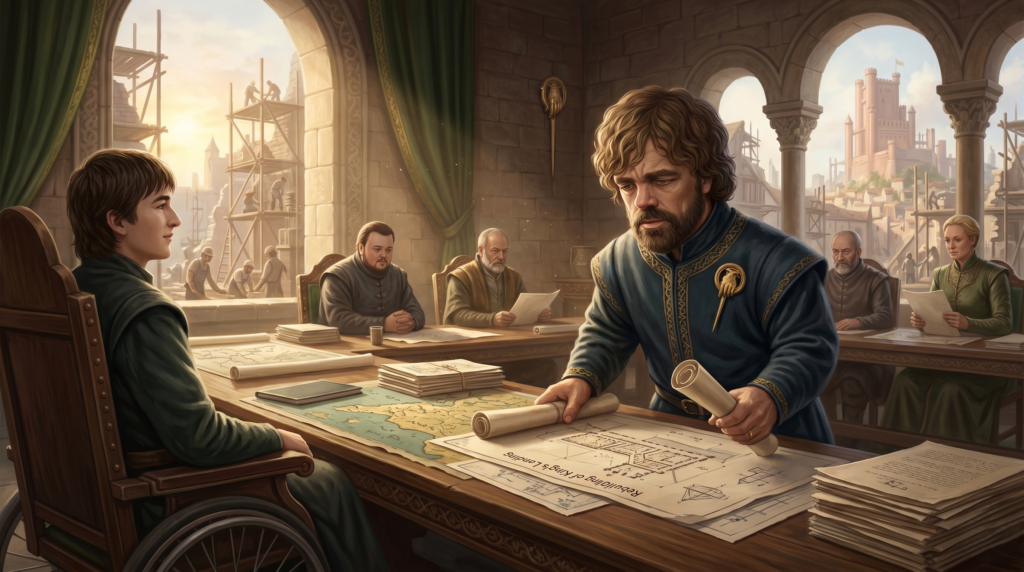
To answer this quickly: Tyrion Lannister survives the series. In the final episode of Game of Thrones, he avoids execution and is appointed as the Hand of the King to the newly elected monarch, Bran Stark (Bran the Broken). He spends his final moments leading the Small Council, tasked with rebuilding a fractured kingdom.
But simply surviving the “Game” is only half the story. Tyrion’s journey from a cynical, wine-guzzling outcast of House Lannister to the chief architect of a new world order is arguably the most significant character arc in modern fantasy television. In this comprehensive guide, we will break down exactly how Tyrion achieved this ending, the evolution of his character, and how his fate compares to the original A Song of Ice and Fire novels.
The Finale: Where Does “The Imp” End Up?
The series finale, “The Iron Throne,” presents Tyrion at his absolute lowest. Having witnessed Daenerys Targaryen burn King’s Landing to the ground, a devastated Tyrion publicly resigns as her Hand, throwing his pin down in the ashes. He is immediately imprisoned for treason, awaiting execution.
However, his sharp tongue and strategic mind—his greatest weapons—save him one last time. From his cell, he successfully convinces a conflicted Jon Snow that Daenerys is a tyrant who will never stop conquering, ultimately leading Jon to assassinate her.
The Trial at the Dragonpit
Following Daenerys’s death, the most powerful remaining lords and ladies of Westeros gather at the Dragonpit to determine the fate of the realm. Tyrion is brought before them in chains. Despite being a prisoner, he dominates the conversation. When the council struggles to choose a new ruler, Tyrion delivers his defining monologue about the power of storytelling.
He nominates Bran Stark, arguing that “Bran the Broken” has the most compelling story and that his inability to father children will break the wheel of tyrannical family dynasties. The lords agree, establishing a new elective monarchy.

The Re-appointment
In a moment of poetic irony, King Bran’s first official act is to name Tyrion as his Hand of the King. Exhausted by the game and burdened by guilt, Tyrion refuses, stating he has made too many terrible mistakes. Bran counters with a cold, pragmatic truth: “I don’t want it either.”
Bran views the position not as a reward, but as penance. Tyrion spent his life tearing down the old world, making catastrophic errors along the way; now, he must spend the rest of his life fixing it.
The Small Council
The final time we see Tyrion Lannister, he is precisely where he belongs: at the head of the Small Council table. He begins the tedious, unglamorous work of ruling, accompanied by a ragtag council of survivors:
-
Ser Bronn of the Blackwater: Master of Coin
-
Brienne of Tarth: Lord Commander of the Kingsguard
-
Samwell Tarly: Grand Maester
-
Ser Davos Seaworth: Master of Ships
Expert Insight: Tyrion’s ending is a brilliant subversion of traditional fantasy tropes. He doesn’t get a hero’s parade or a romantic sunset. Instead, his “victory” is a lifetime of bureaucratic labor, dealing with grain shortages, broken brothels, and infrastructure. It signifies the transition of Westeros from an era of magical conquerors to an era of pragmatic statesmen.
The Evolution of Tyrion Lannister: How He Survived the Game
To truly understand the weight of his ending, we must look at how Tyrion Lannister survived a world designed to crush him. His journey can be divided into three distinct phases of political and personal evolution.
Phase 1: The Wit of the Westerlands (Seasons 1-2)
In the beginning, Tyrion masks his deep-seated insecurities with hedonism, wealth, and razor-sharp wit. He is a cynical observer of the realm’s politics. However, after being falsely accused of attempting to murder Bran Stark and surviving a trial by combat at the Eyrie (thanks to the sellsword Bronn), Tyrion realizes he must actively play the game to survive.
His political genius truly shines in Season 2 when his father, Tywin Lannister, sends him to King’s Landing to act as Hand of the King to the cruel, erratic King Joffrey. Tyrion roots out corruption, neutralizes his sister Cersei’s spies, and masterminds the defense of the city during the Battle of the Blackwater, using wildfire to decimate Stannis Baratheon’s fleet. Despite saving the city, he is stripped of his power, permanently scarred, and given zero credit by his family.
Phase 2: The Fall of the Giant (Seasons 3-4)
Stripped of his title and influence, Tyrion is humiliated. Tywin forces him into an unconsummated, politically motivated marriage with Sansa Stark. But the true turning point comes during the “Purple Wedding.”
When King Joffrey is poisoned, Cersei immediately blames Tyrion. What follows is one of the greatest courtroom dramas in television history. Facing execution for a crime he didn’t commit, Tyrion finally snaps, delivering a blistering speech condemning the entire city of King’s Landing for their ingratitude.
After his champion, Oberyn Martell, loses the subsequent trial by combat, Tyrion’s fate seems sealed. However, his brother Jaime frees him. Before escaping the city, a heartbroken and enraged Tyrion confronts his past: he strangles his former lover, Shae, for betraying him, and murders his father, Tywin, with a crossbow. This act forever severs him from House Lannister and forces him into exile.

Phase 3: The Advisor to the Dragon (Seasons 5-8)
Smuggled across the Narrow Sea in a crate, a suicidal and depressed Tyrion is eventually brought to Daenerys Targaryen. He finds a new purpose in her vision of a better world and is named her Hand of the Queen.
However, Tyrion’s tenure advising Daenerys is fraught with failure. His deep-rooted trauma and lingering emotional ties to his siblings (Jaime and Cersei) cloud his judgment. His military strategies fail against Cersei, and his continuous attempts to appeal to his sister’s nonexistent mercy ultimately contribute to Daenerys’s descent into paranoia and the horrific burning of King’s Landing. His ending as Bran’s Hand is directly tied to the guilt he carries from these later-season failures.
Why Tyrion Lannister Survived When Others Failed
In a cast of hundreds, where seemingly invincible warriors like Khal Drogo, tactical geniuses like Robb Stark, and master manipulators like Petyr Baelish all met grisly ends, how did “The Imp” outlast them all? Tyrion’s survival strategies offer a fascinating look into the core philosophies of Game of Thrones.

Political Agility vs. Physical Strength
From the very first episode, Tyrion acknowledges his physical limitations. As he famously tells Jon Snow: “A mind needs books as a sword needs a whetstone, if it is to keep its edge.” While characters like Ned Stark relied on rigid honor and Jaime Lannister relied on exceptional swordsmanship, Tyrion relied on adaptability. He understood that in King’s Landing, information and leverage were far more valuable than Valyrian steel. He read people as well as he read books, figuring out what his enemies wanted and using it against them.
The “Lannister” Protection
It is impossible to ignore the privilege that came with his last name. Being a Lannister was a double-edged sword. It made him a target for enemies of his family (like Catelyn Stark, who arrested him in Season 1), but the sheer terror inspired by his father, Tywin Lannister, often acted as an invisible shield. Sellswords like Bronn and the mountain clans of the Vale only allied with Tyrion because they knew a Lannister “always pays his debts.” His immense wealth bought him the time he needed to use his intellect.
The Power of Storytelling
In his final, fateful speech at the Dragonpit, Tyrion argues that nothing unites people like a good story. This wasn’t just a justification for making Bran king; it was a reflection of his own survival. Tyrion lived because he could talk his way out of a cell at the Eyrie, talk his way into the good graces of the Second Sons, and talk his way out of Daenerys’s dragon pit in Meereen. He was Westeros’s greatest orator.
Show vs. Books: Is Tyrion’s Fate the Same in “A Song of Ice and Fire”?
For readers of George R.R. Martin’s A Song of Ice and Fire series, the question of what happens to the imp in Game of Thrones remains technically unanswered. The HBO series outpaced the published novels, meaning Tyrion’s final television fate was based on an outline provided by Martin, rather than finished text.
Current Book Status
As of the most recently published book, A Dance with Dragons, Tyrion is nowhere near the Small Council. He is in Essos, having just survived enslavement alongside Jorah Mormont and the dwarf performer Penny. He has successfully manipulated the Second Sons mercenary company into turning their cloaks to Daenerys’s side just as the Battle of Fire is breaking out in Slaver’s Bay. He has not yet formally met the Dragon Queen.
The “Dark Tyrion” Theory
The most significant difference between the show and the books is Tyrion’s psychological state. In the show, Tyrion remains a largely sympathetic, well-intentioned character even in his darkest moments. In the books, his murder of Tywin and Shae shatters his morality.
Crucially, the show omitted the revelation about Tyrion’s first wife, Tysha. In the books, Jaime confesses that Tysha actually did love Tyrion and was not a hired prostitute as Tywin had claimed. This revelation sends book-Tyrion into a spiral of immense hatred and vengeance against his entire family, including Jaime. He journeys through Essos consumed by a desire to rape and murder Cersei and destroy Casterly Rock.
Predictions for “The Winds of Winter”
Experts and hardcore “Thronies” heavily debate whether Martin will grant Tyrion the same “heroic” redemption arc and Hand of the King status seen on TV. Given the much darker path book-Tyrion is currently walking, many theorize his eventual meeting with Daenerys will encourage her most destructive impulses, rather than restrain them. However, him surviving to the very end to help rebuild the realm still aligns well with Martin’s overarching themes of broken men fixing a broken world.
The Legacy of Peter Dinklage’s Performance
It is impossible to discuss the fate of Tyrion Lannister without acknowledging the man who brought him to life. Peter Dinklage’s portrayal transcended the fantasy genre, fundamentally changing how characters with dwarfism are represented in mainstream media.
-
Award-Winning Impact: Dinklage won the Emmy Award for Outstanding Supporting Actor in a Drama Series a record-breaking four times for this role, along with a Golden Globe.
-
Redefining the Archetype: Before Tyrion, “dwarves” in high fantasy were largely confined to Tolkien-esque tropes of miners or comedic sidekicks. Dinklage demanded a fully realized, deeply flawed, and fiercely intelligent character.
-
Cultural Phenomenon: Lines like “I drink and I know things” transcended the show to become global pop-culture catchphrases, cementing Tyrion as the face of the franchise for many viewers.

Frequently Asked Questions
To fully satisfy your search for what happens to Tyrion Lannister, here are the answers to the most common questions fans have about his fate:
Does Tyrion Lannister die in the books?
No. As of the end of A Dance with Dragons, Tyrion Lannister is alive. While he has faced numerous near-death experiences—including greyscale exposure and the fighting pits of Daznak’s Pit—he remains a key POV character heading into the highly anticipated The Winds of Winter.
Why did Tyrion betray Daenerys?
Tyrion’s betrayal was not born of malice, but of horror and family loyalty. Despite advising her against it, Daenerys used her dragon, Drogon, to incinerate King’s Landing, slaughtering tens of thousands of innocent civilians. Furthermore, Tyrion had committed treason right before the battle by freeing his captured brother, Jaime, hoping Jaime could convince Cersei to surrender and ring the city bells. When Daenerys ignored the surrender bells and burned the city anyway, Tyrion realized he had served a tyrant.
Does Tyrion ever become Lord of Casterly Rock?
Technically, no. In the show’s finale, Tyrion is serving as Hand of the King in King’s Landing. With Tywin, Cersei, and Jaime dead, Tyrion is the last trueborn Lannister and the rightful heir to Casterly Rock. However, his duties to the crown keep him in the capital, and the show leaves the exact governance of the Westerlands ambiguous.
Who does Tyrion marry at the end?
Tyrion remains unmarried at the conclusion of the series. His previous marriage to Sansa Stark was never consummated and was legally dissolved, allowing her to eventually become Queen in the North. His tragic romances with Tysha and Shae left him deeply scarred, and the series finale implies he has accepted a life dedicated to the realm rather than romantic love.
Conclusion: The Man Who “Walked Out of the Shadows”
If you came here wondering what happens to the imp in Game of Thrones, the answer is far more profound than simply “he lives.”
Tyrion Lannister’s survival is the ultimate triumph of the mind over brute force. He started as a cynical outcast who drank to forget his family’s disdain, and he ended as the most powerful political figure in Westeros, tasked with leading the realm into a new, more just era. He is the bridge between the bloody, wheel-crushing wars of the past and the peaceful, elected monarchy of the future.
Whether George R.R. Martin’s final novels will mirror this exact trajectory remains one of literature’s greatest mysteries. But for fans of the HBO phenomenon, Tyrion’s final scene—arranging chairs in the Small Council chamber, preparing to fix the world he helped break—is a perfectly bittersweet farewell to Westeros’s most brilliant player.
What do you think of Tyrion’s fate? Did he deserve to be named Hand of the King, or should he have faced harsher consequences for his strategic blunders with Daenerys? Let us know your thoughts in the comments below!


