
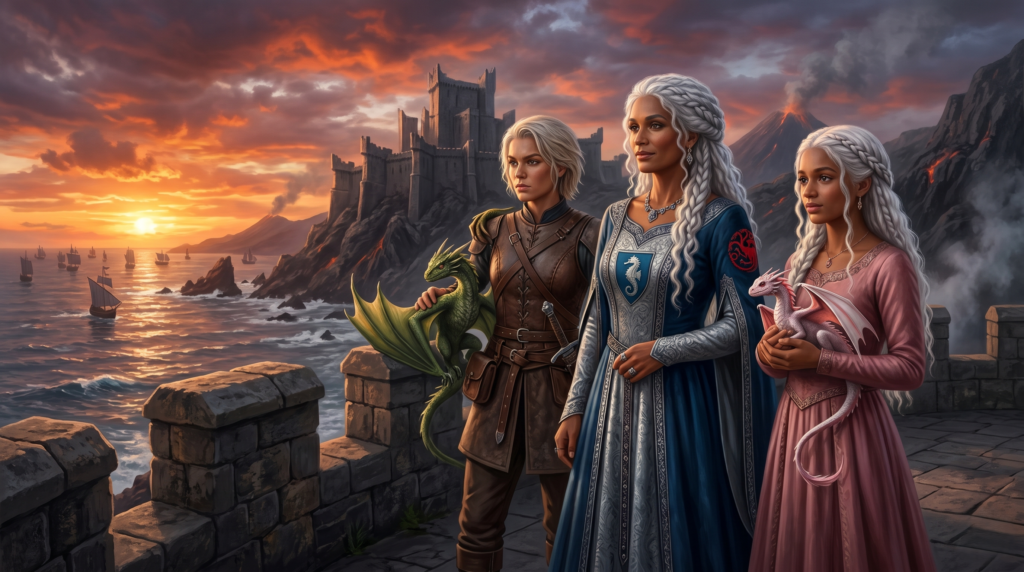
The smoke over the pits of Dragonstone never truly clears, but during the height of the Targaryen dynasty, it billowed with a specific kind of promise—the promise of power, lineage, and the unbreakable bond between a rider and their beast. Yet, behind the Great Council meetings and the clashing of steel, the emotional and political heart of the realm often rested with the women of the sky. To understand the survival of the Iron Throne, one must look closely at the daughters of dragon and her mother, a trio whose bloodline fused the seafaring might of House Velaryon with the draconic fire of House Targaryen.
While history books often obsess over the kings who sat the throne, the story of Lady Laena Velaryon and her twin daughters, Baela and Rhaena, offers a more profound look at what it meant to be a dragonrider in a world that was beginning to burn. This is not just a genealogy; it is a chronicle of resilience, loss, and the fiery legacy that defined an era.
Who Are the “Daughters of the Dragon” and Their Mother?
In the complex web of George R.R. Martin’s A Song of Ice and Fire lore, few families carry as much weight—or as much dragon-fire—as the household of Prince Daemon Targaryen and Lady Laena Velaryon. When fans search for the “daughters of the dragon,” they are uncovering the history of Lady Baela and Lady Rhaena Targaryen.
The “Mother” in this equation is the legendary Lady Laena Velaryon. She was not merely a consort; she was the eldest child of Lord Corlys Velaryon, the “Sea Snake,” and Princess Rhaenys Targaryen, the “Queen Who Never Was.” This lineage made her daughters the ultimate “Power Twins” of Westeros. They were the biological intersection of the two most powerful Valyrian houses remaining in the world.
For the reader, understanding this trio is essential for navigating the events of House of the Dragon. These women represent the “Blacks” in the Dance of the Dragons, but more importantly, they represent the human cost of the Targaryen civil war.
Lady Laena Velaryon: A Dragonrider’s Life and Legacy
Before we can understand the daughters, we must understand the woman who gave them their fire. Lady Laena Velaryon was often described as having the “spirit of the sea and the heart of a dragon.” In a court filled with schemers like Otto Hightower and Larys Strong, Laena stood apart as a figure of pure Valyrian traditionalism and courage.

Claiming Vhagar: The Largest Dragon in the World
One cannot discuss Laena without discussing Vhagar. By the time Laena was twelve, Vhagar was the last surviving dragon from Aegon’s Conquest—a gargantuan, battle-hardened beast that had once carried Queen Visenya.
While many lords feared the sheer size and temper of the old “Hoary Queen,” Laena Velaryon did not hesitate. By claiming Vhagar, Laena didn’t just become a dragonrider; she became the most powerful aerial threat in the known world. This act of bravery set the standard for her daughters. It taught Baela and Rhaena that their worth was not defined by their place in a marriage market, but by their ability to command the monsters of the sky.
A Tragic, Fire-Forged Death
The tragedy of Laena Velaryon is one of the most poignant moments in Targaryen history. After years of happiness with Daemon Targaryen in Pentos, Laena faced a complication during the birth of her third child—a son who died shortly after birth.
-
In the Books (Fire & Blood): Laena, weakened and dying of puerperal fever, attempts to reach Vhagar one last time to fly before she dies. She collapses on the tower steps, a tragic end for a woman who lived for the sky.
-
In the Show (House of the Dragon): The narrative takes a more visceral turn. Knowing she is dying, Laena stumbles to Vhagar and commands the dragon to burn her. It is a “dragonrider’s death”—a final act of autonomy in a world that tried to control her womb.
This moment is the catalyst for everything that follows for the daughters. It left Baela and Rhaena motherless and vulnerable just as the fires of war began to kindle in King’s Landing.
The Twins of Pentos: Baela and Rhaena Targaryen
Born in 116 AC in the Free City of Pentos, Baela and Rhaena were fraternal twins who couldn’t have been more different if they tried. While they shared the silver-gold hair and violet eyes of Old Valyria, their temperaments served as the two different sides of the Targaryen coin.
Growing Up in the Shadow of Giants
The twins spent their earliest years far from the Red Keep. They grew up in the luxury of Pentos, listening to their father’s tales of war and their mother’s songs of the sea. However, this idyllic life was shattered by Laena’s death.
Returning to Westeros for their mother’s funeral was a turning point. They weren’t just returning to their ancestral home; they were entering a shark tank. The loss of their mother was compounded by a political insult: the claiming of their mother’s dragon, Vhagar, by their cousin Aemond Targaryen. For the “daughters of the dragon,” this was more than a loss of power; it was a desecration of their mother’s memory.
The Diverging Paths of the Twins
As they grew, the sisters took on distinct roles:
-
Baela: Became the tomboy, the warrior, and the ward of Driftmark. She was her father’s daughter—bold, rash, and fiercely protective.
-
Rhaena: Became the diplomat and the ward of the Vale. She was more like her grandmother Rhaenys—composed, thoughtful, and deeply aware of the political stakes.
Lady Baela Targaryen: The Wild Spirit of Moondancer
If there is any character who embodies the “fire” in the Targaryen words, it is Baela. She was never content to sit at a needlepoint frame or wait for a husband to dictate her life.
Daemon’s True Heir in Spirit
Baela Targaryen was the only one of Daemon’s children who truly mirrored his chaotic energy. She kept her hair short to keep it out of her eyes while riding, and she was known to prefer the company of stable boys and guards to that of high-born ladies.
Her bond with her dragon, Moondancer, was one of the most intense in the series. Moondancer was a young, slender green dragon—not a behemoth like Vhagar, but incredibly fast. This speed would eventually become Baela’s greatest weapon and her greatest risk.
Baela’s Crucial Role in the Dance of the Dragons
While many nobles hid behind castle walls during the civil war, Baela stayed on the front lines at Dragonstone. When King Aegon II attempted to seize the island secretly, it was Baela who stood in his way.
The Duel over Dragonstone:
In one of the most harrowing aerial battles in the lore, Baela took to the sky on Moondancer to intercept Aegon II on his dragon, Sunfyre. Sunfyre was a massive, elder dragon, but he was wounded. Moondancer was small but agile. Baela used that agility to outmaneuver the King, raining fire upon him. Though Moondancer was ultimately killed and Baela was severely burned, her actions effectively crippled Aegon II for the remainder of the war. She didn’t just fight; she nearly ended the Green pretender’s reign single-handedly.
Lady Rhaena Targaryen: The Patient Warden of the Vale
While Baela was the sword, Rhaena was the shield. Her journey is often overlooked because it lacks the explosive violence of her sister’s, but it is equally vital to the survival of the dynasty.
The Struggle for a Dragon
For a Targaryen, a dragon is more than a pet; it is a manifestation of their soul and status. Rhaena’s early life was defined by a specific kind of grief: her dragon eggs refused to hatch. She watched her sister bond with Moondancer and her cousins bond with their mounts, while she remained “dragonless.”
This “failure” to hatch a dragon in her youth didn’t make her weak; it made her resilient. She learned to navigate the world through alliances and intellect. When the war broke out, she was sent to the Eyrie in the Vale of Arryn. Her mission was ostensibly for her protection, but she carried something far more important than a sword: three dragon eggs.
Safeguarding the Future of House Targaryen
While the dragons of the elder generation were killing each other in the skies over the Riverlands, Rhaena was keeping the embers of the future alive. Her presence in the Vale ensured that the “Black” faction had a foothold in one of the most impregnable regions of Westeros.
The Hatching of Morning:
Towards the end of the war, as the world seemed to be ending, one of Rhaena’s eggs finally hatched. Out came Morning, a beautiful pink-and-white dragon. The birth of Morning was a tectonic shift in the war’s psychology. It signaled that despite the death of the Great Dragons, the Targaryen power was not yet extinct. Rhaena’s patience had paid off, making her the only person in the immediate post-war era with a healthy, growing dragon.

How Their Mother’s Legacy Shaped Their Destinies
The connection between the daughters of dragon and her mother is the emotional anchor of their story. Laena Velaryon was a woman who died because she chose her own path, and her daughters lived by that same creed.
The Shadow of Vhagar
We cannot talk about the daughters without mentioning the trauma of Vhagar’s theft. When Aemond Targaryen claimed Vhagar, he didn’t just take a dragon; he took the twins’ primary connection to their mother. This event solidified their loyalty to Queen Rhaenyra. They didn’t fight for the throne just because of politics; they fought because the Greens represented the people who had “stolen” their mother’s legacy.
Resilience Amidst Extinction
By the end of the Dance, the world was a different place. Most of the dragons were dead. Their father, Daemon, was gone. Their mother was a memory. Yet, Baela and Rhaena stood tall.
-
Baela became a symbol of the fierce, unyielding Targaryen spirit, eventually marrying Alyn Velaryon and ensuring the continuation of the seafaring bloodline.
-
Rhaena became the bridge to the new era, her dragon Morning being the last great hope of the “Golden Age” of riders.
They were the survivors. They were the evidence that House Targaryen could be broken, but it could not be easily extinguished as long as the daughters of Laena Velaryon drew breath.

The Technical Lore: Fire & Blood vs. House of the Dragon
For the SEO-conscious reader and the hardcore lore enthusiast, it is important to distinguish how the “daughters of the dragon” are portrayed across different media.
| Feature | Fire & Blood (Book) | House of the Dragon (TV) |
| Laena’s Death | Dies on the stairs trying to reach Vhagar. | Commands Vhagar to burn her (Dracarys). |
| Baela’s Appearance | Slim, very short hair, boyish clothing. | More regal initially, transitioning to warrior. |
| Rhaena’s Role | Primarily in the Vale, focused on her eggs. | Expanded role in the search for a dragon. |
| The Twins’ Bond | Strong, but they are often physically separated. | More screen time spent on their shared grief. |
Expert insight: The show leans heavily into the “Mother” aspect of the keyword, using Laena’s death to establish the stakes for the “Daughters” earlier than the books do. This makes the eventual payoff of Baela’s duel and Rhaena’s hatching more emotionally resonant for a modern audience.
The Political Impact: Why These Three Women Mattered to the Iron Throne
The “Daughters of the Dragon” were not just secondary characters; they were the key to the Velaryon-Targaryen alliance. Without Laena’s marriage to Daemon, the Sea Snake might never have fully committed his fleet to Rhaenyra’s cause.
Furthermore, during the Regency of Aegon III (the twins’ half-brother), Baela and Rhaena were the most popular figures in King’s Landing. The smallfolk loved them. Baela’s defiance of the Green Council made her a folk hero, while Rhaena’s grace provided a much-needed sense of stability to a war-torn city. They were the “Faces of the Franchise” during the darkest days of the dynasty.
Frequently Asked Questions (FAQs)
Q: Who is the “Mother” of the Daughters of the Dragon?
A: The mother is Lady Laena Velaryon. She was a dragonrider (who rode Vhagar) and the wife of Prince Daemon Targaryen.
Q: What dragons did Baela and Rhaena Targaryen ride?
A: Baela rode Moondancer, a swift green dragon. Rhaena eventually rode Morning, a pink-and-white dragon that hatched toward the end of the Dance of the Dragons.
Q: Did the daughters of the dragon survive the Dance of the Dragons?
A: Yes. Both Baela and Rhaena survived the civil war, though Baela suffered significant scarring from her battle with King Aegon II.
Q: Why are they called the “Daughters of the Dragon”?
A: This is a common fan and in-universe term referring to their father, the “Rogue Prince” Daemon Targaryen, and their pure Valyrian heritage which allowed them to be prominent dragonriders.
Q: Who did Baela and Rhaena marry?
A: Baela married Lord Alyn Velaryon (the Oakenfist). Rhaena married twice: first to Ser Corwyn Corbray and later to Garmund Hightower, with whom she had six daughters.
Conclusion: A Legacy Forged in Fire
The story of the daughters of dragon and her mother is a testament to the fact that power in Westeros is not always found in a crown. It is found in the courage to claim a beast like Vhagar, the audacity to challenge a king over the skies of Dragonstone, and the patience to wait for a dragon egg to hatch when all hope seems lost.
Lady Laena Velaryon gave her daughters more than just silver hair and high-born names; she gave them the blueprint for how to live and die with dignity. As House of the Dragon continues to unfold, the legacy of Baela and Rhaena will stand as a reminder that while kings may start wars, it is often the daughters of the dragon who determine how those wars end and what rises from the ashes.
Whether you are a fan of the tactical warfare of the books or the emotional character arcs of the TV series, the lineage of Laena, Baela, and Rhaena remains one of the most fascinating chapters in the history of the Seven Kingdoms. Their fire didn’t just burn; it lit the way for the future of House Targaryen.
Author’s Note: This deep dive into Targaryen lore was compiled using primary sources from George R.R. Martin’s “Fire & Blood” and production notes from HBO’s “House of the Dragon.” For more insights into the complex families of Westeros, be sure to check our other guides on House Velaryon and the history of the Great Dragons.


