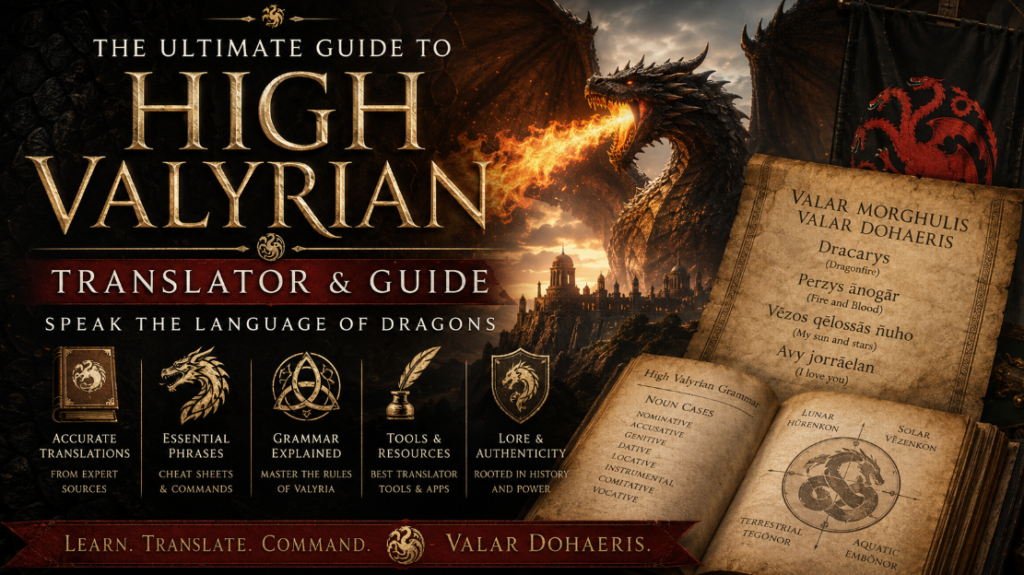
There is an undeniable, visceral thrill in watching Daenerys Targaryen issue the chillingly calm command, “Dracarys,” before her enemies are consumed by dragonfire. Fast forward to House of the Dragon, and we see Rhaenyra and Daemon Targaryen using the exact same ancient tongue to assert their royal dominance, plot their strategies, and connect with their dragons. High Valyrian is much more than mere fantasy dialogue; it represents an entire rich history of magic, dragons, and absolute power. If you are reading this guide, you are likely searching for a reliable valyrian translator to convert your favorite English quotes, design a culturally authentic tattoo, or elevate your cosplay to the next level.
However, you have almost certainly hit a frustrating wall. If you try to rely on standard AI tools, or punch your heartfelt English phrases into a random fantasy text generator found on page three of Google, you are practically guaranteed to end up with embarrassing, nonsensical gibberish. The harsh truth of the matter is that translating English to High Valyrian is not as simple as swapping words out one-for-one.
This comprehensive, skyscraper-level guide is your ultimate roadmap to mastering the language of Old Valyria. We are going to explore the absolute best, most accurate translation resources available today, provide an essential cheat sheet of popular phrases, and break down the fundamental grammatical rules of the language. By the end of this guide, you will have the knowledge to ensure your next dragon command is linguistically flawless.
The Linguistics of Dragonfire: Why High Valyrian is a “Real” Language
Before diving into the tools, it is crucial to establish why a simple, flawless “Google Translate for Game of Thrones” does not exist. High Valyrian is not just a random collection of cool-sounding syllables thrown together by scriptwriters; it is a meticulously constructed language, commonly referred to in linguistic circles as a “conlang.”
The Creator: Master Linguist David J. Peterson
When author George R.R. Martin wrote the A Song of Ice and Fire novels, he only created a handful of Valyrian words and phrases to add flavor to the text. The most notable of these, of course, were Valar Morghulis (All men must die) and Valar Dohaeris (All men must serve). However, when HBO adapted the series for television, the script required extensive, spoken dialogue.
Enter David J. Peterson, a master linguist who originally won a contest to create the Dothraki language for season one, and subsequently developed High Valyrian for season three. Peterson didn’t just invent words; he built an entire, robust linguistic framework from scratch. He created a unique alphabet, strict grammatical rules, noun cases, and complex verb conjugations.
High Valyrian vs. Low Valyrian: Understanding the Lore
To truly master a Valyrian translation, you must understand the lore behind the words. In the fictional world of Westeros and Essos, High Valyrian functions much like classical Latin did in medieval Europe. It is the language of ancient scholars, poetry, spells, and Targaryen royalty. It is pure, highly structured, and carries immense prestige.
Low Valyrian (often referred to derogatorily as Bastard Valyrian), on the other hand, consists of the varied, naturally evolved dialects spoken by the common folk in Slaver’s Bay and the Free Cities. For example, the Astapori Valyrian spoken by the Unsullied is a form of Low Valyrian. When fans look for translation tools, 99% of the time, they are looking for the pure, classical High Valyrian spoken by Daenerys and Rhaenyra.
Why It Matters for Your Translation
Because Peterson built High Valyrian as a fully functional language, English syntax does not map perfectly onto it. You cannot simply take the English sentence “The dragon eats the man,” look up those five words in a Valyrian dictionary, and string them together in that order. Nouns change their spelling based on their role in the sentence (subject vs. object), and verbs are conjugated based on who is doing the action and when. This complex grammatical structure is exactly why relying on a fully automated, low-quality translator website often results in permanent tattoo regrets. To translate correctly, you need the right tools and a basic understanding of the mechanics.

Top 5 Best Valyrian Translator Tools & Resources
If you want accurate, reliable results, skip the meme-generator websites and utilize these expert-approved resources to learn and translate the language of Old Valyria.
1. The Languages of David J. Peterson (The Official Wiki/Dictionary)
When it comes to pure vocabulary, this is the absolute, undisputed source of truth on the internet. Maintained by dedicated conlang experts and heavily drawing from Peterson’s own official notes and updates, the High Valyrian dictionary functions like an intricate, highly detailed Wiktionary.
-
Why use it: If you need to know the exact word for “fire,” “blood,” or “sword,” this database provides the root word, its gender, and exactly how it declines in a sentence.
-
Expert Tip: Use this tool to look up individual root words rather than attempting to translate full, complex sentences all at once. It is the bedrock of any accurate, manual translation effort.
2. Duolingo’s High Valyrian Course
In an unprecedented move for a fantasy television series, the language-learning giant Duolingo partnered directly with David J. Peterson and HBO to create an official, interactive High Valyrian course. With millions of active learners globally, it remains the most robust, accessible tool available.
-
Why use it: While it is not a direct “type-and-translate” text box, it is undeniably the best way to internalize the sentence structure and grammar naturally. Spending just two to three weeks on the app will drastically improve your ability to construct your own accurate translations from scratch.
3. Talkpal AI & Specialized Learning Bots
As we navigate the modern digital landscape, generalized AI has historically struggled with niche conlangs. However, specialized language-tutor bots and platforms like Talkpal have begun integrating High Valyrian vocabulary and grammar rules for interactive, text-based roleplay.
-
Why use it: If you want to practice conversational Valyrian or test a translated phrase to see if the grammar holds up in a contextual dialogue, these specialized AI tutors offer real-time feedback that older, static dictionary websites simply cannot provide.
4. The r/HighValyrian Subreddit & Discord Communities
When automated tools and dictionaries fail to capture the nuance you need, human expertise prevails. The r/HighValyrian subreddit and its associated Discord servers are populated by incredibly dedicated linguists and hardcore fans who have studied Peterson’s work extensively.
-
Why use it: This is your ultimate safety net. If you are translating a long, complex phrase for a permanent tattoo, wedding vows, or a published piece of fanfiction, you should always submit your attempt to these human experts for peer review. They can catch nuanced grammatical errors and idiom mistranslations that apps completely miss.
5. English-to-Valyrian Dictionary Apps (Use with Extreme Caution)
You will undoubtedly find several mobile apps on the iOS App Store and Google Play claiming to be comprehensive High Valyrian dictionaries or translators.
-
Why use it: These are incredibly handy for quick, single-word vocabulary lookups while you are walking the floor at a Comic-Con or actively watching an episode of House of the Dragon.
-
The Warning: Never, under any circumstances, use these apps to translate full English sentences word-for-word. They lack the contextual awareness to conjugate verbs or decline nouns properly, which will leave you speaking a broken, confusing mess instead of regal High Valyrian.

The Ultimate High Valyrian Cheat Sheet for Fans
Sometimes, you do not need to learn the entire language; you just need the perfect phrase for your next Instagram caption, cosplay video, or everyday life. Below is a highly accurate cheat sheet of the most essential High Valyrian phrases, fully vetted for grammatical accuracy.
Essential Greetings and Iconic Quotes
Whether you are greeting a fellow fan or quoting the most famous lines from the books and shows, these are the staples you need to know.
| English Meaning | High Valyrian | Pronunciation Guide |
| Hello | Rytsas | RIT-sas |
| Goodbye | Geros ilas | GAIR-os EE-las |
| How are you? | Skorkydoso glaesā? | Skor-kee-DOE-so GLY-sah? |
| All men must die | Valar Morghulis | VAH-lar Mor-GOO-lis |
| All men must serve | Valar Dohaeris | VAH-lar Doh-HAIR-is |
| Fire and Blood | Perzys ānogār | PAIR-zees AH-no-gar |
Dragon Commands (For Cosplay… or Pet Training!)
A rising trend among Game of Thrones fans is using High Valyrian dragon commands to train their dogs, cats, or even horses. It is unique, highly effective (as the words sound very distinct to animals), and undeniably fun.
-
Dracarys (Drah-KAH-ris): Dragonfire / Attack / Hunt mode.
-
Lykirī (Lee-KEE-ree): Calm down / Be peaceful / Chill out.
-
Sōvēs (So-VAYS): Fly / Jump up.
-
Māzīs (MAH-zees): Come here.
-
Umbās (OOM-bahs): Wait / Stay.
-
Dohaerās (Doh-HAIR-ahs): Serve / Listen to me / Obey.
-
Naejot (NYE-jot): Forward / Walk on.
Romantic Phrases for Tattoos and Vows
Looking to express your love in the language of dragons? These phrases are incredibly popular for couples’ tattoos, wedding rings, and anniversary gifts.
-
Avy jorrāelan: I love you.
-
Vēzos qēlossās ñuho: My sun and stars. (Famously spoken by Daenerys to Khal Drogo, translated into Valyrian).
-
Ñuho glaeso hūrus: Moon of my life. (Drogo’s reciprocal term of endearment).
Translating Your Own Phrases: A Beginner’s Grammar Primer
If you want to move beyond basic cheat sheets and truly use a valyrian translator tool effectively, you need a foundational understanding of the language’s mechanics. High Valyrian is a highly inflected language, meaning words change their endings to convey grammatical information. Here is a beginner-friendly primer to help you construct your own sentences like a true Targaryen.
1. Alphabet and Pronunciation Rules
Before you can translate, you must know how to speak the words. High Valyrian uses the standard Latin alphabet, but with a few specific pronunciation rules that differ from English:
-
The Macrons (ā, ē, ī, ō, ū): When you see a horizontal line over a vowel, it simply means you hold that vowel sound slightly longer. Think of it as a “long” vowel in phonetics.
-
The Rolling “R”: The letter “r” should be trilled or rolled, exactly as it is in Spanish or Italian. This gives the language its rolling, aggressive, yet poetic sound.
-
The Hard “G”: The letter “g” is always pronounced hard, as in “get” or “dragon.” It is never pronounced soft like “gel” or “giant.”
-
The “Ñ” and “Q”: The “ñ” is pronounced like the “ny” in “canyon.” The “q” is a uvular stop—meaning it is pronounced further back in the throat than a standard “k.”
2. Noun Cases and Gender (The Latin Influence)
In English, the order of words tells us what is happening (e.g., “The dog bites the man” vs. “The man bites the dog”). In High Valyrian, the ending of the noun tells you its role in the sentence.
High Valyrian has eight distinct noun cases (Nominative, Accusative, Genitive, Dative, Locative, Instrumental, Comitative, and Vocative). If a noun is doing the action, it takes the Nominative ending. If a noun is receiving the action, it takes the Accusative ending.
Furthermore, High Valyrian nouns do not use “masculine” or “feminine” genders. Instead, David J. Peterson brilliantly categorized them into four elemental classes:
-
Lunar (hūrenkon qogror): Associated with the moon and air.
-
Solar (vēzenkon qogror): Associated with the sun and fire.
-
Terrestrial (tegōñor qogror): Associated with the earth and land.
-
Aquatic (embōñor qogror): Associated with water and liquids.
When using a dictionary tool to look up a word, you must identify its class to know how its ending will change in a sentence.
3. Verb Placement & The “Pro-Drop” Rule
English is an SVO language (Subject-Verb-Object). We say, “I (Subject) see (Verb) the dragon (Object).”
High Valyrian is generally an SOV language (Subject-Object-Verb). The verb almost always anchors the end of the sentence. In Valyrian syntax, you would effectively say, “I the dragon see.”
Additionally, High Valyrian is a pro-drop language. Because verbs are conjugated so specifically, the verb itself tells the listener exactly who is doing the action. Therefore, pronouns like “I,” “You,” or “He/She” are usually dropped entirely. For example, the verb iksā translates perfectly to “you are.” You do not need to add the Valyrian word for “you” in front of it; doing so would sound clunky and redundant to a native speaker.
Common Pitfalls: Why Direct English Translations Usually Fail
Armed with a dictionary, it is tempting to just start plugging words together. But if you want your translation to hold up to the scrutiny of the fandom, you must avoid these common traps.
-
Translating Idioms: English is full of idioms that make zero sense when translated literally. If you try to translate “break a leg” or “spill the tea” into High Valyrian, you will end up describing literal bone fractures and spilled beverages. When translating, break your English phrase down into its most literal, universally understood meaning first.
-
Ignoring Word Order: As mentioned above, placing your verbs in the middle of a Valyrian sentence is a dead giveaway that you used a low-quality online generator rather than doing the actual translation work.
-
The Tattoo Warning: We cannot stress this enough—if you are getting a High Valyrian phrase permanently inked on your body, do not trust a single website or automated app. The internet is full of photos of fans with grammatically disastrous tattoos because they trusted a random “translator” button. Always take your intended phrase to the r/HighValyrian community and have two or three humans independently verify the grammar before you sit in the tattoo chair.

Frequently Asked Questions (FAQs)
To make this the ultimate resource, we have answered the most common questions fans ask when diving into the linguistics of Westeros.
Is there a Google Translate for High Valyrian?
No. Google Translate does not currently support High Valyrian. While there are a few fan-made sites that mimic the layout of Google Translate, their accuracy is notoriously poor for anything longer than a single word. You must rely on official dictionaries, Duolingo, and grammatical rules.
How long does it take to learn High Valyrian?
If you use a tool like Duolingo consistently for 15-20 minutes a day, you can grasp the basic grammar and start forming simple sentences within a month. Becoming fluent enough to write complex poetry or long paragraphs will take several months of dedicated study, much like learning a real-world language.
Is the Valyrian spoken in House of the Dragon the exact same as in Game of Thrones?
Yes! Because House of the Dragon takes place nearly 200 years before Game of Thrones during the height of the Targaryen dynasty, the characters speak the exact same classical High Valyrian. The only difference is that they speak it much more frequently and fluently than Daenerys, who had to learn it largely while in exile.
What is the High Valyrian word for Dragon?
The word is Zaldrīzes (Pronounced: Zal-DREE-zes). It is a solar class noun.
Can I translate my own name into Valyrian?
Unlike nouns and verbs, personal names usually do not translate. If your name is Sarah or Michael, your name in High Valyrian is still Sarah or Michael. However, Valyrian speakers would likely pronounce your name using Valyrian phonetics (rolling the R’s, adjusting the vowels), and if your name was part of a sentence, it might take on a Valyrian suffix to show its grammatical case.
Conclusion: Embrace the Language of Old Valyria
The desire to speak the language of dragons is a testament to the incredible world-building of George R.R. Martin, HBO, and master linguist David J. Peterson. While a magic, one-click valyrian translator button that guarantees 100% accuracy does not exist, you now have something much better: the knowledge to do it yourself.
By utilizing the official dictionaries, practicing with interactive tools like Duolingo, relying on community experts for verification, and understanding the basic grammar structure of the language, you can craft translations that are undeniably authentic. Whether you are prepping for your next cosplay, designing a stunning new tattoo, or just wanting to yell “Dracarys!” at your dog with perfect pronunciation, you are now equipped to speak like a true scion of Old Valyria.
Now it’s your turn! What English phrase are you trying to translate into High Valyrian right now? Drop your phrases in the comments below, or share pictures of your Valyrian tattoos with us on social media. Valar Dohaeris!


