
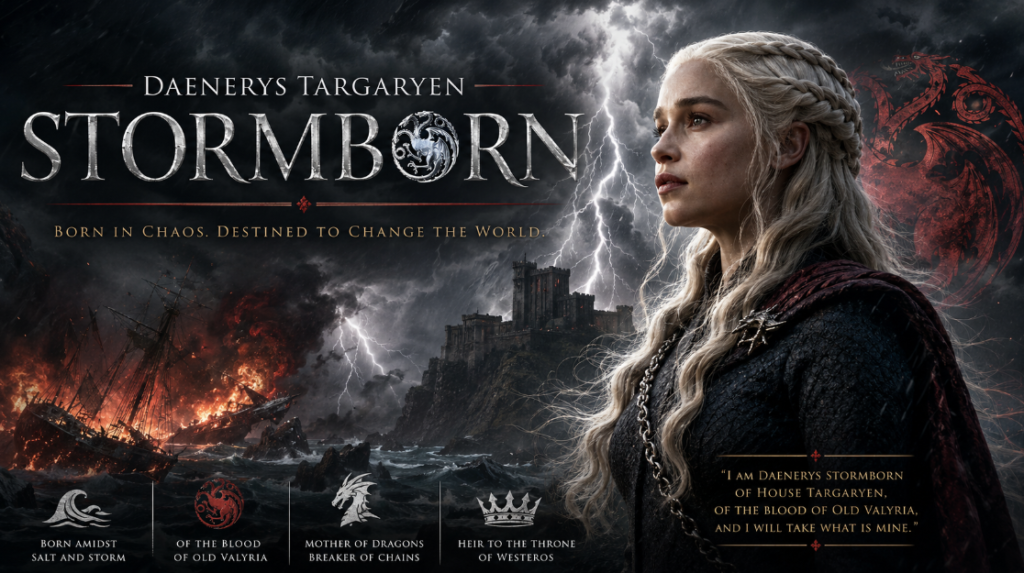
Imagine the sky tearing open over the Narrow Sea, unleashing a tempest so violent it shattered the very foundations of the old world order. In 284 AC, amidst the crumbling remnants of a nearly three-century-long dynasty, a child was brought into the world under a black, howling sky. When fans of Game of Thrones and George R.R. Martin’s A Song of Ice and Fire discuss the legacy of Daenerys, one title stands as the foundation of her mythos: Targaryen Stormborn.
Far from a simple geographic identifier, this title encapsulates a turning point in the history of Westeros. To understand Daenerys is to understand that she was not just a displaced princess; she was a child of literal and metaphorical chaos. “Stormborn” isn’t merely a moniker of birth—it is a prophetic marker that defined her psychology, legitimized her leadership, fueled her claim to the Iron Throne, and ultimately foreshadowed the destruction she would unleash.
For fans seeking a deeper understanding of Westerosi lore, unpacking this specific title provides the key to understanding the series finale, the intricate prophecies of Valyria, and the enduring, blood-soaked legacy of House Targaryen.
II. The History of the Great Storm at Dragonstone (284 AC)
To fully grasp the weight of the “Stormborn” legacy, we must first look at the historical context of the world she was born into. The year was 284 AC (After the Conquest). Robert’s Rebellion had reached its bloody conclusion. Prince Rhaegar Targaryen had fallen at the Trident, the Mad King Aerys II had been slain by the Kingslayer, and the forces of House Baratheon and Lannister had seized King’s Landing.

The Last Stand of House Targaryen
The only surviving members of the royal family—Queen Rhaella (who was heavily pregnant) and the young Prince Viserys—had fled to the ancestral Targaryen stronghold of Dragonstone. It was a bleak, volcanic island fortress in the Narrow Sea, serving as the last refuge for a family that had ruled the Seven Kingdoms for nearly 300 years. Their survival hinged entirely on the Royal Fleet anchored off the coast of the island, ready to evacuate them to the Free Cities of Essos if Stannis Baratheon’s forces approached.
The Meteorological Event That Broke the Fleet
On the night Daenerys was born, Westeros experienced the greatest summer storm in living memory. The tempest was so fiercely violent that it ripped stone blocks from the battlements of Dragonstone. More devastatingly, the raging sea smashed the remaining Targaryen fleet to splinters against the jagged rocks of the island.
This was not just a weather event; it was a catastrophic military loss. The destruction of the fleet removed the Targaryens’ last line of defense and their primary means of secure escape, rendering the newborn princess and her brother completely vulnerable.
The Birth of Daenerys and the Death of Rhaella
Amidst this roaring chaos, Queen Rhaella went into labor. The birth was difficult, and the queen succumbed to complications shortly after bringing her daughter into the world. Daenerys was thus born an orphan, bathed in the tragedy of her mother’s death and the literal destruction of her family’s remaining power.
From an expert lore perspective, the timing of her birth during this cataclysmic storm led many loyalists and observers across the Narrow Sea to believe she was either blessed by the old gods of Valyria—marked for greatness—or cursed to bring ruin wherever she went. The storm was the universe’s violent announcement that the blood of the dragon had not yet been extinguished.

III. Symbolism: What it Means to be “Stormborn”
In literature and television, names carry profound thematic weight. For Daenerys, adopting and weaponizing the “Stormborn” title was essential to her survival and her eventual ascent to power.
The Duality of the Storm
A storm is inherently dualistic in nature. On one hand, it represents terrifying destruction, capable of leveling cities, drowning fleets, and uprooting ancient trees. On the other hand, storms are cleansing. They wash away the old, parched earth and pave the way for new growth.
This duality perfectly mirrors Daenerys’ character arc throughout Game of Thrones. She viewed herself as a cleansing force, destined to “break the wheel” of feudal oppression in Westeros and the slave trade in Slaver’s Bay. Yet, to achieve this cleansing, she had to act as a force of utter devastation, raining fire and blood upon those who stood in her way. Being “Stormborn” meant she was comfortable wielding chaos to achieve her vision of order.
A Title of Survival
Before she was the Mother of Dragons, the Breaker of Chains, or the Khaleesi of the Great Grass Sea, she was simply Daenerys Stormborn. During her formative years wandering the Free Cities of Essos as a “Beggar Queen” with her abusive brother Viserys, this title was her only armor. Stripped of wealth, armies, and a home, the memory of the storm was proof of her royal heritage. It was a psychological anchor that reminded her—and her enemies—that she survived the wrath of the gods on the night she was born; therefore, she could survive the assassins and betrayals of men.
Elemental Branding
House Targaryen is famous for its elemental connection to “Fire and Blood,” but the addition of the storm element makes Daenerys unique among her ancestors. While other Targaryen rulers earned epithets based on their deeds—Aegon The Conqueror, Maegor The Cruel, Aegon The Unlikely—Daenerys was branded by an uncontrollable act of nature at birth. This elemental branding set her apart, aligning her less with mortal monarchs and more with the mythic, god-like figures of ancient Valyrian folklore.
IV. The Prophetic Connection: Is the Stormborn the “Prince That Was Promised”?
Beyond mere historical record, the circumstances of Daenerys’ birth intersect directly with the most closely guarded and debated prophecies in the A Song of Ice and Fire universe. For deep-lore enthusiasts, the “Stormborn” title is the smoking gun in the mystery of Azor Ahai—the legendary hero destined to deliver the world from the Long Night.
The Salt and Smoke Connection
According to the ancient texts of Asshai, the “Prince That Was Promised” (often used interchangeably with Azor Ahai reborn) would be born amidst “salt and smoke” beneath a bleeding star. Daenerys Targaryen perfectly fulfills this elemental criteria. She was born on Dragonstone, a volcanic island that constantly vents sulfurous smoke, during a massive tempest that whipped the salt water of the Narrow Sea into a frenzy. The “bleeding star” later aligned with the red comet that heralded the birth of her dragons.
Maester Aemon’s Tragic Realization
One of the most poignant moments highlighting this prophecy involves Maester Aemon of the Night’s Watch—himself a Targaryen. In his final days, Aemon realizes a crucial mistranslation in the ancient Valyrian texts. The Valyrian word for “prince” is gender-neutral.
As Aemon famously stated, the dragons are neither male nor female, but “now one and now the other, as changeable as flame.” Aemon concluded that the prophecy had never referred to a male savior at all. Daenerys, the Targaryen Stormborn, born amidst the salt of the roaring sea and the smoke of Dragonstone, was the true savior they had been waiting for. This revelation transforms her title from a poetic surname into a divine mandate.
V. How “Stormborn” Defined Daenerys’ Leadership Style
Psychologically, a leader is shaped by the narrative they build around themselves. Daenerys didn’t just survive the storm; she internalized it. This internal tempest dictated her entire approach to ruling, warfare, and justice across Essos and Westeros.
Breaking the Wheel
Daenerys viewed the established political systems of the Seven Kingdoms as a stagnant, crushing wheel that ground the poor and powerless into the dirt. A traditional ruler might seek to stop the wheel or simply sit on top of it, but a storm does not negotiate with architecture—it obliterates it. Her infamous “break the wheel” philosophy is the political equivalent of a hurricane. It relies on overwhelming, unpredictable force to wipe the slate clean so a new world can be built from the wreckage.
The Emotional Weight of the Title
When Daenerys introduced herself, her list of titles was legendary, but “Stormborn” always carried a unique weight. To the Dothraki, a culture that worships strength and fears the open water, a leader born from a raging sea storm commanded immense superstitious awe. To the Unsullied, who were stripped of their humanity and identities, following a queen forged in the violent crucible of nature offered a sense of divine purpose. The title functioned as a brilliant piece of psychological warfare against her enemies and a rallying cry for her followers.
From Survivor to the “Mad Queen”
However, a storm is ultimately impossible to control. As the series progressed toward its controversial conclusion, the “Stormborn” persona began to eclipse her identity as a protector. The destruction of King’s Landing by dragonfire was not just an act of vengeance; it was the final, terrifying manifestation of her elemental nature. The storm that began on Dragonstone in 284 AC finally reached the capital, consuming the innocent and the guilty alike.
VI. Comparison: Daenerys vs. Other “Storm” Figures in Westeros
To understand the uniqueness of Daenerys’ title, it is helpful to contrast her with other figures in George R.R. Martin’s universe who are associated with storms.
The Storm Kings of House Durrandon
Before Aegon’s Conquest, the Stormlands were ruled by House Durrandon, the ancient “Storm Kings” who built the impenetrable fortress of Storm’s End. Their founder, Durran Godsgrief, famously declared war on the sea gods themselves. While the Storm Kings were defined by their stubborn resistance against storms, Daenerys was the physical embodiment of one. The Durrandons built walls to survive the weather; Daenerys used it as her identity.
The Contrast with Stannis Baratheon
Stannis Baratheon, who held Dragonstone for years, also fancied himself a savior. As the Lord of Dragonstone and the Master of Ships, Stannis had a deep connection to the sea and the island. Yet, his rigid, unbending nature was the antithesis of a storm. Stannis broke because he could not bend, whereas the Targaryen Stormborn harnessed the chaos to adapt, conquer, and overwhelm.
VII. The “Stormborn” Legacy in House of the Dragon
The recent hit prequel series, House of the Dragon, adds fascinating retroactive context to Daenerys’ birth.
The Song of Ice and Fire Prophecy
In House of the Dragon, King Viserys I reveals to his heir, Rhaenyra, that Aegon the Conqueror foresaw the end of the world of men—a terrible winter blowing from the North. Aegon called his prophetic dream “A Song of Ice and Fire.”
This revelation deepens the lore of the Stormborn title. Daenerys wasn’t just born into a random weather event; her birth was the culmination of a centuries-old magical bloodline preparing for the Long Night. The elemental focus of House of the Dragon—constantly emphasizing that Targaryens are closer to gods than men—lays the groundwork for why Daenerys’ miraculous birth was so crucial to the fate of the realm.

VIII. Why Fans Still Debate the “Stormborn” Moniker Today
Years after the finale of Game of Thrones, the legacy of Daenerys Targaryen remains fiercely debated on forums, Reddit, and pop culture essays.
The Nature vs. Nurture Debate
Was Daenerys destined to burn King’s Landing because she was “Stormborn,” inherently tied to chaos and the “coin flip” of Targaryen madness? Or was she a victim of trauma, betrayal, and a brutal world that forced her to become a monster? Fans continue to argue whether her title was a warning of her eventual tyranny or simply a tragic irony for a woman who tried to do good but was consumed by her own power.
Cultural Impact
Despite her dark turn, the name has left an indelible mark on modern pop culture. It has been used to symbolize female empowerment, resilience in the face of insurmountable odds, and the fierce independence required to navigate a hostile world. “Stormborn” remains one of the most recognizable epithets in fantasy literature history.
IX. FAQ: Clearing Up Common Misconceptions
Q: Was Daenerys the only Targaryen born during a storm?
While Westeros experiences storms frequently, the tempest of 284 AC is explicitly described as the most catastrophic summer storm in living memory. Its sheer destructive power, coupled with the fall of the Targaryen dynasty, made her birth exceptionally unique in the annals of Westerosi history.
Q: Did the storm actually happen, or is it Targaryen propaganda?
Some deep-lore fans point to the “Lemon Tree” theory—noting Daenerys remembers a lemon tree from her childhood in Braavos, where lemons do not typically grow, suggesting her childhood memories (and perhaps the story of her birth) are flawed. However, the destruction of the Targaryen fleet at Dragonstone is an internationally recognized historical fact in the books, confirming the reality of the Great Storm.
Q: How does the “Stormborn” title differ from “Mother of Dragons”?
“Stormborn” is her origin—it represents her survival, her royal blood, and her prophetic destiny. “Mother of Dragons” represents her power, her magical awakening, and her means of conquest. One is who she is; the other is what she achieved.
X. Conclusion: The Storm That Never Ended
The title Targaryen Stormborn is far more than a stylistic flourish appended to the name of a queen. It is the narrative cornerstone of Daenerys Targaryen’s journey from a frightened exile to the most powerful conqueror the known world had seen in three centuries.
Her birth under a black sky and roaring thunder was the universe’s first signal that the Dragon dynasty was not yet extinguished. It linked her to ancient prophecies, defined her uncompromising leadership, and ultimately foreshadowed the devastating “fire and blood” she would bring to the shores of Westeros. Daenerys did not just survive the storm at Dragonstone; she became the storm that washed away the old world.
What do you think? Was the ‘Stormborn’ title a true sign of divine destiny, or just a coincidence of weather that a clever queen used for propaganda? Share your thoughts and join the debate in the comments below!


