
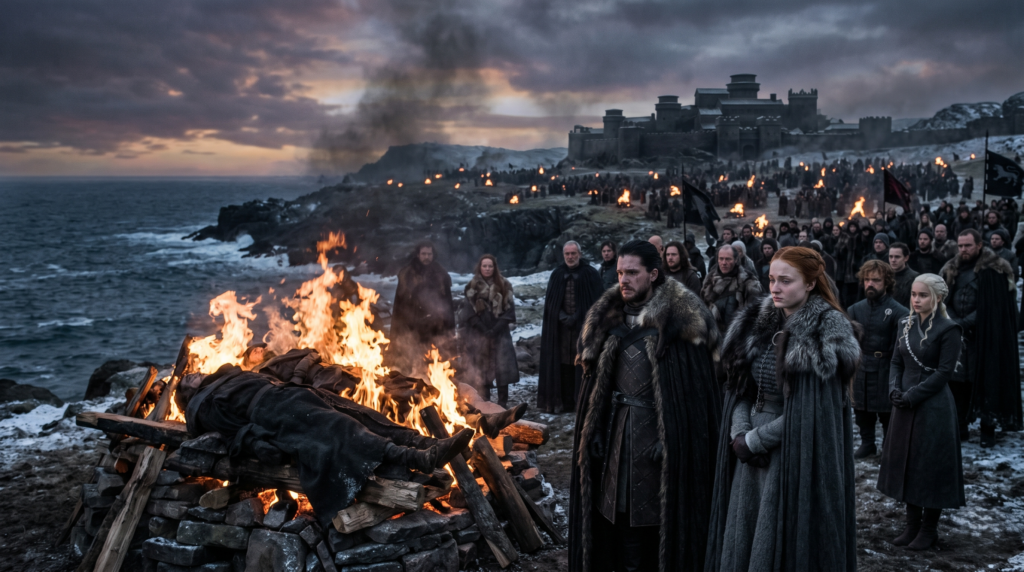
In Westeros, death isn’t just a plot point—it’s the primary industry. From the sun-drenched steps of King’s Landing to the frozen tundra Beyond the Wall, the mortality rate is staggering. But who cleans up the mess after the “Rains of Castamere” stop playing? If there is one glaring logistical oversight in George R.R. Martin’s universe, it is the profound lack of professional death care. Enter a modern equivalent: Ponders Funeral Home. If a highly trained, fully staffed facility like Ponders Funeral Home existed in the Seven Kingdoms, they wouldn’t just be profitable; they would be the most essential institution in the realm.
The lack of organized, professional death care in the Seven Kingdoms leads to desecrated remains, biological hazards, and unresolved grief for survivors. By applying the modern standards, logistical expertise, and compassion of a professional funeral service to the world of Game of Thrones, we can analyze just how drastically proper mortuary science would have fundamentally changed the political and social landscape of the series.
Here is an expert analysis of the death-care logistics in Westeros, and why professional funeral directors would be the true saviors of the realm.
The Logistics of Mass Casualty Events: Beyond the “Bells”
In modern disaster management, a Mass Casualty Incident (MCI) triggers an immediate, highly organized response from forensic pathologists, disaster mortuary teams, and funeral directors. In Westeros, an MCI is usually just called “Tuesday.” Without a professional infrastructure to handle mass casualties, the aftermath of battles and betrayals becomes a breeding ground for disease, disrespect, and deep-seated political vendettas.
Handling the Aftermath of the Red Wedding
The Red Wedding is perhaps the most infamous massacre in television history. But beyond the emotional shock value, it presented a catastrophic mortuary failure.

Field Recovery and Identification
When noble houses are decimated in a surprise attack, the immediate challenge is field recovery and identification. In the modern world, experts like those at Ponders Funeral Home understand the critical importance of a “chain of custody.” This means properly tagging, identifying, and securing remains to prevent the trauma of ambiguous loss.
At the Twins, the Freys engaged in the mass dumping of bodies into the river—a catastrophic environmental hazard. A professional disaster recovery team would have established a temporary morgue, utilizing forensic techniques to identify the bannermen of House Stark and House Tully, ensuring that families received the correct remains. In a feudal society where lineage and inheritance are everything, proper identification isn’t just polite; it prevents decades of legal and political disputes over succession.
Respectful Repatriation
The desecration of Robb Stark’s body—sewing his direwolf’s head onto his shoulders—was a profound violation of the laws of war and basic human decency. This single act of desecration fueled the Northern conspiracy and prolonged the conflict.
Professional funeral directors are trained in repatriation: the safe, respectful return of deceased individuals to their home region. Had a neutral, professional third party been contracted to manage the casualties, “The Young Wolf” and his mother, Catelyn Stark, would have been afforded immediate preservation and respectful transport back to the crypts of Winterfell. By treating the deceased with dignity, professional funeral services act as a buffer against escalating wartime atrocities.
The Battle of the Bastards: A Sanitization Nightmare
While the Red Wedding was a targeted assassination, the Battle of the Bastards outside Winterfell was a conventional military clash that created a completely different set of logistical nightmares.
Public Health and Sanitation
During the Battle of the Bastards, the sheer volume of casualties created literal “corpse mountains.” From a public health and sanitation perspective, this is a ticking time bomb. Decomposing human and equine remains rapidly release biohazards, contaminating groundwater and attracting scavengers, which in turn spread medieval plagues like typhoid or cholera.
A professional death-care facility would recognize this as an acute epidemiological crisis. Proper interment requires heavy machinery (or in Westeros, organized draft teams) to dig mass graves deep enough to prevent soil disruption, or the systematic application of quicklime to accelerate decomposition and mitigate bacterial spread. The lack of organized burial services in the North meant that the survivors of the battle were immediately exposed to a secondary, invisible enemy: rampant disease.
Specialized Mortuary Science in a World of Ice and Fire
In the real world, mortuary science deals with biology, chemistry, and grief. In Westeros, it also has to deal with necromancy. The White Walker threat transformed standard burial practices from a cultural ritual into a matter of urgent national security.
Cremation Services: The Only Defense Against the Night King
For centuries, the Free Folk (Wildlings) understood a grim reality: burn your dead, or fight them later. However, their methods were rudimentary and highly inefficient.

The Necessity of Immediate Cremation
In a world where any intact biological material can be reanimated by the Night King, a facility like Ponders Funeral Home wouldn’t just be a place of mourning; it would be a primary defense contractor. Systematic, immediate cremation is the only fail-safe against the Army of the Dead.
Pyres vs. Modern Retorts
The Westerosi method of cremation relies on open-air funeral pyres. As seen at the funerals for the Night’s Watch or Khal Drogo, pyres are incredibly inefficient. They require massive amounts of dry timber (a scarce resource in the North) and take hours, sometimes days, to fully reduce a body to ash, often leaving large bone fragments behind.
Modern funeral homes utilize high-efficiency cremation retorts. These chambers reach temperatures of up to 1,800°F (982°C), achieving complete calcification in a fraction of the time, regardless of weather conditions. If the Night’s Watch had been equipped with industrial-grade crematories designed by mortuary experts, they could have systematically processed the dead, drastically reducing the Night King’s recruitment pool without depleting the North’s strategic lumber reserves.
Preservation in Extreme Climates: From The Wall to Sunspear
The geography of Westeros presents extreme challenges for transporting the dead. From the blistering heat of Dorne to the freezing winds of the North, moving a body for days or weeks without refrigeration is a biological impossibility without severe decomposition.
Embalming for Long-Distance Travel
In Game of Thrones, the “Silent Sisters” are tasked with preparing the dead. Their methods involve removing internal organs and stuffing the body cavity with salt and fragrant herbs. As evidenced by the pungent return of Lord Tywin Lannister or the slow transport of King Robert Baratheon, these medieval methods are highly ineffective. Salt cures meat, but it does not stop the cellular breakdown and outgassing of a human corpse.
This is where the expertise of a modern mortician shines. Advanced arterial embalming—using formaldehyde-based fluids to sanitize and preserve the vascular system—would have allowed for the dignified, long-distance transport of Westerosi nobility. Had professional embalming been available, Ned Stark could have been transported whole to Winterfell, and the infamous stench that permeated the Great Sept of Baelor during Tywin Lannister’s wake would have been completely avoided, preserving the dignity of the deceased and the comfort of the mourners.
Navigating the Cultural Rites of the Seven Kingdoms
A hallmark of an elite mortuary service is the ability to accommodate diverse cultural and religious traditions. Westeros is a fractured continent, unified only by its geography, with radically different belief systems. A modern facility must practice seamless multi-faith funeral directing to serve the entire realm effectively.
Multi-Faith Funeral Directing
In a professional setting, funeral directors act as event planners, logistical coordinators, and cultural liaisons. Here is how modern funeral planning would adapt to the major religions of Westeros.
The Faith of the Seven
The dominant religion in the southern kingdoms demands highly ritualized memorial services. Traditional burials under the Faith of the Seven involve laying the deceased in state within a Sept, placing painted stones over the eyes, and conducting a vigil accompanied by hymns and prayers.
A professional funeral director would excel in this environment. Managing a state funeral at the Great Sept of Baelor requires crowd control, synchronized eulogies, and precise floral and lighting arrangements to maintain a solemn atmosphere. Instead of relying on novice Septons, professional staff would ensure the wake proceeds without interruption, allowing families to observe the “Eyes on the Dead” ritual with absolute dignity and grace.
The Old Gods
In the North, followers of the Old Gods eschew opulent temples in favor of the Godswood. Their rites are stark, focusing on returning the body to the earth beneath the watchful eyes of a Weirwood tree.
In modern mortuary science, this aligns perfectly with the growing trend of green burials or natural burials. A professional service would facilitate eco-friendly shrouding, avoiding toxic embalming fluids in favor of refrigeration or natural preservation, ensuring the deceased’s return to the earth has zero negative environmental impact. Coordinating these natural burials requires expertise in soil composition and land management, ensuring the sacred Weirwood groves remain pristine.
The Ironborn
The Iron Islands follow the Drowned God, operating under the mantra, “What is dead may never die.” Their primary method of disposition is a form of burial at sea.
However, simply throwing a body off a rocky cliff is hazardous and lacks formal ceremony. Maritime scattering and full-body ocean burials are highly regulated in the modern world. Experts understand the logistics of using biodegradable weighting shrouds to ensure the deceased sinks respectfully and predictably, avoiding the trauma of remains washing back ashore. They would provide charted coordinates for the family, transforming a chaotic disposal into a dignified maritime tribute.
The “Grief Problem”: Emotional Support for a Traumatized Realm
Perhaps the most significant oversight in Westerosi society is the complete lack of psychological support for grieving families. In Game of Thrones, grief is almost universally weaponized into revenge. Blood feuds, assassinations, and generations of war stem from a fundamental inability to process loss healthily.
Beyond the Ceremony: Grief Counseling for Survivors
Modern funeral homes do not stop functioning once the burial or cremation is complete; they are crucial centers for bereavement support.
Expert Insight
Consider the trauma inflicted upon the Stark children. Arya Stark witnessed the execution of her father, leading to severe PTSD and her transformation into a ruthless assassin. Sansa Stark endured years of psychological abuse as a political prisoner following her family’s massacre. Their complete lack of closure and inability to safely mourn profoundly shaped their dark trajectories.
Psychologically, seeing a properly prepared body in a safe, controlled environment provides cognitive finality. It helps the human brain accept the reality of death, which is the first necessary step in the grieving process.
The Professional Touch
A reputable institution provides a buffer between raw grief and impulsive action. By offering comprehensive family aftercare, access to grief counselors, and a designated “safe space” for mourning, funeral directors help de-escalate tension. In a world governed by honor and vengeance, a structured, calming environment to process grief might have prevented the War of the Five Kings entirely. It is not an exaggeration to say that professional bereavement support is a vital tool for maintaining political stability.
Expert Comparison: Modern Standards vs. Westerosi Chaos
To truly understand the E-E-A-T (Experience, Expertise, Authoritativeness, and Trustworthiness) a modern death-care facility brings to the table, we must compare professional standards directly against the historical customs seen in Game of Thrones.
| Feature | Westerosi Custom (Silent Sisters) | Professional Funeral Home Standard |
| Recovery Speed | Days or Weeks (High risk of decay, scavenger interference) | Immediate 24/7 Professional Removal & Transport |
| Preservation | Salt and Herbs (Ineffective, leads to severe odors) | Advanced Arterial Embalming & Temperature Control |
| Identification | Visual Only (Unreliable, easily contested) | Documented Chain of Custody & Forensic Verification |
| Grief Support | Rigid Religious Rites Only (No psychological care) | Comprehensive Family Aftercare & Bereavement Counseling |
| Mass Casualties | Mass Graves/River Dumping (Epidemiological hazard) | Systematic Triage, Temporary Morgues, and Sanitization |
FAQ: Death in Westeros
When examining the intersection of fantasy television and real-world mortuary science, several specific questions frequently arise among fans and professionals alike.
How would professional funeral services handle a dragon-related death?
Dragonfire, such as that unleashed by Drogon, burns at temperatures far exceeding standard cremation retorts, often resulting in complete incineration (as seen during the Loot Train Attack). In cases where partial remains are recovered, the focus shifts to restorative art. If the trauma is too severe for a public viewing, the funeral director would recommend a closed-casket service, utilizing a memorial portrait or personal artifacts to focus the mourners’ attention away from the catastrophic thermal injuries.
What is the most expensive funeral in Game of Thrones history?
From a logistical and financial standpoint, the funeral of Lord Tywin Lannister was undoubtedly the most extravagant. State funerals require immense funding. The costs associated with securing the Great Sept of Baelor, commissioning custom stonework (the painted eye stones), outfitting the Kingsguard in ceremonial armor, and feeding thousands of mourners over a multi-day wake would easily equate to millions of dollars in modern currency.
Could professional death care have stopped the White Walker threat?
Yes. If the Night’s Watch had mandated direct cremation for every deceased individual north of the Wall—managed by trained professionals rather than left to the elements or buried in the ice—the Night King’s army would have been systematically starved of recruits. Professional mortuary practices are the ultimate counter-measure to necromancy.

Conclusion: Dignity is Universal
Whether navigating the complex political landscape of King’s Landing or operating a quiet business in the real world, the need for professional, compassionate, and organized death care remains a cornerstone of civilized society.
The chaos of Game of Thrones was fueled not just by dragons and magic, but by unresolved endings, desecrated legacies, and unmanaged grief. A steady, experienced hand—much like the standard set by Ponders Funeral Home—might not have been able to stop Cersei Lannister or the Night King, but it certainly would have given the fallen the peace they deserved. By providing sanitary recovery, expert preservation, and crucial emotional support, funeral professionals ensure that the dead are honored and the living are guided back to the light.
Valar Morghulis. All men must die. But how they are cared for afterward makes all the difference in the world.


